


추부길 whytimespen1@gmail.com
[The Ailing Chinese Economy: Why Are the Prescriptions Merely Half-Hearted Steps?]
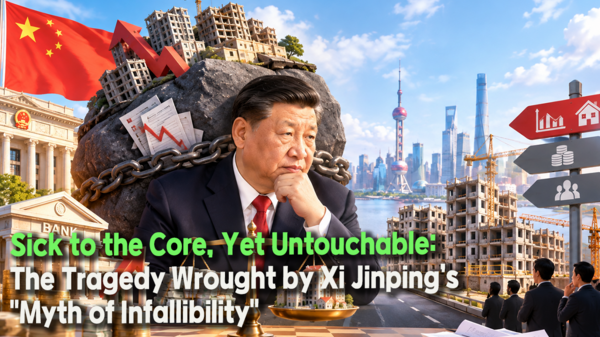
The Chinese economy has fallen deeply ill. The real estate market remains trapped in a prolonged slump, while domestic demand and corporate profitability continue to deteriorate. Yet, Beijing’s prescriptions remain confined to limited measures such as mortgage subsidies and commercial bank capital injections. This raises a fundamental question: Is the true crisis of the Chinese economy less the economic downturn itself, and more a political structure that makes it extraordinarily difficult to decisively correct flawed economic policies? As Xi Jinping’s economic line has merged with the supreme leader's authority, acknowledging policy failures and changing course has become increasingly daunting.
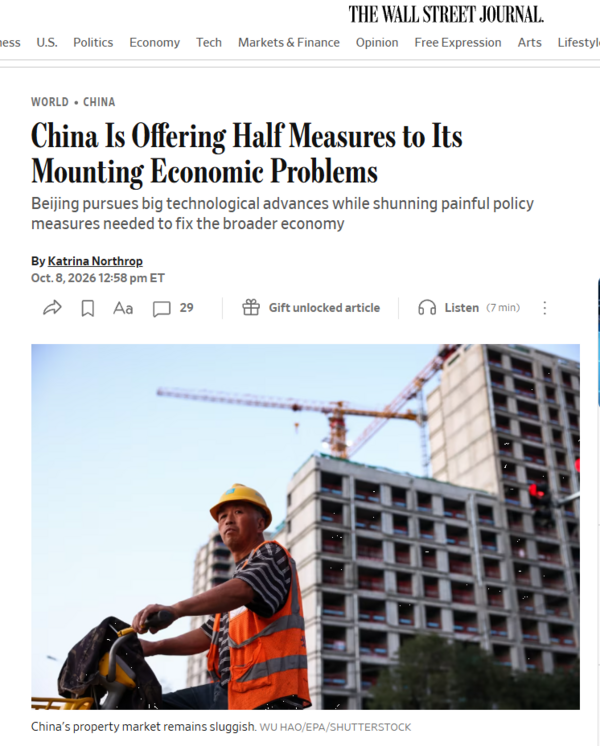
The Wall Street Journal (WSJ) reported on the 8th (local time), "While the crisis in the Chinese economy is deepening, Beijing’s responses remain limited." It noted, "Although China is achieving world-class results in advanced technology fields such as artificial intelligence and space exploration, the broader economy continues to suffer from a real estate slump, job insecurity, and worsening corporate profitability." The WSJ particularly highlighted that "the Chinese government is relying on piecemeal economic stimulus measures rather than large-scale reforms to resolve structural issues."
According to the WSJ, Beijing’s recent policy rollouts include mortgage subsidies, capital injections into state-owned banks, and the expansion of infrastructure investments. However, mortgage subsidies target a limited scope of beneficiaries, and bank capital injections do not offer a fundamental solution to non-performing loans (NPLs). Frederic Neumann, Chief Asia Economist at HSBC, evaluated these measures by noting that they are not powerful tools capable of reviving the economy, and their effects will likely remain gradual at best.
The core issue is that what the Chinese economy urgently requires is not mere additional capital injections, but a fundamental transition of its growth model itself. It must overhaul an economic structure heavily dependent on real estate and local government investment, and instead revitalize household consumption and the private sector. Yet, Beijing continues to adjust only peripheral details while preserving the existing policy framework. This brings us to the most crucial question: Is the Chinese leadership refraining from fixing economic issues because they are unaware of them, or are they finding them difficult to fix despite knowing full well?
[Who Dares to Touch Xi Jinping’s Economic Policy?]
To find the answer to this question, one must examine the power structure of the Chinese Communist Party (CCP). Since taking power, Xi Jinping has consolidated party leadership and expanded the Party Central Committee’s control over economic policy. Technological self-reliance, national security, and the cultivation of advanced manufacturing have evolved beyond mere policy choices to become core pillars constituting Xi Jinping’s national development strategy.
In particular, with the abolition of presidential term limits in 2018 and the confirmation of Xi’s third term in 2022, China’s power structure became even more concentrated around the supreme leader. In an environment where Xi Jinping Thought has been enshrined as the party’s official guiding ideology, advocating for a fundamental revision of his core economic line entails far more than a simple policy debate—it carries significant political risk.
To be sure, the CCP has never officially declared that "Xi Jinping is incapable of making mistakes." However, the more tightly the supreme leader’s judgment is bound to the state's official line, the harder it becomes to publicly admit policy failures or propose alternative paths. This is precisely how the de facto "Myth of Xi Jinping's Infallibility" exerts its stifling influence on economic policy.
From the perspective of policy-making bureaucrats, the safest course of action is not to confront and revise the supreme leader's existing line, but rather to present limited, supplementary measures within that existing framework. Examples include slightly lowering mortgage rates, injecting capital into banks, and expanding infrastructure loans. While these steps may cushion immediate shocks, they cannot solve the underlying structural issues of the economy. Ultimately, analysis suggests that what blocks structural reform in China is not merely economic constraints, but a political dilemma: the moment a policy error is admitted, the supreme leader's authority itself risks being shaken.
[Beijing Trapped in a Mountain of Debt: A Bigger Crisis Awaits the Moment Bad Loans Are Acknowledged]
Compounding the policy rigidity of the Xi Jinping regime is China’s colossal debt load. As the real estate market suffers a prolonged slump, the finances of property developers and local governments have severely deteriorated, leaving financial institutions under the dual pressure of non-performing loans and declining profitability. The Chinese government’s efforts to shore up bank capital and expand policy financing are aimed precisely at preventing an abrupt shock to the financial system.
However, injecting capital into banks does not make non-performing assets disappear. Continuously supporting property developments when unsold housing units continue to pile up fails to solve the root problem. If the government recognizes these losses all at once, financial instability could surge; conversely, continuously extending bad loans traps capital in low-productivity sectors. This is the exact dilemma China faces today.
Experts cited by the WSJ echoed these concerns, noting that the Chinese leadership fears the potential social unrest stemming from massive local government debt and sharp adjustments in property prices, prompting a cautious stance toward large-scale stimulus and structural adjustments. Economic bureaucrats similarly face incentives to favor small-scale measures that minimize financial costs and political liability over high-stakes, large-scale policies whose success cannot be guaranteed.
[Warning Signs in the Chinese Economy: Government Bond Yields Moving Opposite to the World]
Another signal revealing the severity of the Chinese economy is emerging from the government bond market. The WSJ reported that while sovereign bond yields in major global economies are rising, China's 10-year government bond yield has fallen to around 1.7%. This stands in stark contrast to the U.S. 10-year Treasury yield, which hovers around 5.3%. China's low bond yields are hardly a sign of financial stability; rather, as real estate slumps and corporate investment and consumption stall, household and financial sector funds are flocking to relatively safe bonds. This signifies that while savings accumulate, channels connecting them to productive investment and consumption remain severely lacking.
Even more serious is the reality that lowering interest rates fails to sufficiently boost household and corporate spending. Unless anxieties over future income and fears of falling property prices are addressed, monetary easing alone cannot revitalize consumption. Ultimately, one arrives at the conclusion that what the Chinese economy needs is not mere liquidity provision, but the restoration of confidence among economic actors.
[IMF’s Warning: “China Must Change Its Growth Model Itself”]
In a research study titled “Toward a New Economic Growth Model for China” published on September 30, the International Monetary Fund (IMF) diagnosed China as standing at a critical economic crossroads. The study noted that China's traditional growth model faces a complex web of challenges: debt-dependent investment, inefficient resource allocation, a declining working-age population, weak domestic demand, and mounting financial risks.
The solution proposed by IMF researchers is clear: transition from an investment-led growth model to one driven by household consumption, services, and productivity gains, while strengthening social safety nets, reviving the private sector, scaling back industrial policy, and pursuing financial and fiscal reforms. The report assesses that relying on state-directed resource concentration in specific industries is insufficient to achieve sustainable growth.
This point creates a significant tension with Xi Jinping’s economic line. The reforms recommended by the IMF point toward reducing state-led investment while expanding the role of the market, private enterprises, and household consumption. In contrast, Xi Jinping views advanced manufacturing and technological self-reliance as essential components of national security.
To be sure, technological self-reliance and domestic consumption expansion are not inherently mutually exclusive. However, where to deploy limited fiscal and financial resources first is a matter of clear policy prioritization. Whether China can maintain its technology supremacy strategy while simultaneously reviving domestic demand and the private economy remains the core test.
[Incapable of Fixing Problems Within, Blocked on Export Routes Abroad]
While China fails to resolve its internal structural problems, external pressure is mounting. On the 7th, the Office of the United States Trade Representative (USTR) announced that 15 economic entities—including the U.S., South Korea, Japan, the European Union (EU), Germany, France, and the UK—agreed to jointly respond to structural overcapacity in key manufacturing sectors.
While the joint statement did not explicitly name a specific country, it demanded an end to non-market policies and practices that distort markets and perpetuate overcapacity. The participating economies plan to review structural overcapacity issues and implement effective responsive measures through sector-specific coordination frameworks moving forward. This indicates that international pressure targeting China’s state-led manufacturing expansion strategy is becoming increasingly organized.
This deepens China’s dilemma further. If the domestic market fails to rebound, Chinese enterprises must export their output overseas to secure revenue. However, if production capacity continues to expand backed by state support, allegations of overcapacity and unfair competition in foreign markets will only grow. The more China seeks to boost exports, the higher the likelihood that major trading partners will tighten trade defense measures. Consequently, if China cannot revive domestic consumption, it risks falling into a vicious cycle: forced to rely on exports, yet becoming increasingly vulnerable to external trade pressure as that reliance grows. Under these conditions, transforming China's economic growth model has become an unavoidable imperative.
[Why Times Insight | Is Xi Jinping’s ‘Myth of Infallibility’ Pushing the Chinese Economy Deeper into the Quagmire?]
The most critical issue facing the Chinese economy is not merely the real estate slump or weak consumption. It is the weakening political capacity to acknowledge and correct flawed economic policies. Xi Jinping has driven technological self-reliance and state-led industrial policy as his signature economic line. However, the more tightly the supreme leader's political authority is bound to that line, the harder it becomes to admit policy failure. Economic bureaucrats are also likely to calculate that maintaining existing policies while issuing partial, supplementary fixes is politically safer than initiating a fundamental shift in direction.
Of course, not all of China's economic troubles can be attributed solely to Xi Jinping as an individual. Debt accumulation, demographic shifts, and real estate imbalances are problems that have built up over a long time. However, as power becomes increasingly concentrated in the supreme leader, the risk that policy debate and self-correction necessary to resolve these issues will be suppressed grows significantly.
China now stands at a crossroads. Will it stick to its current trajectory and endure long-term stagnation along with international trade pressure, or will it fundamentally revise its growth model? To save the economy, policies must change. But to change policies, Beijing must first acknowledge that Xi Jinping's judgment could be flawed. The moment preserving Xi Jinping’s authority takes precedence over saving the economy, China’s economic crisis can only deepen. This is the most dangerous shadow that Xi Jinping’s "Myth of Infallibility" casts over the future of the Chinese economy.

- TAG