


추부길 whytimespen1@gmail.com
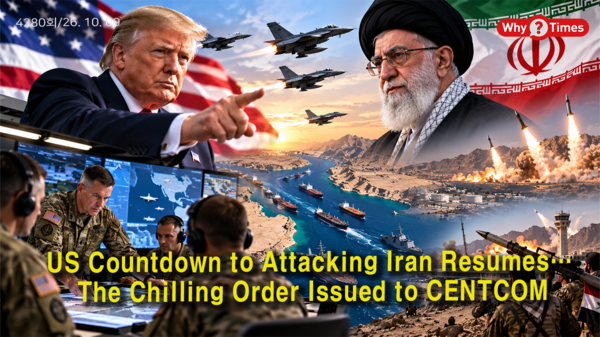
[Pentagon’s Emergency Directives… Now All Eyes Are on Trump’s Final Decision]
The conflict between the United States and Iran has reached a critical juncture that could once again ignite into large-scale airstrikes. With the U.S. Department of Defense instructing Central Command (CENTCOM) to wrap up preparations for major military operations against Iran, global attention is focused squarely on President Donald Trump’s ultimate decision. As speculation mounts over potential military action taking place ahead of the U.S. midterm elections, Iran refuses to back down on nuclear enrichment, while tanker attacks in the Strait of Hormuz are spiking once more. Compounding the situation, Houthi rebels supported by Tehran have struck airports inside Saudi Arabia, plunging the Middle East back into the danger of full-scale regional escalation.
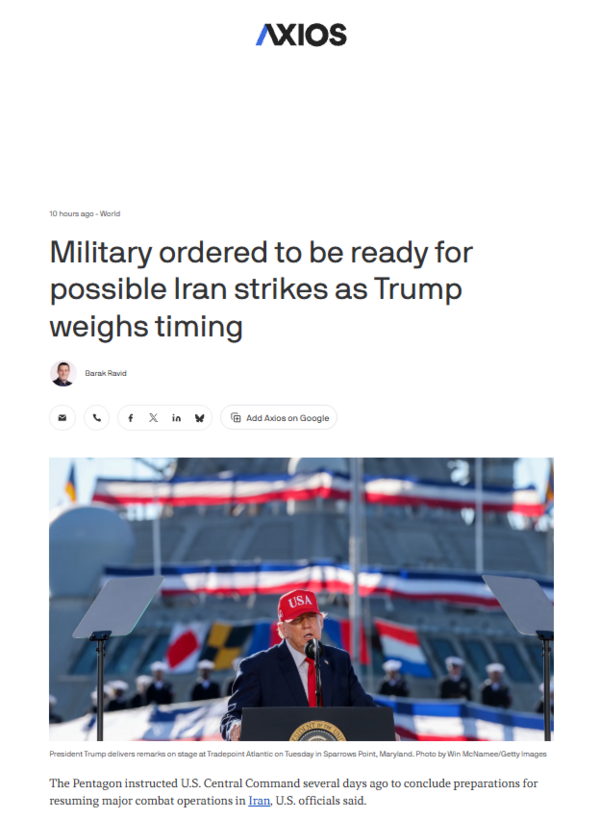
On October 8, U.S. online news outlet Axios reported that “the U.S. Department of Defense delivered directives to Central Command (CENTCOM), which oversees Middle Eastern operations, to finalize preparations for large-scale military actions targeting Iran”. Axios highlighted the gravity of the shift, noting: “While no specific attack date has been set and President Trump has not made a final determination, the situation has fundamentally changed as the Pentagon moves beyond merely reviewing military options to ordering the completion of actual operational readiness”.
Even more striking is the potential scale of the strikes. According to Axios, should the U.S. resume military operations, the targets could encompass not only Iran's nuclear infrastructure but also its energy infrastructure and primary strategic facilities. The possibility of joint military action involving Israel was also raised. This indicates that any offensive could expand far beyond targeted hits on missile batteries or air defense networks around Hormuz to a campaign aimed at degrading Iran's fundamental war-making capacity.
The timeline is equally fraught. According to Axios, observations among U.S. and Israeli officials suggest operations could resume prior to the November 3 U.S. midterm elections. Contrary to earlier assumptions that Trump would defer military strikes until after the elections, pre-election military action has been included on the table. While this does not equate to a finalized strike authorization, it makes clear that the war calendar could accelerate faster than anticipated depending on political calculations.
[Secret Meeting at Camp David… What Decisions Were Made?]
Preceding these military maneuvers, a significant high-level gathering took place in Washington. On October 3, Axios reported that “foreign policy and national security leadership of the Trump administration convened at Camp David under the leadership of Vice President JD Vance”. The meeting included Secretary of State Marco Rubio, Secretary of Defense Pete Hegseth, Special Envoy Steve Witkoff, CIA Director John Ratcliffe, and Chairman of the Joint Chiefs of Staff Gen. Dan Caine to deliberate on the war with Iran and the crisis in Yemen.
According to Axios, a U.S. official familiar with the talks explained that major decisions were settled—or at least discussed in depth—regarding pressing Middle Eastern issues. Among the topics discussed was Saudi Arabia's request for U.S. airstrike support against Houthi forces. Though no direct evidence confirms that final authorization for an attack on Iran was signed at this meeting, the fact that orders to complete attack preparations were dispatched to CENTCOM shortly after Camp David reinforces the assessment that Washington is applying tangible military pressure.
[Trump’s Stern Warnings… Nuclear Negotiations Virtually Stalled]
President Trump has maintained a hawkish stance, framing the prospect of a nuclear-armed Iran as a direct security threat to the American homeland. Emphasizing the logic of defending U.S. cities, he has argued that a nuclear-capable Iran would actively use such weapons. While this represents Trump's threat assessment rather than verified proof that Iran currently possesses functional nuclear weapons or intercontinental strike capabilities against the U.S. mainland, these statements carry heightened political weight when paired with instructions for large-scale operational readiness. Trump is once again bringing Iran’s nuclear ambitions to the forefront as a primary justification for potential military action.
[Why Times Insight | Standing on the Brink: How Long Can the IRGC Realistically Hold Out?]
The most crucial question surrounding Iran today is not merely when the U.S. will strike again, but how long an Iranian regime already reeling from a devastating economic crisis can realistically survive. Under the compounded weight of U.S. sanctions, naval blockades, disrupted crude exports, a plummeting rial, and runaway inflation, the daily lives of the Iranian populace are under extreme duress. Should large-scale U.S. military strikes resume, Iran could face a scenario where state governance itself is destabilized beyond ordinary economic distress.
First, Iran’s economy is structurally ill-equipped to sustain a prolonged conflict.
The foundational vulnerability of the Iranian economy lies in the simultaneous compression of foreign exchange earnings, state revenue, and consumer purchasing power. Blocked oil exports cripple hard currency inflows, which directly spikes the cost of imports. Coupled with the devaluation of the rial, prices for basic foodstuffs, medicine, and daily necessities surge, shrinking real household income.
Moreover, Tehran's capacity to absorb these economic shocks is diminishing. Sustained conflict demands immense military expenditure, while suppressing domestic unrest requires ongoing subsidy payouts and domestic security budgets. As the economy deteriorates, funding these competing obligations becomes increasingly impossible, creating a vicious cycle: sacrificing the national economy to sustain war efforts ultimately erodes the capacity to wage war itself.
Second, endurance by the IRGC does not equate to the endurance of the entire Iranian state.
The Islamic Revolutionary Guard Corps (IRGC) is not a conventional military apparatus. It is the institutional core of the Iranian regime, merging military power, intelligence networks, commercial monopolies, and political control. Consequently, even as living conditions for ordinary citizens deteriorate drastically, the IRGC leadership retains a strong incentive to maintain a uncompromising line to safeguard its own organizational dominance and power.
From the perspective of the IRGC command, acceding fully to U.S. demands is not seen as a routine diplomatic compromise. If reducing nuclear enrichment capabilities and retreating regionally are perceived as fatal threats to their political status and regime survival, they have every reason to resist, regardless of the economic toll on the public.
However, this strategy faces inherent limits. Strong coercion notwithstanding, the IRGC cannot exist in isolation from the broader national economy. Paying soldiers and security personnel, procuring military hardware, maintaining commercial concessions, and funding local control networks all require capital and material resources. Should economic hardship deepen further, internal fault lines could emerge within the IRGC itself. While the supreme command may advocate resistance to the end, regional commanders and mid-level officers may prioritize their own survival, their families' well-being, and the future of their units. (It should be noted, however, that currently available intelligence does not indicate an imminent large-scale fracture or breakdown in the IRGC chain of command.)
Third, renewed large-scale U.S. airstrikes would push Iran’s crisis into an entirely different dimension.
Where previous U.S. military pressure focused largely on degrading nuclear and military targets, recent discussions explicitly cite energy infrastructure as potential targets. If U.S. forces carry out major strikes against Iran’s vital energy facilities and command-and-control networks, the damage would hobble both its military execution capabilities and its long-term economic recovery.
The destruction of energy infrastructure extends far beyond lost oil export revenues. It would trigger cascading shocks across domestic power grids, industrial production, logistics, and state revenue. For a country already navigating severe hardship, managing such damage would make maintaining basic state functions exceptionally difficult. The primary variable is not simply how much destruction the U.S. can inflict, but whether that damage breaks the IRGC's operational will or drives it toward more extreme forms of asymmetric resistance.
Fourth, Iran’s true existential crisis may stem from internal regime fractures rather than battlefield defeat.
What Tehran fears most may not be U.S. bombardment alone, but the lethal convergence of wartime strain and economic collapse sparking domestic uprisings—compounded by cracks in the loyalty and cohesion of security forces tasked with suppressing them.
The Iranian leadership can demand continued sacrifice from its population to wage war. Yet as living standards collapse, state coffers empty, and military losses accumulate, the cost of maintaining regime control will climb relentlessly. Powerful as it is, the IRGC cannot maintain indefinite control over every region if financial incentives and organizational cohesion erode.
Key indicators to monitor going forward extend beyond surface inflation rates or protest sizes; they include the structural integrity of the IRGC command, the operational loyalty of internal security forces, the fiscal solvency of the state, and the internal unity of the ruling elite. If several of these pillars begin to fracture simultaneously, Iran’s ordeal will transition rapidly from an economic crisis into a systemic regime crisis.
Fifth, while President Trump recognizes Iran’s vulnerabilities, exploiting them carries profound risks.
From Washington's perspective, if economic pressure alone has failed to yield complete compliance, adding severe military shocks presents a compelling leverage point to force concessions. With Iranian oil exports and state finances already under acute pressure, high-intensity airstrikes force a stark choice upon Tehran's leadership.
Ultimately, Iran is operating against two distinct survival clocks:
The Economic Clock: How long crude exports, hard currency reserves, state budgets, and public endurance can hold out.
The Regime Clock: How long the IRGC can maintain internal cohesion and domestic control under heavy military bombardment and economic distress.
These two clocks do not necessarily run at the same speed; the IRGC may well outlast the collapse of the civilian economy for a considerable period. However, if major U.S. strikes amplify military losses, exacerbate economic ruin, and weaken elite cohesion, the situation could shift abruptly.
The fate of Iran will not be decided solely by the volume of U.S. munitions. It hinges on whether the IRGC can retain control over the country after absorbing those strikes—and whether the Iranian public can bear any further sacrifice.
As Trump readies military options once more, Iranian leadership can no longer base its calculations solely on nuclear leverage or threats in the Strait of Hormuz. The IRGC may choose to fight to the end to protect its power, but the overarching question remains: How much longer can the state of Iran itself endure that fight?
- TAG