


추부길 whytimespen1@gmail.com
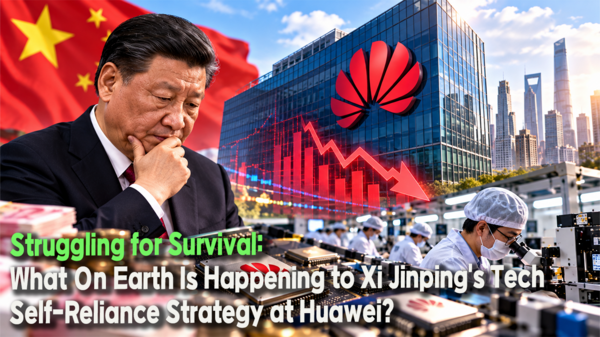
[Samsung Forecasts Record Profit While Huawei Struggles for 'Survival'… The Two Faces of the AI Boom]
Amid a global AI semiconductor boom, Huawei—the ultimate symbol of China's high-tech sector—is once again crying out for "survival." Remarks by Huawei executives highlighted in public reports on October 7 have sent shockwaves through the industry. While claiming to have broken free from reliance on U.S. technology, the company simultaneously admitted to facing surging memory prices, a shortage of advanced semiconductor production capacity, and deteriorating profitability. While the same AI boom propelled Samsung Electronics toward record-high profit forecasts, Huawei proclaimed a "survival crisis" as its net profit plummeted 36% despite revenue growth. This raises a fundamental question: Is the tech self-reliance that China has so loudly championed actually succeeding in economic terms?
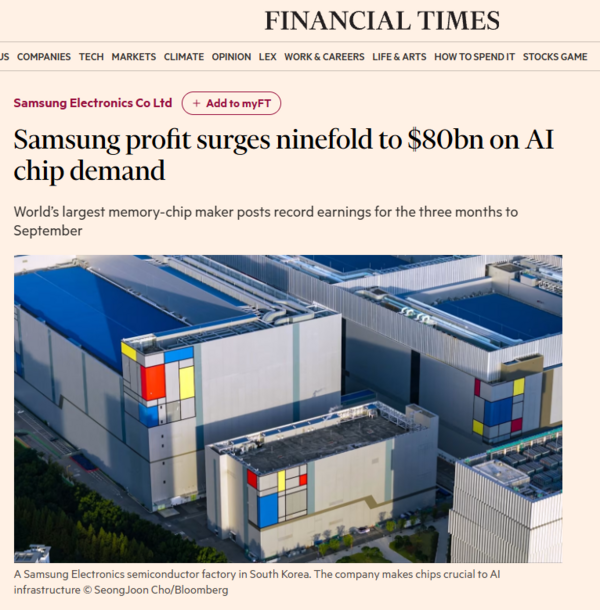
On October 8 (local time), the Financial Times (FT) analyzed: “Samsung Electronics’ third-quarter performance outlook is stunning. Driven by explosive demand for AI semiconductors and rising memory prices, Samsung’s third-quarter operating profit is expected to reach 107.4 trillion won—a nearly ninefold increase year-on-year.” The FT added, “Demand from AI data centers has brought an unprecedented boom to the global memory market,” while noting that “Samsung, too, faces margin pressure in its smartphone division due to rising component prices, showing that this boom does not confer equal profits upon all business segments.”
Yet during the same period, a completely different narrative emerged from Huawei in China. On October 7, Sina Finance reported: “Yu Chengdong (Richard Yu), Executive Director and Chairman of the Consumer Business Group at Huawei, stated that surging memory prices have added over $200 in additional costs per smartphone. As Huawei absorbed these costs internally, overall profit margins declined sharply. He emphasized that price increases are ultimately inevitable and that the company must focus on surviving first.” These remarks were originally made during an international media roundtable on September 29 and resurfaced through a summary of the meeting published by Huawei on October 6.
Regarding this, Reuters pointed out: “Here lies the critical paradox of the current situation. While companies supplying AI chips and memory are seeing expanding profit opportunities, smartphone manufacturers forced to purchase expensive components face rising cost pressures. On top of this, Huawei must bear the costs of U.S. export controls along with the immense expense of developing proprietary semiconductors and software. Thus, the global AI boom represents both an opportunity and a fresh cost shock for Huawei.”
[“We Have Shed Reliance on US Technology”… So Why Speak of Survival Again?]
Even more notable were Yu Chengdong’s comments published by Chinese semiconductor media outlets on October 7. He claimed that “since U.S. sanctions were imposed in 2019, Huawei has essentially broken free from reliance on U.S. technology by developing its own chips, operating systems, and core software.” He highlighted that “since 2023, smartphone chips have been produced natively in China, and the HarmonyOS ecosystem has expanded to cover over 90 million devices.” This was framed as a declaration that Huawei had breached the U.S. tech blockade to build an independent technological infrastructure.
However, during the same roundtable, Yu acknowledged that “China’s advanced semiconductor production capacity remains insufficient.” He explained that “both the Kirin chips for smartphones and the Ascend chips for AI require advanced manufacturing capacity, but domestic production facilities in China cannot adequately keep pace with rapidly surging demand.” In particular, under conditions where access to cutting-edge EUV lithography equipment is restricted, China continues to face the operational difficulty of producing advanced chips using DUV equipment. Declaring independence from U.S. technology and achieving world-class manufacturing competitiveness are two entirely different matters.
[Revenue Rose But Net Profit Plummeted… Huawei’s Bizarre Report Card]
These burdens are already clearly reflected in Huawei’s financial statements. According to Huawei’s first-half financial results reported by Reuters on August 31, revenue reached 467.82 billion yuan—a 9.6% increase year-on-year. However, consolidated net profit fell to 23.81 billion yuan, marking a steep drop of approximately 36%. Research and development (R&D) expenses rose 25.2% to 121.38 billion yuan, accounting for a massive 25.9% of total revenue. While top-line revenue expanded, escalating R&D expenditures, manufacturing costs, and administrative overhead severely eroded profitability.
Even more alarming warning signs appeared in cash flow and inventory metrics. According to Reuters, whereas operating activities generated a positive cash inflow of 311.8 billion yuan in the first half of last year, operating cash flow swung to a net outflow of 39.88 billion yuan this year. Operating cash flow deteriorated by approximately 71.1 billion yuan in just one year. Inventory assets also surged 42% compared to the end of last year. Although it remains unverified whether this inventory build-up was primarily driven by advance purchases of memory components, production expansion, or supply chain stockpiling—meaning it cannot be cited as direct evidence of weak sales—it unmistakably highlights a mounting working capital burden on the company.
[The Invoice for Self-Reliance… The True Burden Left by US Sanctions]
The second major crisis confronting Huawei is the staggering cost of replacing U.S. technology. According to Reuters, since U.S. export controls were enacted in 2019, Huawei has pursued a strategy of independently developing or co-developing with domestic Chinese partners the semiconductors, software, and AI computing technologies it previously sourced from overseas suppliers. Prime examples include its proprietary HarmonyOS operating system, Kirin mobile processors, and Ascend AI accelerators. Indeed, on September 24, Reuters evaluated that Huawei had transformed from a firm merely surviving U.S. sanctions into Nvidia's chief rival within China.
However, that achievement was accompanied by astronomical R&D expenses and manufacturing infrastructure costs. While Huawei achieved substantial progress in reducing U.S. tech dependency by leveraging domestic Chinese supply chains, it still faces steep hurdles in advanced chip production capacity and manufacturing cost competitiveness. Furthermore, under a structure where AI chips and smartphone processors compete for limited advanced fabrication capacity, scaling up production volumes is inherently difficult. Success in technical development does not automatically guarantee adequate output or high profitability.
In this light, the efficacy of the U.S. tech blockade should not be judged purely on a binary scale of whether it crushed Huawei or failed to do so. While U.S. sanctions did not drive Huawei out of the market entirely, they imposed an immense burden, forcing the company to sink vastly higher amounts of R&D funding and production resources just to remain competitive. Of course, not all of Huawei’s R&D increases can be attributed directly to U.S. sanctions, as proactive investments to capture the expanding AI market are also included. Nevertheless, it is clear that the cost of replacing U.S. technology has emerged as a crucial variable governing the economic viability of China's technological self-reliance.
[The Return of 'Survival' After 4 Years… Recalling Ren Zhengfei’s Warning]
This is not the first time the word "survival" has dominated headlines at Huawei. In an internal memo in August 2022, founder Ren Zhengfei emphasized that "the core focus of corporate operations must shift from scale expansion to securing profits and cash flow." He instructed that "low-margin peripheral businesses must be scaled back or closed down, making survival the primary operating principle." At that time, U.S. sanctions and a global economic slowdown were heavily squeezing Huawei's business foundation.
In the years that followed, Huawei mounted a dramatic comeback by reviving its proprietary chip and smartphone businesses. According to Reuters, annual revenue reached 880.9 billion yuan by 2025, and the company significantly expanded its footprint in the Chinese AI chip market. Yet in 2026, the rhetoric of "survival" has resurfaced. If the core crisis four years ago was direct U.S. technology blockage, today's crisis stems from the astronomical costs of sustaining self-reliance combined with soaring global memory prices. While the root causes differ, both crises share a common reality: Huawei must continuously commit massive resources simply to stay alive in its technological war with the United States.
[Why Times Insight | What Huawei's Survival Warning Means for Xi Jinping]
It would be premature to view Huawei’s declining profitability as a sign of imminent collapse across China's broader high-tech sector. On the contrary, Huawei has achieved remarkable milestones by enduring intense U.S. technology sanctions to build its own semiconductors, operating systems, and AI computing ecosystems. Yet it is precisely for this reason that Huawei’s recent financial statements carry such heavy significance: margin erosion is taking place even within one of the single most successful flagship enterprises of China’s self-reliance drive.
The reason Huawei's situation is deeply uncomfortable for Xi Jinping is obvious. Huawei is a unique enterprise capable of mobilizing China's finest engineering talent, vast capital, and immense domestic market scale. If even Huawei must stress "survival" once again, what kind of crushing burdens must countless other Chinese semiconductor and AI firms—possessing far fewer financial resources—be bearing in the name of self-reliance? Naturally, because business models and financing conditions vary across firms, Huawei’s ordeal cannot be generalized across the entire Chinese tech landscape. Yet there is no denying that Huawei serves as a vital litmus test for the economic sustainability of China's national self-reliance strategy.
The U.S. tech blockade must also be reassessed through a fresh lens. The fact that the U.S. failed to banish Huawei from the market entirely does not mean the tech containment strategy was ineffective. If Chinese firms are forced to sink vastly more money, manpower, and time simply to narrow the tech gap, that expenditure itself becomes a heavy drag on the broader Chinese economy. The U.S. tech blockade operates not merely by blocking Chinese technology development, but by drastically elevating the cost of achieving self-reliance.
To be sure, Chinese government policy support and its massive domestic market may absorb a substantial portion of these cost pressures. Should Huawei’s AI semiconductor business achieve high profitability in the future, its current massive R&D spending may well be praised in retrospect as a masterstroke of investment for future competitiveness. Indeed, Huawei continues to expand its market presence in AI processors and large-scale computing systems within China. Therefore, concluding that current profit squeezes signal long-term failure would be hasty.
However, proving that China can achieve technological self-reliance is fundamentally different from proving that such self-reliance is economically sustainable over time. China is proving that it can manufacture advanced high-tech products while reducing its reliance on U.S. technology. Yet whether it can produce world-class products in sufficient volume, at competitive cost structures, while consistently securing healthy profits remains an unproven challenge.
Huawei’s crisis poses that exact question directly to Xi Jinping: Can the political goal of technological self-reliance succeed in raw economic terms? China’s technological ambition has entered a new phase—one where it will be judged not merely by technological capability, but by commercial profitability.
- TAG