


추부길 whytimespen1@gmail.com
["Russia Must Share More": U.S. Prepares Official Diplomatic Pressure]
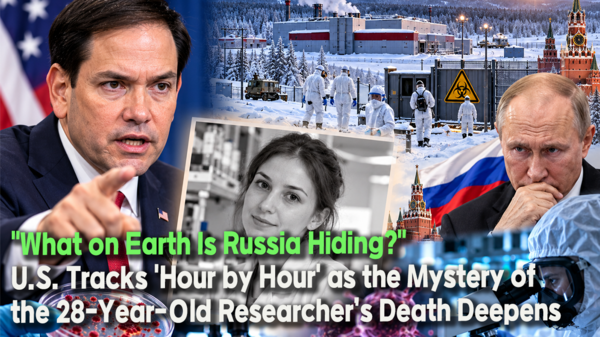
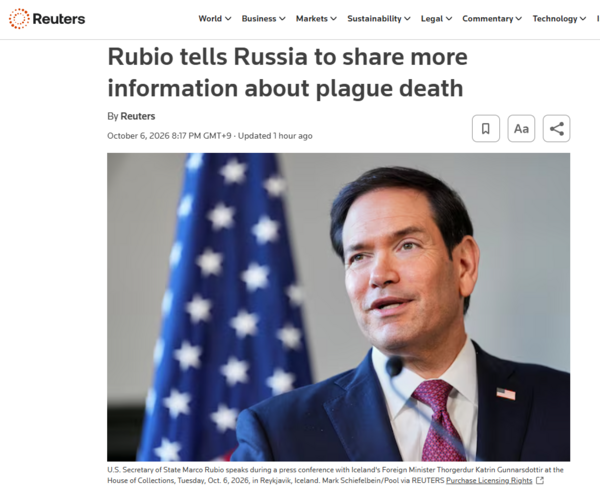
The death of a 28-year-old female researcher from unexplained pneumonia at a plague research institute in Irkutsk, Siberia, is escalating beyond a localized infectious disease event into a major biosecurity dispute between Washington and Moscow. While the World Health Organization (WHO) currently assesses that there are no signs of additional infections and that the risk of international spread remains very low, the United States is intensifying its pressure on Russia for full transparency. U.S. Secretary of State Marco Rubio declared that "Russia has an obligation to share more information with the world," revealing that Washington is monitoring the situation "hour by hour". Ultimately, the core focus has shifted from whether plague is actively spreading to what exactly happened to the 28-year-old researcher, and why Russia has failed to clearly declare her cause of death.
The Trump administration is preparing an official diplomatic démarche demanding further information from Moscow regarding the researcher's death. This elevates the incident beyond passive observation into a formal diplomatic issue requiring an official response from the Russian government.
U.S. officials maintain that under the International Health Regulations (IHR), rapid information sharing is mandatory for health events with potential international implications. Agencies including the U.S. Centers for Disease Control and Prevention (CDC), the Department of State, and health-related bodies are actively moving to determine the facts.
The tone from Secretary of State Marco Rubio sharpened noticeably within a 24-hour period. Initially taking a measured stance, Rubio stated that Russia has a clear responsibility to disclose more to the global community, directly bringing Moscow's transparency into question. Rubio emphasized that contingency plans are already in place should the situation prove more severe than currently reported, adding that the U.S. government is watching developments extremely closely on an hourly basis. His framing made clear that while the incident might prove minor, it could equally represent a far more significant issue than initially acknowledged.
[Trump Steps In: "Scheduled Call with Putin"]
The White House is also taking action. President Donald Trump noted that a phone call with Russian President Vladimir Putin is planned to discuss the Siberian incident. U.S. intelligence agencies are examining the case in depth, with Trump indicating that further details may be shared shortly.
Notably, Trump’s messaging combines both pressure and an offer of assistance. While voicing concern over developments inside Russia, he expressed America’s readiness to assist Moscow if needed. This underscores that Washington’s immediate priority is not instantly branding the event a "biological weapons accident," but first establishing a clear picture of what occurred.
[WHO States "No Confirmed Plague Cases"—Yet One Critical Question Remains]
An objective assessment of the available facts is essential. Russia officially notified the WHO that no confirmed cases of plague have been identified in Irkutsk, and that tests on individuals who came into contact with the deceased researcher revealed no dangerous pathogens. The WHO similarly evaluated the current risk to the general public as low, with specific risk levels rated as moderate-to-low for the Irkutsk region, low for Russia as a whole, and very low for the WHO European region. Taking the WHO announcements at face value, there is no evidence of a widespread "Black Death" outbreak in Russia. Yet this gives rise to an even more fundamental question: If not plague, what caused the sudden death of the 28-year-old researcher?
A crucial detail stands out in the analytical record: while contact tracing confirmed that no dangerous pathogens were detected among those exposed to her, it remains unclear whether the deceased researcher herself underwent definitive plague testing, or if plague has been completely ruled out as her cause of death.
[Why Did the 28-Year-Old Researcher Suddenly Die?]
The deceased was 28-year-old Darya Shipilova, a researcher working at the Anti-Plague Research Institute in Irkutsk. Shipilova suffered a rapid deterioration in health before dying under a diagnosis of "pneumonia of unknown origin". The facility where she worked specializes in studying high-consequence pathogens, including plague across Siberia and the Far East.
Following her death, Russian authorities reacted swiftly. Approximately 200 individuals who had come into contact with her were placed under medical observation and contact tracing, while portions of the Shelekhov Hospital where Shipilova received treatment were subjected to quarantine measures. Anna Popova, head of Russia's public health watchdog Rospotrebnadzor, personally traveled to Siberia to convene emergency meetings.
["A Test Tube Was Broken": Unconfirmed Claims]
The most widely circulated claim surrounding the incident is that Shipilova accidentally broke a test tube containing plague pathogens. While reports suggested a laboratory accident had occurred, Russian health authorities maintain there is no evidence of any incident involving dangerous microorganisms. Moscow’s official stance remains that no link has been established between Shipilova’s professional duties and her death. Therefore, at this stage, it cannot be definitively concluded that her infection resulted from a broken test tube.
This, however, leaves a persistent paradox. If there was no laboratory accident, no link to the pathogens handled in her work, and no dangerous pathogens detected in her contacts, why did a healthy 28-year-old researcher suddenly succumb to severe, unexplained pneumonia? It is precisely this information void that sustains Washington's skepticism.
American sensitivity to this event extends beyond the word "plague" itself. Officials across the CDC, Department of State, health authorities, and national security organs are jointly reviewing the case. High-level health and security meetings have been held at the White House. Washington's core inquiry is straightforward: What was Shipilova exposed to, and what exact research was being conducted at that laboratory?
[U.S. Official Documents Reveal Deep Historical Precedent]
There are clear historical reasons why Washington hesitates to accept Moscow's explanations at face value. The U.S. State Department’s 2024 Arms Control Compliance Report offered a stern assessment regarding Russia's biological weapons capabilities. Washington assesses that Russia inherited offensive biological research and development programs from the former Soviet Union and has failed to fully terminate activities prohibited under the Biological Weapons Convention (BWC). The report explicitly notes that the Soviet program was "absorbed, not dismantled" by the Russian Federation. Furthermore, the State Department raised concerns over the ongoing modernization of certain military research facilities previously involved in the Soviet offensive bioweapons program.
[47 Years Ago, Russia Also Claimed "Nothing Happened"]
A pivotal historical precedent informs Washington's stance: the 1979 Sverdlovsk anthrax leak. Following an outbreak of anthrax in Sverdlovsk (now Yekaterinburg) that killed at least 64 people, the Soviet Union insisted for years that contaminated meat was the sole cause. In reality, the outbreak resulted from an accidental airborne release of anthrax spores from a military biological facility.
U.S. Department of State records show that official confirmation of the truth came only in 1992, when President Boris Yeltsin acknowledged the military facility origin—13 years after the event. CDC records document that at least 66 individuals died from inhalational anthrax due to the Sverdlovsk military facility accident. Crucially, the Soviet Union had continued its offensive biological program even after becoming a party to the Biological Weapons Convention in 1975. From Washington's viewpoint, this history makes it impossible to dismiss the Siberian case simply because Russia says everything is fine.
[Not Yet a Proven 'Bioweapons Accident', but Questions Abound]
The verified facts to date resolve into three key points:
No Evidence of Widespread Outbreak: There is no evidence that plague is actively spreading across Russia. The WHO assesses the risk of international spread as very low.
No Unquestioned Link to Bioweapons: There is no concrete evidence linking this death to biological weapons research. Claims regarding a broken test tube have been denied by Moscow and remain unverified.
Persisting Information Gap: The precise cause of the researcher's death has not been fully disclosed.
Because of this gap, Washington is taking active diplomatic measures. Rubio has demanded full disclosure of additional information, Trump has scheduled direct talks with Putin, and the administration is preparing a formal diplomatic démarche to demand answers.
[Why Times Insight | The Issue Isn't Just 'Plague'—It's Trust]
What must be avoided above all in evaluating this situation is sensationalism. There is currently no evidence that pneumonic plague is sweeping through Russia. Why, then, is the United States increasing diplomatic pressure on Moscow?
Because Russia has yet to provide adequate answers to the most fundamental questions: What caused the death of the 28-year-old infectious disease researcher? Was there truly no laboratory accident? Is her death genuinely unrelated to the pathogens she handled daily? And why does it remain unconfirmed whether the deceased herself was tested for plague, or whether plague has been definitively ruled out?
These questions are sensitive precisely because of Moscow's historical record. In 1979, when anthrax leaked from a military facility and killed dozens, the Soviet state insisted contaminated meat was to blame, taking 13 years to acknowledge the truth. Today, official U.S. assessments continue to hold that Russia never fully dismantled the offensive biological infrastructure inherited from the Soviet era.
While history alone does not prove what happened in Irkutsk, it provides ample ground to demand a far higher standard of transparency. The true turning point in this incident will not merely be whether additional plague cases emerge, but whether Russia releases sufficient data—including autopsy findings, precise cause of death, laboratory logs, and the nature of ongoing research—to permit independent international verification.
If Russia discloses comprehensive data and allows verification by external bodies such as the WHO, this incident will likely conclude as a tragic loss of a young scientist surrounded by heightened international caution. Conversely, if Moscow repeats that the death was merely "unexplained pneumonia posing no risk," the international community will be left with a single, unavoidable question:
"What on earth is Russia hiding?"

- TAG