


추부길 whytimespen1@gmail.com
[Saudi Arabia’s $2.5 Billion ‘Sky Stadium’ Halts Operations]
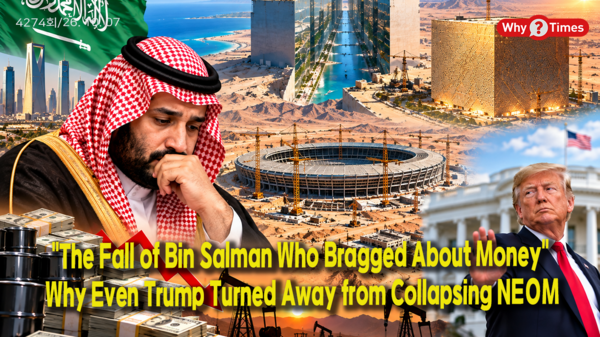
The "Future in the Desert" that Saudi Crown Prince Mohammed bin Salman (MBS) once showcased to the world on the back of oil money is grinding to a halt piece by piece. Following setbacks to NEOM, Mukaab, and LIV Golf, the construction plans for NEOM Stadium—a $2.5 billion "sky stadium" conceived as a flagship venue for the 2034 World Cup—have now been indefinitely postponed.
Having once positioned himself as the new strongman of the Middle East while keeping his distance from the United States, MBS turned back to American military power as regional conflict threatened his national security—only for Trump to turn down his request. Money, oil, and diplomatic confidence vis-à-vis the United States—the three pillars supporting Bin Salman’s stature—are shaking simultaneously.
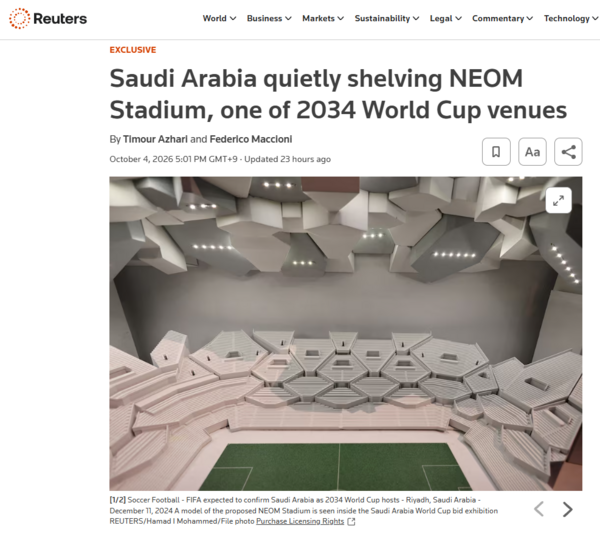
Saudi Arabia has effectively placed on indefinite hold the construction plan for NEOM Stadium, which was considered the most ambitious venue proposed for the 2034 World Cup. The original design envisioned a 46,000-seat stadium hovering approximately 350 meters above the ground within MBS’s signature "The Line" project, accessible via autonomous transit systems and high-speed lifts, with estimated costs reaching $2.5 billion.
According to Middle East construction intelligence firm MEED, the project is currently classified as "on hold." While completion dates between 2026 and 2033 have been outlined for other World Cup stadiums and infrastructure, NEOM Stadium currently lacks any target completion date. Bin Salman’s ultimate symbol of "making the impossible possible through money and technology" has effectively frozen in mid-air.
[On the Same Day, the ‘Saudi Version of the Grammys’ Was Also Cut]
Equally notable were reports that Saudi Arabia is set to cancel next year’s Joy Awards, an annual star-studded ceremony dubbed the "Saudi Grammys and Oscars". The event had served as a flagship soft-power initiative, inviting global celebrities to Riyadh to project an image of a once-closed oil kingdom transforming into a world-class cultural and entertainment hub.
The blade of fiscal austerity is expanding beyond heavy construction into culture and entertainment—meaning the postponement of NEOM Stadium and the cancellation of the Joy Awards cannot be viewed in isolation. They serve as clear signals that Saudi Arabia has begun cutting back on high-visibility projects that once devoured astronomical sums primarily for global showmanship.
[170 km Future City: Now Deemed “Not Strictly Necessary by 2030”]
In reality, NEOM’s retreat began much earlier. The original concept for "The Line" called for a massive structure 500 meters high and 200 meters wide, stretching 170 kilometers across the desert to form a vertical city housing up to 9 million residents. However, as project costs ballooned and construction faced repeated delays, the plans underwent continuous recalibration.
Ultimately, Yasir Al-Rumayyan, Governor of the Public Investment Fund (PIF) that owns NEOM, publicly acknowledged that The Line is no longer an absolute top priority. He signaled that having The Line operational by 2030 is not strictly necessary. The PIF is redirecting capital toward sectors capable of delivering faster returns, such as logistics, mining, and artificial intelligence. A venture once touted as the world's grandest architectural undertaking was quietly demoted to a project "not urgently required by 2030".
[The 400-Meter ‘Flex’ Cube Mukaab Is Stalled as Well]
The Mukaab—a colossal cube-shaped skyscraper slated for the heart of Riyadh—met a similar fate. Measuring 400 meters in width, length, and height, with an internal floor area of nearly 2 million square meters, the Mukaab was another dramatic symbol of Bin Salman’s giga-project vision. However, Saudi Arabia halted construction on the Mukaab beyond foundation work to reassess the project's economic viability and funding structure.
More importantly, Saudi investment priorities have fundamentally shifted. Rather than pouring vast capital into futuristic architectural feats, Riyadh is concentrating funds on projects with clear deadlines and economic returns, such as the Expo 2030 Riyadh, the 2034 FIFA World Cup, and developments like Diriyah and Qiddiya. The development model driven by Bin Salman under the premise that "money is infinite" has finally begun running cold economic calculations.
[LIV Golf, Fueled by $5 Billion, Enters Chapter 11]
The same dynamic unfolded in the realm of sports. Launched in 2022 with massive financial backing from the PIF, LIV Golf aggressively signed top-tier PGA Tour players using astronomical signing bonuses. It was Bin Salman's flagship sports venture, intended to demonstrate that raw financial power could reshape global sporting structures.
However, as the PIF stepped back from providing unlimited additional capital, LIV filed for Chapter 11 bankruptcy protection in a New Jersey court in September to undergo restructuring. Court filings estimated its liabilities between $500 million and $1 billion. Yet, this does not mean LIV is liquidating. On October 5, BC Partners Credit agreed to provide up to $300 million in financing to support restructuring and a planned relaunch in 2027. Framing this as total liquidation would be inaccurate; rather, a sports experiment once underwritten by unlimited PIF capital was forced into court-supervised restructuring funded by external capital.
[97% of the Annual Deficit Forecast Reached in Just Six Months]
Why did Bin Salman suddenly begin curbing expenditures? The root cause lies in fiscal reality. The Saudi government's 2026 budget, announced late last year, projected revenues of 1.147 trillion riyals against expenditures of 1.313 trillion riyals, anticipating a fiscal deficit of roughly 165 billion riyals. However, by the end of the first half of the year alone, the cumulative fiscal deficit reached nearly 160 billion riyals—exhausting roughly 97% of the original full-year deficit projection in just six months.
This should not be interpreted as an imminent sovereign default crisis for Saudi Arabia. The second-quarter deficit narrowed significantly to 34.3 billion riyals compared to 125.7 billion riyals in the first quarter, and Riyadh covered its first-half deficit through debt issuance rather than drawing down strategic reserves. Nevertheless, the message is unequivocal: while Saudi Arabia is not out of money, it can no longer fund an unlimited list of megaprojects simultaneously.
[Regional Conflict Strikes the Vulnerable Core of the 'Oil Money Kingdom']
Compounding these fiscal pressures is the ongoing conflict involving Iran. As shipping through the Strait of Hormuz faced disruptions, Saudi Arabia had to rely heavily on its East-West Pipeline to divert crude oil to Yanbu Port on the Red Sea. However, as Houthi forces expanded their presence along western Yemen, they threatened the Bab-el-Mandeb Strait. From Saudi Arabia's perspective, if the eastern route through Hormuz is blocked, oil must be exported through the western Red Sea route—a corridor where security could no longer be guaranteed.
Houthi missile and drone strikes simultaneously threatened energy infrastructure on Saudi territory. While Bin Salman spent immense sums attempting to build a "post-oil Saudi Arabia," conflict laid bare the harsh reality that the kingdom's economic lifeline remains tethered to petroleum and the two maritime straits that carry it.
[Bin Salman Called Trump Twice a Day]
This context illuminates a pivotal interaction from a month ago. On September 10, as Houthi offensives intensified, Bin Salman placed a direct call to Donald Trump, asking the U.S. to conduct military strikes against the Houthis. The two leaders reportedly spoke at least twice that day. Bin Salman specifically sought direct U.S. kinetic strikes on Houthi targets.
However, Trump declined. The U.S. position was that Washington would provide intelligence and targeting support to Saudi Arabia, but American forces would not directly initiate another military front against the Houthis. Ten days later, Trump reconsidered Houthi airstrikes but ultimately put the plan on hold again. Trump weighed his desire to support Bin Salman against his determination to avoid entangling the U.S. in another Middle Eastern conflict.
[Why Did the Autonomy-Seeking Bin Salman Turn Back to Washington?]
This moment carries deep strategic weight. Over recent years, Bin Salman attempted to forge a Saudi Arabia that did not rely exclusively on Washington. He expanded ties with China, collaborated with Russia through OPEC+, and in 2023 restored diplomatic relations with Iran via Beijing's mediation. These moves signaled to Washington that Riyadh possessed options beyond the U.S.
Yet, regional conflict exposed the structural limits of this strategic autonomy. The moment missiles and drones threatened Saudi oil infrastructure and Red Sea export routes, Bin Salman needed neither Chinese capital nor Russian oil coordination; he required American intelligence and military power. But Trump refused to act on Bin Salman's terms. The Crown Prince, who had leveraged strategic distance to raise his leverage over Washington, found himself forced back into seeking American military protection.
[Why Times Insight | Why Didn't Trump Rescue Bin Salman?]
It would be premature to conclude that Trump has completely abandoned Bin Salman. The United States continues to provide intelligence and targeting data to Saudi Arabia while indirectly supporting anti-Houthi operations by Saudi and Yemeni government forces. Declaring the U.S.–Saudi alliance dead would be an exaggeration. However, Trump’s refusal to order direct U.S. strikes despite Bin Salman’s explicit request serves as a defining snapshot of contemporary U.S.–Saudi dynamics.
Trump's strategic calculus is straightforward: direct American strikes on the Houthis would open another active front in Yemen alongside broader regional tensions. Conversely, by restricting involvement to intelligence sharing, Washington obliges Saudi Arabia to conduct its own military defense.
From Washington's viewpoint, there was little incentive to initiate another military campaign solely on Bin Salman's behalf. This reflects a reversal in bargaining power. When Saudi Arabia had multiple geopolitical options, Washington needed to actively accommodate Riyadh. However, as Saudi Arabia’s dependence on the American security umbrella increases, the leverage flips, reducing Trump's incentive to yield to Bin Salman's requests.
Trump’s refusal and the suspension of NEOM Stadium fit into a unified narrative. When capital seemed limitless, Bin Salman declared he would build a 170-kilometer city in the desert, construct a 400-meter cube, recruit the world's top golfers with unprecedented offers, build a stadium 350 meters in the air, and assert strategic independence from Washington.
The reality today is different. "The Line" has been deprioritized, the Mukaab is paused, LIV Golf was forced into corporate restructuring, NEOM Stadium has lost its target completion date, and cultural initiatives are being scaled back. Simultaneously, Saudi security remains reliant on American power. This does not equate to an immediate Saudi collapse; Riyadh continues to invest heavily in prioritized strategic projects like the Expo 2030, other 2034 World Cup venues, Diriyah, and Qiddiya.
Nonetheless, the end of an era is unmistakable.
"Money is unlimited."
"Capital alone can reshape global sports, tourism, and urban futures."
"If Washington is unsatisfactory, alternative partners are readily available."
The three core assumptions that underpinned Bin Salman’s posture over the past decade are wavering at once. Perhaps more symbolic than the pause on NEOM Stadium is the image of a leader who once leveraged his position against Washington calling the U.S. President twice in a single day for military intervention, only for Washington to stand down.
The bravado that once characterized Bin Salman's global posture has encountered hard financial and strategic limits. Trump's calculation regarding Saudi Arabia today can be summarized in a single question:
"Now, who needs whom more?"
- TAG