


추부길 whytimespen1@gmail.com
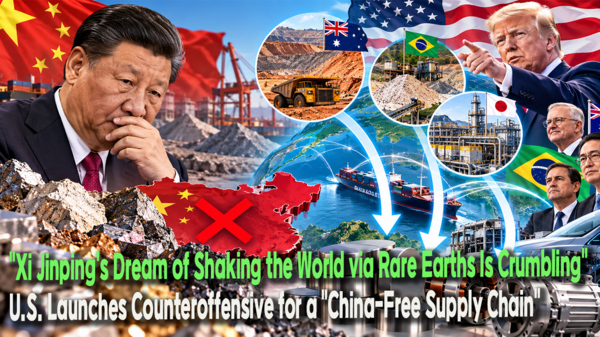
[The U.S. Department of Defense Staked $400 Million… Now 'China-Free Magnets' Emerge]
The "rare earth weapon" brandished by Chinese President Xi Jinping to bring the United States to its knees is driving global supply chains in an unexpected direction. Rather than stopping at demanding more rare earths from China, the U.S. government is directly investing in private enterprises—building out mines, refining networks, and magnet production facilities to forge a supply chain capable of enduring without China altogether. As alternative supply networks rapidly expand through Australia, Brazil, and Japan, China’s weaponization of rare earths is paradoxically accelerating global decoupling from Beijing. While China’s overwhelming dominance has not crumbled overnight, the long-term monopoly foundation of what Xi believed to be his most potent leverage has begun to fracture.
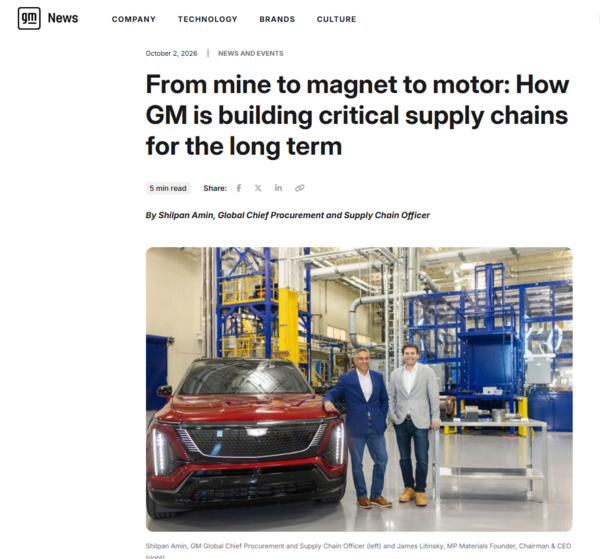
According to GM News, the official global media newsroom of General Motors (GM), MP Materials—a U.S. company in which the U.S. Department of Defense invested $400 million to break China's rare earth monopoly—has entered the stage of supplying GM with rare earth permanent magnets produced at its Fort Worth, Texas facility. On October 2, GM officially confirmed that its collaboration with MP Materials represents an initiative to establish a domestic critical mineral supply chain spanning "from mine to magnet to motor."
GM News further noted that MP Materials has already delivered its first magnets produced at the Fort Worth plant to GM, which is currently testing them for electric vehicles in Michigan. This holds significance far beyond manufacturing a single magnet on U.S. soil; it signifies that the United States has begun operationalizing a functional supply chain—connecting "mine → separation/refining → metal → magnet → automobile"—without passing through China.
[When China Locked Down Rare Earths, the U.S. Seized the Bottleneck for the C919]
Four days earlier, on October 1, a far more explicit move emerged from Washington. According to Reuters, the Trump administration began delaying the processing of export licenses for critical U.S. aircraft components destined for China. The targeted items include landing gear and aviation hydraulic fluids needed by Commercial Aircraft Corporation of China (COMAC)—key inputs that Beijing cannot easily replace in the short term.
The context behind Washington wielding this card warrants particular attention. Reuters reported that the United States intends to leverage its dominance in the aerospace sector as negotiating leverage against China’s control over rare earths. If China holds the U.S. Achilles' heel with rare earths, the U.S. plans to target China's vulnerability in aviation and advanced technologies. Consequently, the U.S.–China supply chain conflict has escalated into a bottleneck confrontation: Chinese rare earths versus American advanced aerospace technology.
[Australia Moves Too… Securing Heavy Rare Earths in Brazil]
The United States is not acting alone. According to Reuters, on September 30, Lynas Rare Earths of Australia—the largest rare earth producer outside China—agreed to acquire Meteoric Resources, owner of a major rare earth project in Brazil, for $672 million. Lynas is targeting the Caldeira project in Minas Gerais, Brazil. This deal holds strategic weight as it secures a non-Chinese source of heavy rare earths, one of the most difficult segments for Western nations to decouple from Chinese reliance.
Lynas already operates the largest non-Chinese rare earth supply chain, mining in Australia and processing in Malaysia. Integrating the Brazilian assets creates another robust non-Chinese rare earth axis spanning Australia → Malaysia → Brazil.
[U.S. Department of Defense Cuts Out Chinese Iron inside Magnets]
Around the same time, an even more notable move unfolded in the United States. The U.S. Department of Defense made a direct equity investment of $65 million in Hertha Metals, a Texas-based startup. Hertha does not produce rare earths themselves, but rather high-purity iron required to manufacture rare earth permanent magnets.
According to The Wall Street Journal (WSJ), approximately 94% of iron used for such magnets is currently supplied by China. Hertha plans to invest roughly $100 million in Conroe, Texas, to build a facility capable of producing 10,000 metric tons of high-purity iron annually. The output will feed into rare earth permanent magnets used in F-35 fighter jets, missile guidance systems, and electric vehicles. This illustrates how granular U.S. strategy has become: Washington is not merely securing mines, but systematically stripping away Chinese control at every bottleneck along the chain—from mine → separation/refining → metal → magnet → feed iron.
[Events of a Single Week Point to a Single Destination]
Viewing these developments collectively reveals a clear trajectory. U.S.-made rare earth magnets have entered GM's supply chain; Washington is using aviation component exports to COMAC as leverage; Australia’s Lynas is securing Brazilian heavy rare earth reserves; and the U.S. DoD has become a direct shareholder in a magnet raw-material startup.
While appearing as separate incidents, they share a singular objective: creating a critical mineral supply chain that functions without China. Paradoxically, the catalyst behind this movement was Beijing itself. By wielding rare earths not as commercial commodities but as a geopolitical weapon against Washington, China prompted the U.S. to view rare earths through the lens of national security rather than market dynamics.
[The True Meaning of the 'Two-Month Truce' Finally Comes into Focus]
In this light, the significance of the trade truce—extended for merely two months until January following the U.S.–China summit in September—takes on a different meaning. Although both nations held a summit, the underlying rare earth dispute remains unresolved. While the U.S. requires Chinese supplies in the immediate term, Washington has no intention of remaining tethered to Beijing indefinitely.
Consequently, two clocks are ticking simultaneously in Washington. The first is the "diplomatic clock," maintaining current rare earth flows through negotiations with China. The second is the "supply chain clock," building an operational framework to source rare earths without China. Washington’s ultimate objective is to accelerate the second clock as rapidly as possible.
[Counteroffensive #1: A $12 Billion 'Strategic Rare Earth Reserve']
Washington’s primary initiative for this objective involves stockpiling critical minerals at the national level under "Project Vault." Modeled after the Strategic Petroleum Reserve, this initiative aims to stockpile rare earths and critical minerals like gallium and cobalt, ensuring U.S. manufacturers can endure periods of Chinese export restrictions, conflict, or logistical disruptions.
The potency of China's rare earth card stemmed largely from the fact that American firms operated on the assumption of uninterrupted Chinese supply. Washington is now moving to eliminate this vulnerability. If Chinese export controls fail to immediately halt U.S. industry, Beijing’s negotiating leverage inevitably diminishes.
[Counteroffensive #2: The U.S. Government Becomes an Owner in Rare Earth Firms]
Even more striking is the direct capital injection by the U.S. government into rare earth companies, exemplified by MP Materials. In July 2025, the DoD structured a $400 million preferred stock investment to acquire approximately a 15% stake in MP Materials, alongside a $150 million loan to support the construction of a new magnet manufacturing facility.
Furthermore, Washington established a 10-year price floor mechanism around $110 per kilogram for Neodymium-Praseodymium (NdPr) output. This serves as a government firewall ensuring U.S. producers remain viable even if China intentionally depresses global rare earth prices. In the past, American firms had to compete against Chinese rivals strictly on market price; today, the U.S. government acts as investor, financier, and long-term buyer. As China converted rare earths into a strategic weapon, the U.S. transformed the sector from a standard commodity market into a national security industry.
[Counteroffensive #3: Extracting Rare Earths from E-Waste]
Recycling represents another vital pillar. Developing new mines and building refining infrastructure requires considerable lead time. Consequently, the U.S. is integrating "urban mining"—recovering rare earths from discarded electronics, scrap magnets, and industrial waste—into its supply chain.
A primary example is the partnership between Apple and MP Materials. Apple signed a $500 million long-term agreement with MP Materials to source U.S.-produced rare earth magnets, while simultaneously establishing a recycled supply chain to recover rare earths from post-consumer electronics and industrial scrap. This yields an entirely new supply source independent of Chinese ore imports.
[Counteroffensive #4: Binding Allies, Not Acting Alone]
The most concerning shift for Beijing is Washington's effort to bind nations endowed with resources and technological capabilities—such as Japan, South Korea, Australia, and Europe—into a unified critical mineral supply network. Australia possesses mining capacity; Japan holds advanced material and high-performance magnet technologies; and South Korea brings world-class manufacturing, material processing, and refining capabilities.
Combined with massive U.S. capital and the world’s largest demand from advanced tech and defense sectors, the dynamic changes fundamentally. While individual nations struggle to compete with China alone, connecting them into a single supply chain creates a formidable bloc. Washington is not merely building a supply of "U.S.-made rare earths," but establishing a rare earth economic sphere that effectively excludes China.
[Why Times Insight | Xi Jinping Brandished the Rare Earth Weapon Too Soon]
China’s dominance over rare earths will not disappear overnight. Beijing maintains an overwhelming position in rare earth separation, refining, and permanent magnet production, and replacing this infrastructure will require significant time for the U.S. and its allies. However, the critical takeaway from this conflict is not current market share, but the fundamental shift in strategic direction.
Historically, while the U.S., Japan, and Europe recognized China’s rare earth dominance, they deferred building alternative supply chains due to the low cost of Chinese supplies. Beijing’s actual weaponization of these resources flipped that calculus. The U.S. government now purchases corporate equity, guarantees floor prices, constructs magnet plants, and invests directly in raw-material startups, with U.S.-made magnets already flowing into GM's supply chain.
Xi Jinping used China's rare earth assets as leverage. From that moment, Washington moved beyond seeking greater volume from China and began deploying capital to build a supply chain that renders China optional. The instant Beijing weaponized rare earths, it handed the global economy every incentive to escape Chinese monopoly—a move that may prove to be Xi Jinping's most fatal strategic miscalculation in the rare earth war.
- TAG