


추부길 whytimespen1@gmail.com
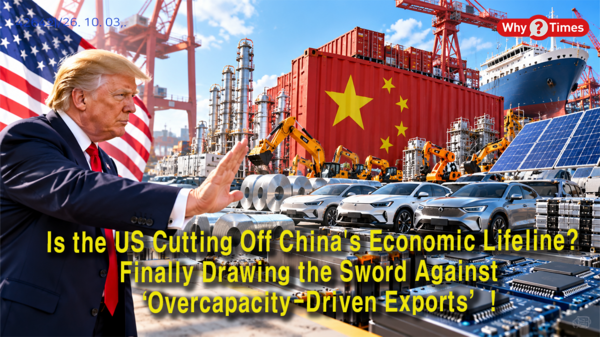
[“We Will Not Accept It Silently”… The Bomb Dropped by Greer]
The United States has begun pointing its blade at the most vulnerable spot of the Chinese economy. Even amid sluggish domestic consumption and investment, the critical buffer allowing Chinese manufacturing to endure has been its massive export volume driven by sheer production capacity. However, the U.S. has defined this "overcapacity → export" pipeline as an unfair trade practice and signaled that retaliatory actions will be unveiled within weeks. If American pressure triggers tighter trade barriers across other major global markets, China risks facing a dual crisis: a shrinking export outlet compounded by internal domestic weakness.
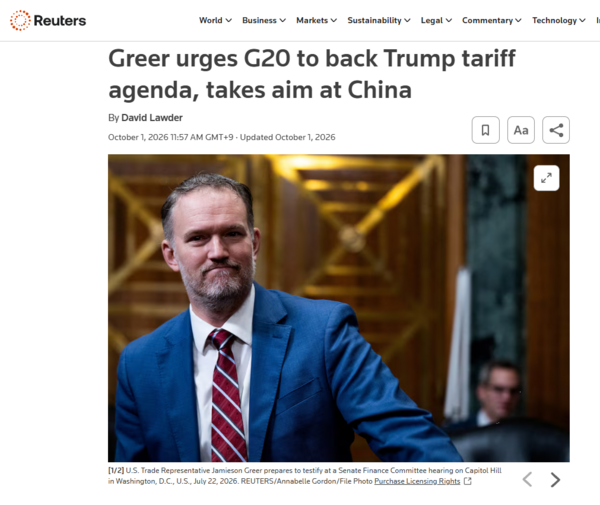
Reuters reported on October 2 that "the U.S. has finally begun taking decisive action against China’s overcapacity issue," adding that "U.S. Trade Representative (USTR) Jamieson Greer clearly expressed that Washington will not sit idly by as foreign overcapacity goods flood into the U.S." Greer's comments came during an interview with Nihon Keizai Shimbun on the sidelines of the G20 Trade Ministers' Meeting held in Milwaukee, Wisconsin.
YouTube
Greer stated that "the U.S. will act," announcing that "the results of the ongoing investigations into overcapacity will be made public in the coming weeks." Pointing specifically to the destructive price wars in China’s electric vehicle (EV) sector, he argued that "even within China, they acknowledge the problem enough to use the term 'involution' (neijuan), but the root cause remains overcapacity."
Greer’s remarks cannot be dismissed as mere rhetoric because the U.S. government is already executing the requisite legal procedures. On March 11, the USTR initiated formal Section 301 investigations into the "structural overcapacity and production capabilities" of 16 economies, including China, the EU, South Korea, Japan, India, and Mexico. Following public comments, a four-day hearing was conducted from May 5 to May 8.
[Target Set at the Heart of Chinese Manufacturing: Autos, Batteries, Semiconductors, and Shipbuilding]
What deserves even greater attention is the scope of the investigation. The sectors cited by the USTR as areas of overcapacity concern include aluminum and automobiles, as well as batteries, chemicals, electronics, machinery, robotics, semiconductors, shipbuilding, solar power, steel, and transportation equipment. This heavily overlaps with the core strategic industries China has concentrated on fostering during its rise as a manufacturing powerhouse.
Furthermore, the "structural overcapacity" defined by the USTR does not simply mean manufacturing goods in large volumes. It targets structures where domestic production capacity—artificially inflated and disconnected from local demand through subsidies, non-commercial activities of state-owned/controlled enterprises, market access barriers, and subsidized loans—results in persistent trade surpluses and idle capacity.
[Greer Explicitly Highlights ‘Involution’… China’s Own Headache over Cutthroat Competition]
Greer’s direct reference to China’s "involution" (neijuan) is significant for this reason. In China's EV market, automakers have sacrificed profitability by slashing prices just to defend market share. Greer posited that while China labels this phenomenon "involution," the underlying driver is fundamental overcapacity.
An issue recognized domestically in China as a self-destructive price war is thus being reframed in Washington through trade logic as "structural overcapacity impacting global markets." When domestic markets fail to absorb excess output, corporations seek buyers overseas; the U.S. is directly challenging the damage this spillover inflicts on its own manufacturing base.
[The Dilemma of the Chinese Economy: Weak Domestic Demand, Fast-Running Factories]
Recent economic indicators from China illustrate why this debate is escalating. According to Reuters, China’s industrial output in August expanded by 5.2% year-on-year, picking up pace from 4.5% in July. Conversely, retail sales growth for the same month slowed to just 0.4%, down from 0.6% in July.
Under these conditions, foreign markets serve as an indispensable safety cushion for Chinese industry. Reuters reported that "China's exports surged 25% year-on-year in August," driving the monthly trade surplus to $119.09 billion. Reuters analyzed that "robust exports serve as a vital pillar supporting a Chinese economy bogged down by weak domestic consumption and investment."
[EU Raises Concerns Too… The Scenario China Truly Fears]
When launching the investigation in March, the USTR clearly laid out its stance: "The U.S. will not sacrifice its domestic industrial base to absorb the overcapacity issues of other nations." Greer emphasized at the time that "the U.S. will no longer sacrifice its industrial foundation while other countries export their overcapacity to us."
At the G20 Trade Ministers' Meeting in Milwaukee on September 30, Greer identified structural overcapacity as one of four key agenda items pushed by the U.S. According to Reuters, Greer presented Washington’s position that Chinese industrial subsidies and non-market economic policies dump excess supply into global markets, creating an unlevel playing field for producers worldwide.
Even more burdensome for Beijing is that the U.S. is not the sole entity raising this issue. EU Trade Commissioner Maroš Šefčovič also voiced concern over overcapacity during the Milwaukee G20 meeting, citing the adverse impact felt by Europe's steel and automotive sectors.
In the steel sector, international action advanced another step. The OECD-led Global Forum on Steel Excess Capacity (GFSEC) agreed on a new "Milwaukee Framework" for joint action on September 30. Greer urged that "like-minded nations must adopt more effective measures to counter overcapacity and market distortions."
[If Blocked in the U.S., Redirect to Europe?… The Game Changes If Europe Closes Its Doors]
Thus, the primary threat to the Chinese economy cannot be explained by U.S. tariffs alone. Even if Chinese firms face headwinds in the American market, they can redirect export volumes toward Europe, Southeast Asia, the Middle East, and Latin America. Indeed, the 25% surge in China's August exports was sustained by strong demand for high-tech goods across diverse non-U.S. markets.
The real danger arises if massive inflows of Chinese goods into secondary markets spark rising domestic injury claims among local manufacturers. Should major economies follow the U.S. in expanding defensive trade measures—such as anti-dumping duties, countervailing duties, and safeguards—the overseas outlets available for Chinese redirection will rapidly contract.
That scenario completely changes the equation. Rather than a single market closing, multiple global outlets meant to absorb Chinese excess volume would narrow simultaneously. Production unabsorbed abroad would flow back inward, exacerbating domestic price competition, eroding corporate margins, and depressing factory utilization rates.
[Trump and Xi Handshake with Smiles… But the Tariff Blade Remains Drawn]
What makes this momentum even more striking is that it follows right after a bilateral summit between the U.S. and China. Following their recent meeting, both nations agreed to extend their trade truce by two additional months until January 10, while pursuing tariff reductions on $30 billion worth of non-sensitive items from each side.
Yet, this temporary reprieve does not signal a halt in U.S. trade pressure. Following the summit, Washington continues its Section 301 investigation into Chinese overcapacity, with Greer explicitly signaling that findings will be released within weeks.
Ultimately, two distinct dynamics are unfolding concurrently between Washington and Beijing. On one side, Trump and Xi shake hands, temporarily pausing the escalation of a trade war. On the other, the USTR prepares Section 301 remedies targeting China's industrial policy and structural overcapacity. The clear trajectory of Washington’s trade policy embedded in Greer's remarks is: Negotiate, but never pause structural pressure.
[Why Times Insight | U.S. Targets 'China's Economic Survival Model', Not Just Made-in-China Goods]
To reduce this situation to merely "the U.S. imposing higher tariffs on Chinese goods" is to miss the core issue. What the USTR is formally challenging is not product pricing per se, but "structural overcapacity"—where state subsidies, state-owned enterprises, and financial support expand production capacity completely decoupled from actual market demand.
The mechanism leveraged by the Chinese economy can be simplified as follows: Expand production capacity by ramping up investments and factory construction. When domestic demand fails to match output, scale up overseas sales at aggressive price points. High export volumes then act as a buffer sustaining factory operations and broader manufacturing momentum. The contrasting recent figures—5.2% growth in industrial production, 0.4% in retail sales, and a 25% surge in exports—provide crucial evidence of this underlying structure.
Therefore, the critical factor is not merely the percentage rate of U.S. tariffs, but how widely American initiatives spread across major global markets. If Europe, Asia, the Middle East, and Latin America absorb redirected Chinese supply when U.S. access narrows, the impact can be largely buffered.
However, if key markets across the U.S. and Europe simultaneously erect trade barriers to protect their own domestic industries against overcapacity, the dynamic fundamentally shifts. China would then be forced to absorb internally the weight of excess production that foreign markets previously absorbed. As price wars intensify and corporate profitability deteriorates, the drag will inevitably spill over into factory operating rates, employment, and investment.
This is why Greer's statement—"The U.S. will act"—carries profound weight. Washington is not merely targeting a single Chinese electric vehicle or a ton of steel. It has set its sights on the vital economic lifeline that allowed China to run a massive manufacturing engine by dumping excess capacity globally, even amidst sluggish domestic demand.
The upcoming U.S. measures, set to be unveiled in a matter of weeks, will force a fundamental question: If China cannot sell enough at home and can no longer sell freely across global markets as before, can the 'Factory of the World' continue to operate under its existing model?
- TAG