


추부길 whytimespen1@gmail.com
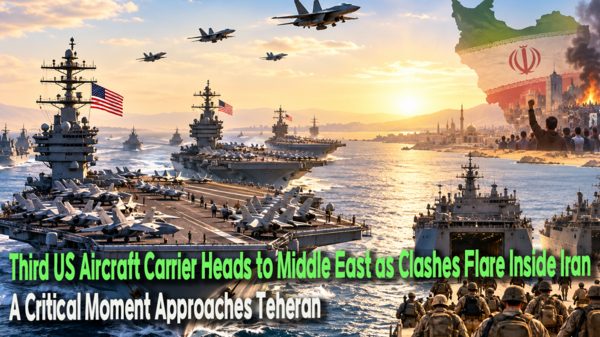
[“The Third Carrier Moves”… Up to 10,000 Additional Troops Deployed]
A third US aircraft carrier has begun moving toward the Middle East. Accompanied by carrier strike groups and Marine amphibious forces, the deployment brings up to 10,000 additional troops to the region, significantly expanding the military options available to Washington should President Trump decide to resume strikes against Iran. Coincidentally, violent armed clashes inside Iran have escalated to the point of killing a Revolutionary Guard (IRGC) brigadier general. Meanwhile, following an attempted mid-air crash of a Tel Aviv-bound Flydubai flight, Trump publicly raised the possibility of Iranian involvement. Pinched between external naval posture and internal armed conflict—compounded by fresh terrorism allegations—the situation surrounding Iran is entering a dangerous new phase.
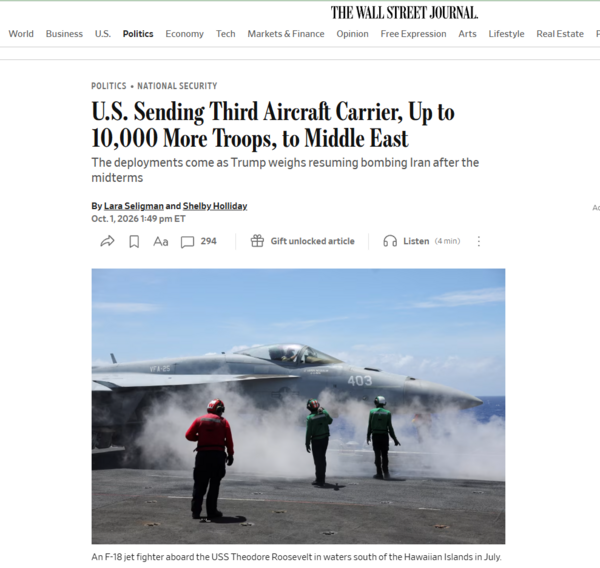
The United States has begun sending major forces back to the Middle East, with plans from the Department of Defense to reinforce the region with 9,000 to 10,000 additional personnel by deploying the nuclear-powered aircraft carrier USS Theodore Roosevelt (CVN-71) Carrier Strike Group alongside the Makin Island Amphibious Ready Group. Ships and personnel are expected to arrive in the region by late November.
It is not just a single aircraft carrier on the move. The USS Theodore Roosevelt Carrier Strike Group is accompanied by the Makin Island Amphibious Ready Group and the 13th Marine Expeditionary Unit. With more than 50,000 US troops already stationed in the Middle East, completing this deployment could push the total US footprint in the region beyond 60,000. The Pentagon has also extended the deployment periods for key assets, including air defense units and the 82nd Airborne Division.
The number of carriers is particularly noteworthy. The USS George H.W. Bush and USS George Washington are currently operating in the area; if the Roosevelt joins them while the Washington remains in place, it could create a rare posture where three carrier strike groups operate simultaneously in the Middle East. This would be the first such deployment since April, though it remains unconfirmed how long a three-carrier posture would last given the possibility of the Washington returning to Japan. While these moves do not inherently signal an immediate strike order, they unambiguously expand Washington's firepower and tactical flexibility if Trump chooses military action.
[Troop Reinforcements Align with Trump’s Escalation Warnings]
The timing of this force buildup is crucial. This military reinforcement is taking place as Trump considers resuming airstrikes against Iran following the mid-term elections. While it is premature to conclude that a November strike has been finalized, Washington is visibly bolstering the physical military options available should diplomacy collapse.
Iran is taking the possibility of renewed strikes seriously. Senior Iranian military commanders are preparing plans to launch a stronger and more expansive retaliation than before if the US or Israel strikes again. Iran is considering expanding its response beyond the Middle East, while Tehran-aligned armed groups in Lebanon, Yemen, and Iraq stand ready to act depending on developments.
Diplomatic off-ramps appear to be narrowing. Iran recently proposed reducing regional tensions via Qatari mediation—requesting an end to blockades and an easing of crude oil sanctions—but Trump rejected the proposal. Furthermore, the US announced new sanctions targeting Iran's automotive, railway, and metals industries, reflecting simultaneous tightening of both military and economic pressure.
[A New Wildcard Emerges… Attempted Crash of Tel Aviv-Bound Flydubai Flight]
At this delicate juncture, an unexpected crisis erupted. On September 30, aboard Flydubai Flight FZ1073 en route from Dubai to Tel Aviv, an Omani co-pilot stabbed the captain with a knife in an attempt to crash the aircraft. Despite being wounded, the captain unlocked the cockpit door, enabling off-duty crew and passengers to breach the flight deck and subdue the attacker. Off-duty pilots took control of the yoke and executed an emergency landing at Tabuk, Saudi Arabia. It was a harrowing near-miss with 174 lives on the line.
The aircraft plunged approximately 17,000 feet in just two minutes during the struggle. Detecting the abrupt altitude loss and course deviation, the Israeli Air Force stood ready to scramble fighter jets. Had the crew and passengers delayed intervention by even a few seconds, the outcome could have been catastrophic.
Trump swiftly introduced the 'Iran variable' into the incident. When asked about potential Iranian ties, Trump indicated that based on information he was receiving, such a connection was plausible. He added a stark warning that Iran would face severe consequences if direct involvement were confirmed. A sitting US President thus publicly introduced the idea of Iranian state backing into an attempted commercial airliner crash.
To be clear, no public evidence currently proves that the Iranian government or the IRGC ordered the attack. Israeli authorities are currently leaning toward a 'lone actor' scenario involving the co-pilot, with no evidence of Iranian state direction discovered so far. Prime Minister Netanyahu similarly stated that the co-pilot appears to have been influenced by radical Islamist ideology, adding that it remains premature to determine whether Iran was directly involved.
The immediate takeaway is not that Tehran was definitively behind the attack, but rather that Trump publicly raised the possibility of Iranian backing and threatened a decisive response if confirmed. If ongoing investigations uncover linkages to the IRGC or Iranian proxy networks, Washington’s justification for military action could expand beyond nuclear and Straits of Hormuz concerns into combating overseas state-sponsored terrorism.
[Gunfire Grows Louder Inside Iran]
The second pressure point on Tehran stems not from abroad, but from within its own borders. On the night of September 29, heavy fighting broke out between government security forces and armed militants in the Garibabad area of Iranshahr, located in southeastern Sistan-Baluchestan province. Reports indicate that dozens of military vehicles were deployed alongside heavy weapons, including RPGs and surveillance drones, while major access roads were completely cordoned off.
This confrontation occurred just six days after a senior IRGC officer was killed in action. On September 23, Brigadier General Hossein Zarifi—commander of the Shahid Sajjad Operational Base under the IRGC Ground Forces' Quds Base—was killed in combat with militants in the Saravan region alongside his base intelligence chief.
It is too early to label these domestic developments a full-scale 'civil war.' The armed clashes remain largely concentrated in Sistan-Baluchestan, and there is no evidence of a synchronized nation-wide armed uprising against the central government. Yet, treating this as a routine law-and-order issue understates its gravity. The death of a flag-officer IRGC commander followed days later by a battle involving heavy weapons, armor, and drones highlights the escalating intensity of violence in the southeast. Having to commit IRGC military, intelligence, and internal security assets domestically at the exact moment external military tension with the US peaks imposes a severe strain on Tehran.
[As US Carriers Move, Iran Prepares 'Stronger Retaliation']
Watching US movements closely, Tehran is preparing its own military options. Senior Iranian leadership is formulating plans to execute far stronger retaliatory strikes should the US or Israel launch another attack. Targets under consideration reportedly extend beyond US military facilities and allied states in the Middle East to encompass broader regional coordinates.
[Why Times Insight | Iran Confronts Three Simultaneous Fronts]
Understanding the current situation requires looking at these developments not as isolated events, but as interconnected vectors:
The External Military Front: The USS Theodore Roosevelt Carrier Strike Group and up to 10,000 troops are deploying to the Middle East. While no strike orders have been issued, US strike capabilities in the theater are surging. Should the USS George Washington delay its departure, the US could temporarily field a three-carrier strike posture.
The Internal Security Front: In Sistan-Baluchestan, an IRGC brigadier general was killed in action, followed days later by heavy combat involving military armor and drones. While short of a full civil war, Tehran is forced to simultaneously manage two distinct national security crises—external deterrence against the US and internal armed counter-insurgency.
The Unpredictable Flydubai Wildcard: No public evidence currently confirms Iranian state involvement in the Flydubai attack, and Israeli investigators currently suspect a lone radicalized actor. However, Trump’s explicit public warning linking the incident to Iran creates a potent political dynamic. Investigative findings from this incident could quickly spill over into the broader US-Iran geopolitical standoff.
Key indicators to monitor moving forward include: whether the USS George Washington remains to formalize a three-carrier presence; whether investigative agencies uncover evidence tying the Flydubai co-pilot to Iran or the IRGC; and whether armed conflict in Sistan-Baluchestan spreads to other provinces. A major movement in any single indicator could push the crisis into an entirely new phase.
With US naval assets underway and Iran preparing escalated counter-strikes, the greatest peril lies not in a pre-planned calendar date, but in an unforeseen trigger event sparking an unintended conflict. Iran now finds itself navigating three active, interconnected fronts simultaneously.
- TAG