


추부길 whytimespen1@gmail.com
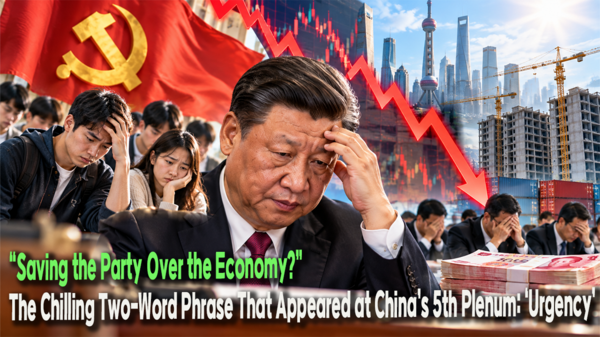
[“Why ‘Urgency’ Now?”… The Ominous Two-Word Phrase Ahead of the 5th Plenum]
Warning lights have flashed on for the Chinese economy once again. Youth unemployment has soared to 18.9%, retail sales growth for August slumped to just 0.4%, and both real estate and private investment contracted significantly. An increasingly anxious Beijing ultimately rolled out additional stimulus measures, cutting interest rates and even subsidizing mortgage interest for first-time homebuyers. Yet, with the 5th Plenary Session of the Chinese Communist Party (CCP) Central Committee set to convene just a month later, the core focus placed front and center by the leadership is not merely the economy, but "comprehensively governing the Party with strict discipline" (Quanmian Congyan Zhidang)—that is, ruling the Party with an even iron hand. In particular, the official CCP phrasing highlighting the "Party’s ruling status" and "urgency" demonstrates that Beijing currently views internal Party cohesion and maintaining governance authority as no less critical than managing the economic slowdown.
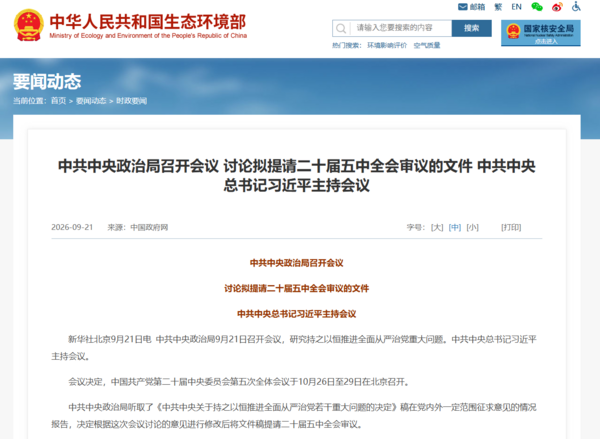
On September 21, the Political Bureau of the CCP Central Committee officially announced that "the 5th Plenary Session of the 20th Central Committee will be held in Beijing from October 26 to 29," adding that "the Politburo discussed a draft decision on 'major issues concerning the continuous advancement of comprehensive and strict Party governance' and decided to submit it to the 5th Plenum for deliberation." What deserves close attention is that the keyword for deciphering this upcoming 5th Plenum may not be "strict Party governance," but rather "urgency" (Jinpaoxing).
Had the rhetoric stopped there, it might have been viewed simply as an extension of the anti-corruption drive and Party-building campaign that Xi Jinping has pursued since taking power in 2012. However, the Politburo went a step further, emphasizing that the entire Party must "deeply recognize the importance and urgency of comprehensively governing the Party with strict discipline from the strategic height of consolidating the Party's ruling status." It effectively placed "ruling status" and "urgency" side by side in the very same context.
[Factories Are Running, but Purses Are Sealed]
Behind the Party’s emphasis on tightening discipline lies abnormal signals appearing simultaneously in consumption and investment across the Chinese economy. Furthermore, the issue touching public sentiment most directly is employment. Looking at these developments, the challenge facing China today extends far beyond declining GDP figures. Structural issues are compounding: youth entering the job market cannot find stable employment, while the real estate slump and sluggish consumption simultaneously weigh on household and corporate sentiment.
[An Anxious Beijing Finally Starts Loosening the Purse Strings]
Chinese leadership is not sitting idly by. On September 29, China announced fresh economic stimulus measures. Measures targeting real estate went a step further: to revive the stagnant housing market, the central government directly moved to lower mortgage interest burdens for households. Two days earlier, the State Council also pledged to strengthen countercyclical policies to achieve its economic growth targets.
Herein lies the central paradox when interpreting the upcoming 5th Plenum: Beijing is easing monetary policy for the economy while politically tightening its grip on the Party. It would be inaccurate to conclude that the Chinese leadership is abandoning the economy to focus solely on the Party. Rather, it is more precise to view this as a dual-track strategy of "economic stimulus + political control"—injecting financial and fiscal support into the market while simultaneously reinforcing central command authority and organizational discipline in the political realm.
At the same time, shifts among foreign enterprises are starkly evident. According to a survey published on September 28 by Japanese credit research firm Teikoku Databank, the number of Japanese companies operating local subsidiaries, factories, or offices in China stood at 10,118 as of June 2026. This represents a drop of 2,916 companies—a 22.4% plunge—in just two years from 13,034 in 2024. Compared to the peak of 14,394 companies in 2012, the figure has fallen by 4,276 companies (29.7%), marking the lowest total since tracking began in 2010.
[The Shaking 'Livelihood Contract']
At this junction, economic issues directly connect to political ones. Since the Reform and Opening-up era, one of the core concepts explaining CCP rule has been "performance legitimacy." The implicit contract was that in exchange for limited political freedom and participation, the Communist Party would secure social acceptance of its rule by delivering economic growth, rising incomes, and improved living standards. The premise that post-reform economic growth has served as a foundational pillar supporting the Party's political legitimacy has long been a central analytical framework in Chinese political studies.
During periods of high growth, this mechanism functioned inside the Party as well. Driving economic growth and attracting investment were critical performance metrics for local cadres, while real estate development and land sales provided local governments with massive revenues. However, following the real estate downturn, local government revenues from land sales plummeted. As the fiscal capacity of local governments weakens, the incentive and reward structures that functioned during past growth eras are coming under severe pressure.
[From 5,000 to 3,000 RMB a Month… Local Bureaucrats Are Shaking]
This pressure is becoming increasingly visible among frontline civil servants. Radio Free Asia (RFA) reported that "delayed wage payments and allowance cuts for teachers and civil servants have emerged in several regions, including Henan, Shandong, and Guangdong." RFA added that "due to the elimination of various allowances, some grassroots civil servants saw their monthly income drop from around 5,000 RMB to the 3,000 RMB range," while "residents in Zhejiang Province testified that annual compensation for general civil servants was slashed by 50,000 to 60,000 RMB."
[As Carrots Disappear, the Whip Grows Heavier: 410,000 Sanctioned in the First Half]
The central leadership's response is to enforce even stricter discipline. According to the Central Commission for Discipline Inspection (CCDI), discipline inspection and supervision organs nationwide filed 538,000 cases and disciplined 412,000 individuals in the first half of 2026. In the first half of 2023, 316,000 cases were filed and 258,000 individuals disciplined; in just three years, both case filings and disciplinary actions have surged dramatically. The CCDI evaluates this as a fruit of strict Party governance, demonstrating a commitment to "carry through strictness to the very end."
In political science terms, however, a paradox emerges. When economic conditions worsen, local bureaucrats ought to proactively support businesses and revive investment and consumption. Yet, when accountability pressure and inspection oversight become excessively harsh, bureaucrats may conclude that rather than taking risks, "doing nothing is the safest course of action." Indeed, political analysts have noted that the phenomenon of "lying flat" (tangping) within the Chinese bureaucracy may be a side effect produced by the intense central control and strict accountability characteristic of the Xi Jinping era. (It is worth distinguishing that this is an interpretation put forward by scholars of Chinese politics rather than an official self-assessment by the Chinese government.)
[Reviving the Economy Requires Mobilizing the Private Sector, But…]
The Chinese leadership is fully aware of the private sector's importance. In 2025, Xi Jinping summoned prominent private entrepreneurs—including Alibaba's Jack Ma and Tencent's Pony Ma—to emphasize restoring entrepreneurial confidence, while also pushing forward the Private Economy Promotion Law. In recent stimulus measures, Beijing added an extra 300 billion RMB to the re-lending quota targeted at private enterprises.
Looking at the policies currently pursued by the CCP authorities, the underlying structure resembles: "revive the private economy, but do not let it slip beyond Party control." Reviving the economy requires restoring entrepreneurial confidence and private investment, but as political uncertainty rises, the leadership's incentive to tighten central control also grows. Analysts have long pointed out that Chinese economic reform inherently carries an unresolved tension between "expanding economic autonomy" and "maintaining political control."
[Re-binding 100 Million Party Members]
Amid this landscape, the CCP organization remains immense. According to official statistics from the Organization Department of the Central Committee, total Party membership reached 101.286 million at the end of 2025—an increase of 1.015 million from the previous year—spanning 5.431 million primary-level Party organizations. Party members aged 61 and above alone account for 29.914 million. The CCP utilizes this vast organizational network as its primary execution mechanism, stretching from the central government down to rural villages and corporate enterprises.
Consequently, as economic discontent and social pressures mount, one of the very first entities the leadership must manage is its own Party apparatus. The Politburo’s emphasis ahead of the 5th Plenum on the "Party’s long-term governance capacity," "ruling status," and "centralized, unified leadership" should be understood in this context. This is not evidence that Chinese leadership expects an imminent economic collapse. However, official documents clearly confirm that Beijing is prioritizing internal Party discipline and central command capability to prepare for the possibility of escalating economic and social pressures ahead.
[Why Times Insight | What Xi Jinping Fears Is More Than Just GDP Growth Numbers]
Defining this 5th Plenum simply as a "meeting to abandon the economy and save the Party" would mean missing a critical dimension. The Chinese leadership is actively deploying capital: it has cut interest rates, expanded financial support for private enterprises, and begun subsidizing mortgage interest for first-time homebuyers. In short, Beijing recognizes that it must revitalize the economy and has taken concrete action to do so.
Yet, while loosening financial constraints for the economy, Beijing is moving in the exact opposite direction politically. It demands stricter discipline, greater centralization, and uncompromising policy execution from the Party. The blueprint is to stimulate the economy without relinquishing power. The fact that these two moves are occurring simultaneously is the key to understanding China today.
From this perspective, the real point to watch at the upcoming 5th Plenum is how the CCP intends to supplement "growth rewards"—a cornerstone of its governance legitimacy since Reform and Opening-up—at a time when growth, real estate, and employment are all coming under simultaneous pressure.
The answer provided during the Deng Xiaoping era was the expansion of markets and openness. The answer offered by the current Xi Jinping leadership is somewhat different: it supplies capital to private enterprises and underpins consumption and real estate, while politically tightening central control and Party discipline even further.
Yet this approach carries an unavoidable dilemma: capital can be deployed by decree, but entrepreneurial confidence cannot be manufactured by order. Obedience can be demanded through discipline, but proactive initiative and dedication from bureaucrats cannot be commanded into existence.
Therefore, what truly bears watching at the October 5th Plenum is not the familiar slogan of "anti-corruption" itself. Rather, it is why the CCP has chosen this exact moment of economic difficulty to explicitly raise the terms "Party’s ruling status" and "urgency." Perhaps those two words—"urgency"—reveal the true nature of the crisis felt by China’s leadership far more clearly than any GDP growth figure ever could.
- TAG