


추부길 whytimespen1@gmail.com
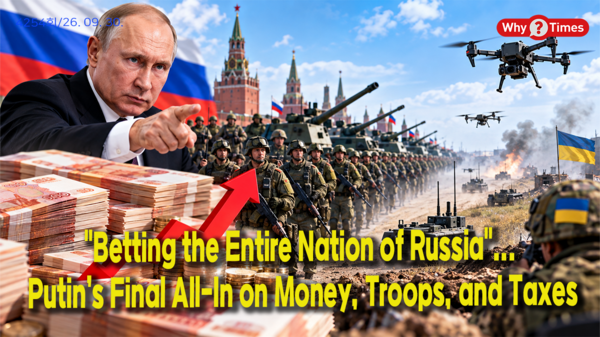
[2027 Defense Budget Surges 27% Above Original Plan... 50 Trillion Roubles Over Three Years]
Vladimir Putin has begun placing Russia’s capital, military personnel, tax revenues, and national debt directly onto the Ukrainian chessboard. Russia expanded its 2027 defense budget by a staggering 27% above previous projections to 17.1 trillion roubles ($202.6 billion), and on the very same day, decreed yet another increase in its military personnel ceiling. In short, this signifies Russia's intent to go all-in with every resource at its disposal to alter the course of the war in Ukraine.
The issue, however, is that at the exact moment Putin mobilizes the nation's full capacity, the nature of the warfare itself is shifting. Ukrainian forces announced that they have recaptured 176 square kilometers of territory in northern Donetsk through their ongoing "Operation Vivaldi", deploying an updated doctrine that integrates drones, unmanned ground vehicles (UGVs), and battlefield deceptions. Ultimately, one question remains: Can Putin truly alter the trajectory of the war in Ukraine with an "all-in" gamble that leverages Russia’s very future?
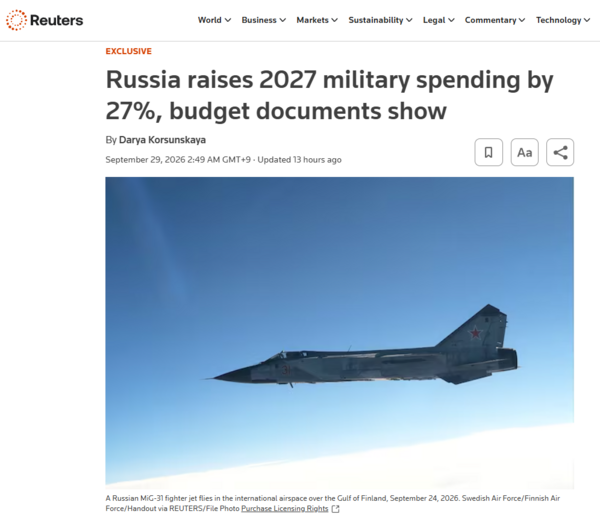
According to reports, Russia's defense spending for 2027 has been set at 17.1 trillion roubles, or approximately $202.6 billion. This represents a massive 27% increase from the previously drafted target of 13.5 trillion roubles and marks the highest defense allocation since the full-scale invasion of Ukraine in 2022, bringing Russia's total military expenditure over the next three years alone to roughly 50 trillion roubles.
What stands out even more is that as recently as a year ago, the Russian government had established a medium-term plan to taper the growth rate of its military budget. However, as actual wartime costs outpaced expectations, that plan effectively collapsed. While this year's official defense budget stands at 12.1 trillion roubles, actual expenditure remains classified. Therefore, it is important to distinguish that the 27% figure does not represent a year-over-year growth rate compared to this year's actual outlay, but rather an increase over the originally planned 2027 budget baseline. Ultimately, Russia chose not a path toward winding down military spending to return to a peacetime economy, but the exact opposite: locking itself into a long-term war footing by funneling far more capital into weapons, ammunition, defense plants, and troop numbers.
[Troop Headcount Increased on the Exact Same Day Funding Was Raised]
An even more revealing scene unfolded on the same day. Putin signed a presidential decree expanding the establishment ceiling of the Russian Armed Forces once again, raising the total headcount to 2,441,630 personnel, including 1,550,500 active military service members—an increase of 15,500 personnel in this latest expansion.
This is not the first time troop numbers have been raised. This marks the fourth expansion this year alone, following additions in March, June, and July. Over just seven months, four consecutive expansions have added a total of 52,500 positions to the military ceiling, including 50,500 active service personnel. Considering that there were only three such expansion decrees during the first four years following the full-scale invasion of Ukraine, the frequency of personnel expansion measures has accelerated sharply this year.
This indicates that Putin is not merely expanding the defense budget on paper, but simultaneously taking steps to convert those funds into standing military manpower. However, there is no conclusive evidence to suggest these successive increases are aimed solely at replacing frontline losses. It is more plausible to view this as a strategic move to maintain a larger standing force in preparation for a prolonged war in Ukraine and potential future military requirements.
[As Oil Revenue Shrinks, Taxes and National Debt Are Dragged In]
The underlying problem, however, remains financing. Early in the war, Russia was able to absorb wartime costs using vast revenues generated from oil and gas exports. Yet as cumulative sanctions and shifting energy market dynamics take their toll, that landscape is changing. The Russian government revised down its oil and gas revenue forecast for this year to 7.6 trillion roubles. Conversely, projected total government expenditure has climbed to 48.6 trillion roubles, causing the estimated budget deficit to double from 1.6% to 3.2% of GDP.
Consequently, the Kremlin pulled out the tax hike card. The Russian government plans to secure an additional 200 billion roubles annually by imposing new windfall taxes on sectors such as metals and mining. Taxation on financial income is also set to tighten. Expanding progressive tax brackets on savings interest, dividends, and capital gains is estimated to affect roughly 4 million citizens. Meanwhile, the dividend tax rate applied to investors from "unfriendly nations" will rise from 15% to 35%.
Yet collecting more taxes alone will not cover the shortfall. Thus, the Russian government is expanding domestic borrowing and tapping its sovereign wealth fund. Moscow plans to expand net domestic borrowing by 26% this year to 5 trillion roubles and draw down 459 billion roubles from its sovereign wealth fund to plug the fiscal deficit. Furthermore, public debt is projected to climb to 21.7% of GDP by 2027. Ultimately, Putin is putting far more than just the defense budget on the table; taxes, national debt, and Russia's emergency reserves are being thrown into the pot as well.
[“Guns Now, Pay Later”]
Alexander Kolyandr of the Center for European Policy Analysis (CEPA) titled his analysis of this Russian budget simply "Guns Now, Pay Later." This structural shift is precisely what drew his attention: prioritizing war and social welfare outlays while squeezing other sectors, raising taxes, and financing whatever gap remains through increased borrowing. Russia’s internal national debt ballooned from 23.7 trillion roubles at the start of 2025 to 33.2 trillion roubles by September of this year.
The problem is that the longer a war economy persists, the more intense the competition for resources becomes between the defense industry and the civilian sector. As the government absorbs domestic capital into state bonds while accepting high interest rates, and as defense firms suck up labor and capital, the resources remaining for private enterprise shrink proportionally. Hence, this budget is not merely a "defense budget increase". It functions as a declaration that Putin intends to lock the structure of the Russian economy itself into a long-term war posture.
[But the Nature of the War Is Changing]
Herein lies the dilemma. While Russia scales up traditional military metrics—money and troop numbers—the ways in which the war in Ukraine is being fought are evolving rapidly. A prime example is "Operation Vivaldi," currently being waged by Ukraine’s 3rd Army Corps in northern Donetsk.
Citing an announcement by Brigadier General Andriy Biletsky, commander of the 3rd Army Corps, Ukrainian forces recaptured an additional 51 square kilometers in the latest phase of Operation Vivaldi, bringing the total territory retaken since the start of the operation to 176 square kilometers. Ukrainian forces announced the liberation of three villages—Nove, Ridkodub, and Katerynivka—alongside restoring control over two adjacent sectors.
Even more significant is how these areas were retaken. Ukrainian forces deliberately misled Russian commanders into misjudging the primary axis of advance, inducing them to waste reserve troops on a secondary sector before striking the actual main offensive line. Unmanned systems, including drones and unmanned ground vehicles, were also heavily integrated into the attack.
The strategic weight of this operation extends beyond merely recapturing a handful of villages. Russian forces had been exerting heavy pressure on major Ukrainian defensive strongholds in northern Donetsk. Operation Vivaldi directly disrupted this Russian offensive axis. Analysts at the Institute for the Study of War (ISW) evaluated the gains made by Ukrainian forces in this sector as "operationally significant."
This is not to say that the overall battlefield situation has flipped decisively in Ukraine’s favor. Yet, it clearly underscores that this is becoming a war where throwing vast amounts of manpower and money onto the line no longer guarantees a decisive breakthrough on its own.
[Why Times Insight: The Real Problem Is "After the All-In"]
What deserves the closest attention in Putin's choice is not the 27% defense spending increase figure itself. It is the reality that, to sustain this war, Russia is simultaneously mobilizing not just its defense budget, but also its manpower, tax system, national debt, and sovereign wealth fund. Rather than calculating a return to a peacetime economy once the conflict ends, a national structure engineered for prolonged war is becoming distinctly visible.
However, injecting more money and troops does not automatically yield a proportional increase in battlefield gains. In the war in Ukraine, drones, electronic warfare, unmanned ground vehicles, and long-range strike systems are constraining the movement of troops and armor, fundamentally reshaping how large-scale ground forces operate. Operation Vivaldi serves as an example where Ukrainian forces combined deception tactics with unmanned systems to achieve localized counteroffensive successes within this transformed battlefield environment.
This does not mean Russian power has vanished. Russia still possesses superior manpower, vast defense industrial capacity, and continues to maintain heavy pressure along the eastern front. Therefore, the key metric going forward is not simply "how much more money Russia can spend." The crucial test is how effectively that massive additional investment can be converted into actual territorial gains and strategic military success.
And right here lies the inherent danger of Putin's "all-in." If Russia fails to achieve decisive military results despite committing 17.1 trillion roubles in defense spending, maintaining a 1.55 million-strong active military, raising taxes, expanding public debt, and drawing down its sovereign wealth fund, it will be left carrying both the crushing financial costs of the war and a severely strained economy.
Rather than reducing the stakes to bring the war to an end, Putin has chosen to dramatically raise the stakes on the entire Russian state. Thus, the truly perilous moment for Putin is not right now as he goes "all-in," but what comes afterward. If he bets the entirety of Russia and still fails to redraw the map of the war, the bill presented to Putin at that point could pose an entirely different order of threat.

- TAG