


추부길 whytimespen1@gmail.com
[Chinese Stock Market Hits 1-Year Low... Starting with a Collapse in Tech Shares]
Warning lights have simultaneously turned on for the advanced technology stocks into which China has poured its national future. On the 28th, mainland China’s benchmark CSI 300 Index plunged up to 2.4% during intraday trading to hit its lowest level in a year, with semiconductor and optical communication stocks leading the market downturn. Notably, the mere news that Beijing might permit domestic companies to purchase Nvidia’s new chips was enough to rattle China’s home-grown AI semiconductor manufacturers.
Unitree, which emerged just a month ago as the symbol of China’s "robotics rise," has also plummeted around 55% from its post-IPO peak. Beyond the question of whether China can breach US technology blockades, a far tougher test has begun: whether Chinese high-tech industries can prove their actual market competitiveness once policy protections and the investment craze are stripped away.
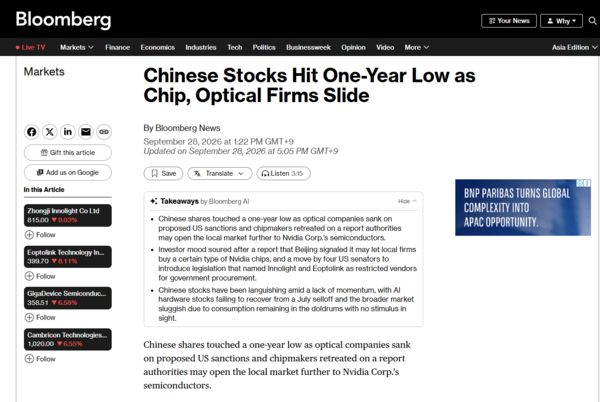
Bloomberg reported on the 28th (local time) that "mainland Chinese equity markets were hit hard, led by tech shares," noting that "the CSI 300 Index dropped as much as 2.4% intraday to touch a 1-year low, while semiconductor firms Cambricon and GigaDevice, alongside optical communication makers InnoLight and OptoLink, each fell by at least 5% or more, causing the semiconductor-heavy STAR 50 Index to record its largest single-month decline."
Bloomberg added, "What shook the market were two pieces of news pulling in completely opposite directions: one was that Chinese authorities might allow domestic firms to purchase Nvidia’s new semiconductors, and the other was that US Senators introduced legislation restricting government procurement aimed at Chinese optical communication companies. The signal that China's 'doors may open' and the US move to 'shut its doors' weighed on Chinese tech stocks on the very same day."
[The Irony... News of Opening Doors to Nvidia Shakes Domestic Chinese Semiconductors]
According to Bloomberg, the first shock stemmed from Nvidia. Reports surfaced that China’s Ministry of Industry and Information Technology (MIIT) required certain domestic companies to report how many of Nvidia’s RTX Pro 5500 chips they intended to buy and for what purpose. Although neither the Chinese government nor Nvidia has officially confirmed sales in China yet, the market interpreted this as a strong signal that Beijing is increasingly likely to allow domestic enterprises to purchase the new Nvidia chips.
While this may be welcome news for Chinese AI developers, it is a completely different story for domestic Chinese AI chipmakers. Amid US export controls and Beijing’s localization drive, Chinese firms like Cambricon were spotlighted as "import substitution" champions to replace Nvidia. However, if Chinese companies regain access to performance-proven Nvidia products, domestic chipmakers will face far more direct market competition.
The irony lies in the fact that what shook Chinese semiconductor stocks that day was not a new batch of US semiconductor sanctions, but rather the news that Beijing might re-open its doors to Nvidia. Naturally, a single day’s stock price movement cannot define the overall technological capability of China’s semiconductor industry. Yet, the fact that domestic firms like Cambricon swung wildly on the mere possibility of Nvidia’s re-entry demonstrates that investors are starting to look past the "localization premium" to weigh real market competitiveness.
[The US Takes the Opposite Route, Shutting Doors... Targeting Chinese Optical Communications]
On the same day, the second shock arrived from Washington. On the 25th, US Senators Dave McCormick, Ruben Gallego, John Cornyn, and John Fetterman introduced a bipartisan bill aimed at restricting the use of Chinese-made optical transceivers—devices that convert electrical signals into light for fiber-optic transmission and back again—in sensitive US federal national security systems. Its official title is the "Restricting Certain Foreign Optical Components in National Security Systems Act."
Regarding this move, Billy Leung, an investment strategist at Global X Management, noted, "While the direct bottom-line impact on the two optical communication companies may be limited, this action illustrates that technology regulation and diplomacy are moving along entirely 'different tracks.'"
[The Summit Concluded, but the Tech Rivalry Continued]
This sharp drop drew extra attention because it occurred immediately following the summit between US President Donald Trump and Chinese President Xi Jinping. According to Bloomberg, while the summit yielded anticipated outcomes such as tariff relief on approximately $30 billion worth of goods and the extension of a trade truce through January, there were few results that surprised the market.
In this context, Bloomberg pointed out, "Chinese AI hardware stocks had already been struggling to recover since their July correction, with mounting concerns over high valuations and fierce domestic competition." Bloomberg further noted, "Under these circumstances, the simultaneous prospect of Nvidia re-entering the Chinese market and US legislative moves targeting optical communications rattled an already fragile investor sentiment."
["1,100 Yuan → 400-Yuan Range"... The Robotics Hype Cools in Just One Month]
This "reality check" for Chinese high-tech shares is not confined to semiconductors. One of the most dramatic cases is Unitree Robotics. When Unitree listed on Shanghai’s STAR Market on August 19, its shares soared from an IPO issue price of 150.80 yuan to open at a staggering 1,100 yuan—a massive 629.44% jump. At the time, its market capitalization intraday surged to 444.9 billion yuan, closing its first trading day at 845 yuan.
However, the euphoria was short-lived. Reuters reported on the 21st that "Unitree’s stock price has dropped approximately 55% from its post-listing peak," adding that "comparing its peak valuation of 444.9 billion yuan to its subsequent level of around 200 billion yuan means that over 240 billion yuan (approx. 50 trillion KRW) in market value effectively evaporated."
The Real Question Is Not "Are Robots Selling?", but "Who Is Buying Them and Why?"
That said, it would be inaccurate to claim that Unitree faces "no market at all." Unitree shipped over 5,500 humanoid robots in 2025, making it one of the world's largest suppliers of humanoid robots based on public data. The core issue lies in the nature of current demand rather than sales volume alone.
According to filings submitted by Unitree to the Shanghai Stock Exchange, 73.60% of its humanoid robot revenue between January and September 2025 came from research and education sectors. Commercial and consumer uses accounted for only 17.39%, while industrial applications made up just 9.01%. Furthermore, roughly 50% to 70% of that industrial revenue was derived from corporate greeting and tour roles, whereas actual industrial tasks like smart manufacturing and inspection represented only low single-digit percentages of its overall humanoid business.
The issue is not that robots aren't selling; it's who is buying them and for what purpose. Currently, the primary market for Unitree’s humanoids is not a labor force replacing workers on factory floors, but rather R&D platforms for universities, research institutes, and corporate developers. In short, a significant gap remains between the market expectation of "robots replacing human labor" and the actual market from which the company currently generates revenue.
[Ultimately, Beijing Tapped the Brakes Too]
What is even more telling is that western investors are not the only ones growing cautious of overheating in the humanoid robotics sector—Chinese regulatory authorities are as well. Reuters reported on the 21st that "Chinese regulators are using informal 'window guidance' to slow down the pace of IPOs for humanoid robotics companies."
What regulators are scrutinizing closely is revenue quality alongside company valuations. A number of robotics firms derive substantial revenue from data collection centers or projects backed by local governments; regulators and investors have begun questioning whether such revenue represents sustainable, genuine commercial demand.
An investment industry source quoted by Reuters estimated that "excluding revenue from government-backed data centers and projects could lower the valuations of certain robotics companies by 60% to 70%." This underscores that removing state-supported revenue streams could drastically alter the valuation landscape for parts of China's humanoid industry.
[Why Times Insight]
The sharp decline in the Chinese stock market on the 28th and the plunge in Unitree’s stock are distinct events in timing and immediate triggers. Yet, they converge around a single fundamental question. Over the past few years, the most powerful narrative sustaining China’s high-tech sector has been the self-reliance story: "If the US blocks it, China will build it." Semiconductors, optical communications, and humanoid robots stand as flagship strategic industries under this doctrine.
However, the market’s inquiry is shifting to the next level. If the past question was "Can China make it?", the crucial question today is "Is it competitive once the policy safety net is removed?" Domestic semiconductor shares wobbled on the mere possibility of Nvidia’s re-entry, while Chinese optical communication firms were exposed to regulatory actions from the US Congress proceeding independently of US-China summits. Meanwhile, humanoid robotics stands before the trial of whether it can generate recurring commercial demand in real industrial settings.
It is particularly noteworthy that Chinese regulators themselves have begun putting the brakes on the humanoid IPO frenzy. This signals that Beijing finds itself facing its own dilemma: aggressively nurturing national strategic industries while simultaneously filtering out inflated corporate valuations and revenue reliant on government projects.
In the end, the next test for China’s tech rise is not just breaking through US technological blockades. It is proving whether its products can compete on global markets in price, performance, and commercial viability after stripping away policy support, localization premiums, and investment euphoria. The questions posed by the Chinese stock market crash on the 28th and Unitree’s 55% plunge from its peak just a month after listing ultimately meet at this exact junction.

- TAG