


추부길 whytimespen1@gmail.com
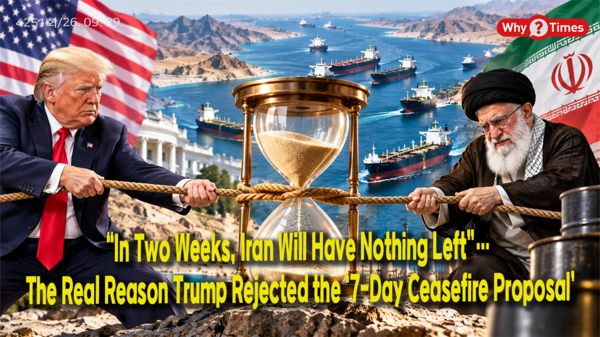
[Bessent’s ‘Two-Week Deadline’… “Nothing Left After That”]
Iran presented America with a ‘7-day’ timeline, but Trump chose to wait out a ‘2-week’ deadline instead. Tehran offered a proposal to reopen the Strait of Hormuz in a week if the U.S. lifted its naval blockade and oil sanctions, but U.S. President Donald Trump rejected the offer. The very next day, U.S. Treasury Secretary Scott Bessent asserted that “there are only about 15 million barrels of Iranian oil left on the water, and once the final volume passes to China in about two weeks, there will be nothing left to trade.” Combined with a significant recovery in oil flow through Hormuz, Washington sees no reason to rush into concessions with Iran. Why is Iran in a hurry, and why is Trump holding out? The core of the current U.S.-Iran termination negotiations lies precisely in this ‘battle against time.’
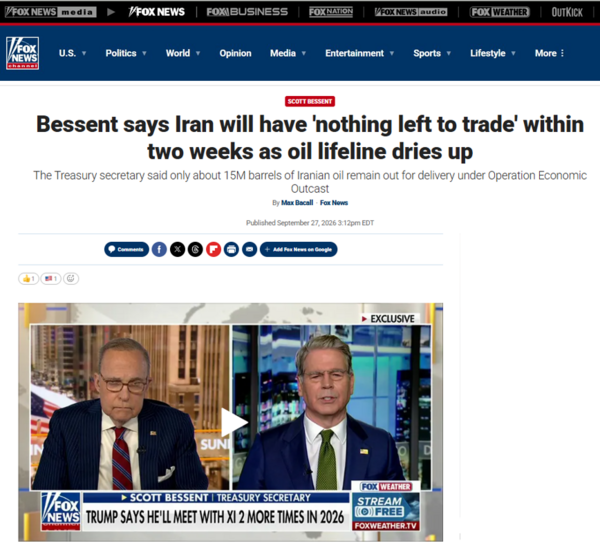
A decisive statement explaining why President Trump rejected Iran’s ‘7-day ceasefire proposal’ emerged recently. On Sunday, U.S. Treasury Secretary Scott Bessent stated that “there are currently only about 15 million barrels of Iranian oil en route to China on the water, and once these volumes reach final delivery in about two weeks, Iran will have nothing left to trade.” He added that it is precisely this pressure that is driving Iran to seek a deal.
This statement carries weight beyond a simple economic forecast, effectively laying bare why the Trump administration is in no rush to negotiate. According to Washington’s calculations, maintaining pressure is far more advantageous for the U.S. than accepting Iran’s conditions now. The strategy is to further squeeze Iran’s primary source of foreign currency—oil exports—before sitting down at the bargaining table, thereby demanding much larger concessions. Bessent himself noted that Iran is currently “feeling the squeeze,” citing it as the reason Tehran desires an agreement.
However, Bessent’s ‘two-week’ remark does not imply that the Iranian economy will experience an immediate total collapse in exactly two weeks. The 15 million barrels represent an administration estimate of oil already loaded and currently in transit. Nor does it mean that Iran’s oil production capability will vanish entirely. Stated accurately, it reflects the U.S. assessment that maintaining pressure for roughly two more weeks will significantly weaken Iran’s ability to generate foreign exchange through oil exports far beyond current levels.
What matters most, however, is not just whether Bessent’s forecast materializes precisely as predicted, but the strategic ledger President Trump is operating from during negotiations. Bessent explained that the administration’s “Operation Economic Outcast” aims to isolate Iran from the global economy, stating that the objective of any forthcoming agreement is to create an environment where Iran has no choice but to comply. At minimum, the Trump administration currently assesses that “time is on America’s side.”
[Why Trump Kicked Away Iran’s ‘7-Day’ Proposal]
At this precise juncture, Iran presented an antithetical timeline. Iranian Foreign Minister Abbas Araghchi conveyed a 7-day termination roadmap to the U.S. through Qatari mediation. The concept was for the U.S. to lift naval blockades, waive oil sanctions, and unfreeze frozen Iranian assets, after which Iran would reopen the Strait of Hormuz on the seventh day and initiate full-scale negotiations, including on the nuclear issue. Reports indicate the frozen assets total at least $12 billion.
The issue was the sequence of events. Iran’s position is that the U.S. must first relinquish its primary leverage tools—the blockade and sanctions—before it reopens Hormuz and negotiates nuclear matters. Conversely, the U.S. insists that core issues, including nuclear capabilities, must be treated as a single package from the outset. Analysts observe that because the Trump administration assesses its naval blockade and enhanced sanctions to be yielding results, it lacks strong incentive to revert to the structure of previous agreements.
Trump ultimately rejected Iran’s offer. According to Bessent, Trump evaluated that “Iran overplayed their hand.” Yet Trump simultaneously noted, “I expect further talks with Iran this week.” This signals not a complete destruction of the negotiating table, but rather a stance of “we will not settle under current conditions.”
Juxtaposing Bessent’s ‘2 weeks’ with Iran’s ‘7 days’ makes Trump’s calculus clear. Iran demanded America pay a price within 7 days, but the U.S. believes waiting two more weeks will shift the entire negotiating table decisively in its favor.
[Yet the Dynamics in the Strait of Hormuz Have Shifted]
There is another backdrop to why the U.S. is not rushing negotiations. Washington assesses that the economic weight of the Strait of Hormuz—Iran’s most potent leverage card—is changing compared to the early stages of the conflict.
Bessent claimed that, excluding Iranian crude, an average of 15 to 22 million barrels per day are currently passing through Hormuz, compared to roughly 20 million barrels prior to the conflict. He noted that “with U.S. support, over 1 billion barrels of crude have transited out of the strait so far,” framing it as “over 1 billion barrels for the U.S., 0 for Iran.” While these figures represent U.S. government tallies and may differ from private shipping industry estimates, they clearly demonstrate how Washington views the current situation in Hormuz.
Indeed, operational analyses point out that “differing perceptions of Hormuz between the U.S. and Iran are central to negotiations.” Iran views control over Hormuz as crucial leverage to force an end to the conflict, but the U.S. refuses to recognize Iran’s exclusive control over the strait. Ultimately, the dynamic pits Iran demanding “pay a price and we will reopen the strait” against the U.S. countering that “reopening the strait alone is insufficient.”
That said, it is premature to conclude that Iran has lost all operational leverage over Hormuz. Transit risks remain, and normal commercial shipping has not fully recovered. However, to the extent the U.S. assesses it can maintain a viable level of oil flow, the price Iran can demand in exchange for reopening Hormuz inevitably drops. In short, Iran still holds the Hormuz card, but Washington’s valuation of that card is steadily declining.
[Iran’s ‘7 Days’, America’s ‘2 Weeks’]
Viewed this way, the structure of current negotiations becomes even clearer. Iran put a 7-day schedule on the table, offering to reopen Hormuz a week after the U.S. first lifts blockades and sanctions. America, however, is eyeing a 2-week timeline. By Bessent’s math, applying pressure a little longer will exhaust remaining Iranian oil shipments bound for China, further eroding Tehran’s negotiating power.
Expert analyses from late September align with this assessment, suggesting it is highly probable Trump believes maintaining economic sanctions will extract larger concessions from Iran. However, analysts also warn that if the U.S. maintains pressure too long, it risks hardening Iran’s position or losing the window for negotiation altogether.
Therefore, rather than concluding that “an Iranian surrender is imminent,” it is more accurate to state that “Washington assesses the urgency has shifted from America to Iran.” That precise assessment forms the rationale allowing Trump to reject Iran’s proposal and sustain pressure.
[Why Times Insight: ‘7 Days, 2 Weeks, November 3’: Three Clocks Are Ticking]
Summarizing current U.S.-Iran negotiations in a single sentence: “Washington assesses that the sense of urgency has flipped.” In the early stages of the war, Hormuz was a powerful card Iran could wield against the global economy. Now, however, the U.S. claims crude oil flows have substantially recovered, while viewing Iran’s oil export capacity as rapidly narrowing under sanctions and blockade. This is the context enabling statements that “nothing will be left in two weeks.”
Thus, three clocks are ticking simultaneously at the negotiation table:
Iran’s ‘7 Days’: A timeline proposing to reopen Hormuz one week after the U.S. lifts blockades and sanctions.
Bessent’s ‘2 Weeks’: A calculation that holding out a bit longer will deplete remaining Chinese-bound Iranian crude, further degrading Tehran’s leverage.
America’s ‘November 3’: A clock that applies reverse pressure on Trump, as a prolonged war and sustained high energy prices increase political burdens for the Republican party.
Ultimately, Trump’s rejection is less an end to peace talks and more a declaration of “we won’t buy at this price.” Iran demands an end to blockades and sanctions in exchange for opening Hormuz, while the U.S. assesses that maintaining current pressure will yield far greater concessions on nuclear and security issues. Whether Iran will actually make additional concessions or whether economic pressure will instead provoke a hardline backlash remains to be seen.
Iran’s ‘7 days’, Bessent’s ‘2 weeks’, and America’s ‘November 3’. The trajectory of U.S.-Iran negotiations will ultimately depend on which of these three clocks runs out first.
- TAG