


추부길 whytimespen1@gmail.com
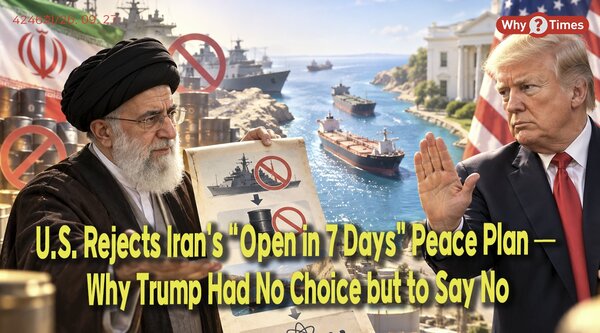
[“U.S. Must Act First”… The Core of the 7-Day Proposal]
Iran has proposed a so-called “7-day roadmap” to the United States to end the war, but President Donald Trump rejected it. The crux of the problem lies in the sequencing. Instead of reopening the Strait of Hormuz first, Tehran demanded that Washington immediately lift its naval blockade and crude oil sanctions. Only then, Iran claimed, would it reopen the strait and enter nuclear negotiations. At the same time, however, a senior Iranian official stated that Tehran has no intention of making concessions on its nuclear program. Because this framework forces Washington to surrender its primary leverage first and wait for Iran’s subsequent compliance, analysts note that the offer was fundamentally unacceptable to Washington.
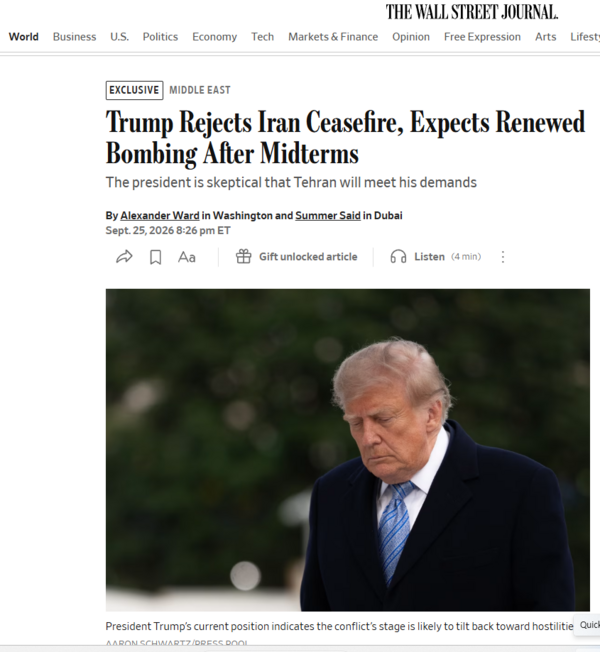
Quoting U.S. officials, The Wall Street Journal (WSJ) reported in an exclusive that President Trump did not accept Iran’s 7-day ceasefire proposal. He reportedly told aides that he expects to resume bombing runs against Iran following the November midterm elections.
Tehran’s proposal is not a simple promise to "reopen Hormuz in seven days". Foreign Minister Abbas Araghchi explained that "if the U.S. accepts the necessary conditions, a 7-day implementation process will begin the following day, and the Strait of Hormuz will reopen on the final day". Iran's plan mandates that Washington first lift its maritime blockade, ease sanctions on oil, and unfreeze Iranian assets, deferring substantive negotiations over Iran's nuclear program until after the strait is opened.
[From the U.S. Perspective: A Demand to 'Surrender Leverage First']
This very sequencing presents the single largest obstacle to negotiations. Currently, the most potent leverage the U.S. holds over Iran consists of its naval blockade and economic sanctions. Under Tehran’s plan, Washington would be forced to dismantle these pressure mechanisms first, relying purely on trust that Iran would reopen the strait a week later. Conversely, Washington demands that core issues—including the nuclear program—be addressed comprehensively from the outset. Ultimately, the stalemate is less about whether to agree to a ceasefire and more about who must lay down their primary bargaining chip first.
This dynamic also removes any incentive for Washington to rush concessions. The U.S. assesses that the naval blockade and economic sanctions are exerting severe strain on the Iranian economy. Indeed, President Trump reinforced his stance during his address at the UN General Assembly, emphasizing that Iran must be further isolated economically. Believing that current pressures are working, Washington sees no reason to lift the blockade prematurely and compromise its negotiating power.
[The Decisive Blow: “No Concessions on Nuclear Issues”]
Even more decisive were the statements regarding the nuclear program coming directly out of Tehran. On September 25, Reuters quoted a senior Iranian official as saying that "even if the U.S. accepts the proposal to reopen Hormuz, Iran will show no flexibility regarding its nuclear program". The official added that "Hormuz will remain closed until the U.S. fully satisfies all of Iran's demands".
This statement captures the core reason why the Trump administration cannot accept Iran's proposal. A overarching priority repeatedly cited by Trump throughout this conflict has been preventing Iran from acquiring nuclear weapons. Yet Iran demanded that the U.S. remove blockades and sanctions while explicitly refusing to compromise on the nuclear issue—the very matter Washington deems paramount. For the U.S., accepting this scheme would mean forfeiting its main leverage only to start an even harder negotiation completely from scratch.
[Trump Already Doubts Iran’s Willingness to Execute]
According to the WSJ, while President Trump publicly maintains that Iran will eventually be driven to make a deal, he remains privately skeptical about whether Tehran would ever fulfill his conditions in good faith. At the UN General Assembly, Trump insisted that his approach to Iran is driven strictly by the imperative to prevent a nuclear-armed Tehran, rather than by midterm election politics. At the same time, he laid out stark choices publicly, stating that Iran must decide whether to embark on a path toward rebuilding through an agreement or face vastly escalated military actions.
[Pressure Moves Beyond the Sea: Squeezing the Skies]
While negotiations remain deadlocked, U.S. pressure continues to broaden. On September 8, under the banner of "Operation Economic Outcast," the U.S. Department of the Treasury imposed sanctions on 36 entities and individuals that aided Iran’s aviation sector. The Treasury asserted that Iran's civil aviation network was being used to transport weapons, personnel, and illicit cargo, targeting foreign intermediaries and indirect procurement channels.
As a result, international routes for Iranian carriers are rapidly shrinking. The WSJ reported that flight cancellations, alongside restrictions on refueling and ground handling services for Iranian aircraft, are mounting across Azerbaijan, Iraq, Georgia, Turkey, and Oman. Although China and Russia continue to accept Iranian flights—meaning total isolation has not yet been achieved—the simultaneous targeting of aviation alongside naval routes places a heavy new burden on Iran's economy.
[Even the UAE Cuts Off Iranian Flights]
The movement of the UAE is particularly significant. Al Jazeera reported that "citing new U.S. sanctions, the UAE General Civil Aviation Authority announced the suspension of flights operated by Iranian airlines to and from the UAE". Given that the UAE has long served as one of Iran's vital gateways to the global economy, this move carries weight far beyond a mere reduction in flight frequencies.
According to Reuters, shifts are also appearing in Turkey’s financial network. Turkey's banking regulator revoked the operating license of Bank Mellat's Istanbul branch. While Reuters noted that the official decision did not explicitly cite U.S. pressure, analysts pointed out that the action coincided with Washington’s heightened demands for international partners to intensify economic pressure on Iran.
[WSJ: “U.S. Pressure Campaign Aims to Sever Iran from the World”]
On September 26, the WSJ published a further exclusive detailing how U.S. Treasury officials are traveling across the Middle East and Europe. Their mission is to pressure governments to dismantle remaining aviation and financial links with Iran, advancing a deliberate campaign to sever Tehran from global financial and transit networks. The WSJ reported that under this pressure, several regional governments are actively trimming their aviation and banking ties with Tehran.
This dynamic poses a severe threat to Iran. Historically, despite protracted Western sanctions, Iran managed to maintain external connectivity by utilizing overland, air, and banking networks in neighboring countries alongside ties with China and Russia. However, with maritime blockades now compounded by tightening air and financial chokepoints, the cost of evading sanctions will skyrocket. While it may be premature to describe Iran as "completely cut off from the world," Washington's strategy to systematically peel Tehran away from the global economy is becoming unmistakably clear.
[Tehran’s Defiant Answer: “No Concessions on Nuclear”]
The critical issue is the message emerging from Tehran at this exact juncture. While President Masoud Pezeshkian seeks a diplomatic exit before the U.S. midterms, hardliners are asserting that nuclear concessions remain completely off the table. The senior Iranian official quoted by Reuters underscored that "even if the U.S. accepts the Hormuz proposal, Iran will display zero flexibility on the nuclear issue".
If Tehran maintains this posture, Washington has no incentive whatsoever to accept the 7-day plan. It would require the U.S. to lift its naval blockade and economic sanctions first, wait for the opening of Hormuz, and then attempt to restart nuclear talks from square one. Ultimately, the hardline insistence on refusing nuclear compromises stems from a miscalculated belief that Tehran holds the upper hand—a stance that ultimately grants the U.S. further justification for military action.
[Eyes Turn to the Post-November 3 Horizon]
Attention now converges on November 3, the date of the U.S. midterm elections. According to U.S. officials cited by the WSJ, Trump explicitly informed his team that he expects to resume strikes on Iran following the elections. From Tehran's perspective, time is by no means on its side. As the naval blockade persists and aviation and financial pathways are increasingly squeezed, Washington appears content to wait until Iran offers real nuclear concessions.
Iran, for its part, remains reluctant to yield its final major bargaining chip: control over the Strait of Hormuz. Over the coming weeks, the decisive watershed will be whether Tehran chooses to put meaningful proposals on the table first or risks prolonged economic isolation that culminates in renewed military confrontation after November.
[Why Times Insight]
The most critical takeaway from these negotiations is not the "7 days" timeframe itself, but rather the issues of sequencing and trust. Iran proposed that the U.S. first dismantle its core pressure tools—the naval blockade and economic sanctions—before Tehran reopens Hormuz and transitions to nuclear talks. The U.S., conversely, demands a comprehensive settlement addressing core issues, including the nuclear program, from the beginning. Overriding all of this is Washington's deep distrust of Iran.
For the U.S., accepting Iran’s proposal as written would mean abandoning its most effective leverage upfront while waiting and hoping for Iranian compliance. Compounded by senior Iranian statements refusing nuclear concessions, the Trump administration has no reason to accept the offer under these terms.
Furthermore, Washington can intensify pressure even as it waits. Measures that began at sea have expanded into aviation and finance, producing concrete shifts in key economic conduits like the UAE and Turkey. While channels through China and Russia remain open, the accurate description is not "complete isolation," but rather a "rapidly tightening vise".
The choices facing Tehran grow harder by the day. The core question is whether it will open Hormuz first to create diplomatic space on the nuclear front, or attempt to hold out while demanding preemptive U.S. sanction relief. If Tehran chooses the latter, it remains to be seen how long it can endure sanctions expanding across sea, air, and finance. Crucially, whether pragmatic negotiators can overcome domestic hardliners will determine Iran's ultimate trajectory. The clock ticking down to November 3 is not just an American political timeline—it is a deadline requiring Iran to choose between meaningful negotiation and prolonged, escalating conflict.
- TAG