


추부길 whytimespen1@gmail.com
[The Red Carpet Was Lavish, but There Was No Joint Accord]
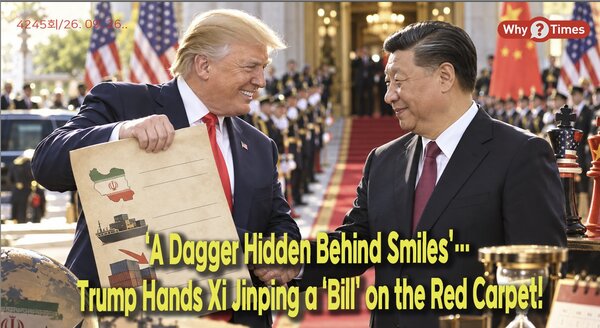
U.S. President Donald Trump welcomed Chinese President Xi Jinping with lavish protocol during a three-day visit, yet drew a firm line at the summit table regarding assistance to Iran and the implementation of trade agreements. Instead of a declaration ending the trade war, what emerged was merely a two-month extension of the truce. The two nations issued neither a joint press conference nor a comprehensive joint statement. Behind the broad smiles, the unresolved balance sheet between the U.S. and China remained squarely intact.
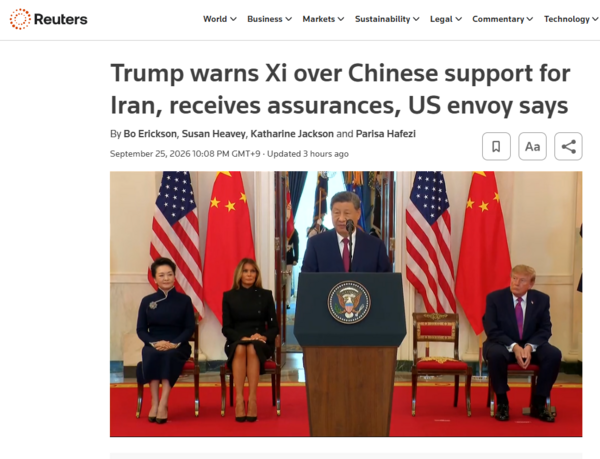
Reuters reported on September 26 (local time) that "Chinese President Xi Jinping and First Lady Peng Liyuan departed for home after concluding a three-day state visit to the United States—Xi's first state visit to the U.S. in 11 years since 2015." The outlet noted, "President Trump took the unusual step of greeting President Xi directly upon his arrival at Joint Base Andrews. Yet, once the dazzling scenes are stripped away, the underlying reality looks quite different."
Reuters further evaluated that "the summit was high on symbolism but light on substance," adding that "there are no signs of breakthroughs on core issues such as AI, trade, Taiwan, or the Iran conflict." From the outset, both sides were expected to release separate statements highlighting content meant for their respective domestic audiences, rather than issuing a joint press conference or statement.
President Trump offered a different assessment. After concluding his final schedule with President Xi, he stated that "tremendous progress was made" and that "this visit was extremely positive for both countries." President Xi also emphasized, "We have two more opportunities to meet before the year is out." Ultimately, the significance of this summit lies less in a single major agreement and more in maintaining the structural framework of head-of-state negotiations without letting U.S.-China relations plunge into catastrophe.
[The First Bill on the Closed-Door Table: Iran]
Following the summit, details of highly sensitive conversations exchanged behind closed doors were revealed by the American side. David Perdue, the U.S. Ambassador to China, stated in a CNBC interview on September 25 that "President Trump directly warned Xi Jinping regarding China’s support for Iran." According to Perdue, the U.S. had previously communicated its position that support for Iran—whether direct or indirect, including intelligence, components, or military equipment—is "completely unacceptable," and President Trump reiterated this clearly during the summit. Reuters, Axios, and the New York Post reported on this successively.
One point warrants particular attention: the U.S. explicitly stated that it "will not trade the Iran issue for the Taiwan issue." Ambassador Perdue clarified that "the Iran issue is a separate matter that is not tied to other ongoing U.S. priorities or commitments regarding Taiwan." This statement carries considerable weight, especially given Reuters' report just prior to the summit suggesting that President Xi was expected to demand a halt to U.S. arms sales to Taiwan, citing the 1982 U.S.-China Joint Communiqué.
According to U.S. accounts, China demonstrated a degree of responsiveness. Ambassador Perdue claimed, "We saw evidence that they listened to us," adding that "China has pulled back some of its support." However, he did not disclose specifically which support or activities China had halted. When asked whether China had indirectly aided Iran in maintaining a blockade of the Strait of Hormuz, he conceded, "The U.S. suspects as much, but there is no direct evidence."
[Yet, Trump's Warning Was Missing from the Chinese Announcement]
What is intriguing is the official summary released by the Chinese side following the summit. The Chinese government's statement noted that "Xi Jinping told Trump that the U.S. and Iran should return to the track of resolving issues through dialogue and negotiation." President Xi expressed hope that "the U.S. and Iran would return to the Islamabad Memorandum of Understanding to reach a comprehensive agreement, including on nuclear issues." However, President Trump’s warning that "China’s support for Iran is unacceptable"—as disclosed by the U.S.—was nowhere to be found in the Chinese release.
In effect, Washington and Beijing held the same summit yet publicly emphasized entirely different aspects. The U.S. highlighted its "red line" of blocking Chinese support to Iran, while China stressed the resumption of negotiations between the U.S. and Iran. This stark contrast serves as a defining scene illustrating the true nature of this summit.
[Why Did Trump Raise the Iran Issue with China?]
The U.S. is sensitive to this matter because China’s cooperation is vital to cutting off economic and technical support to Iran. U.S. officials are particularly concerned that Iran recently acquired the capability to track and target U.S. military bases in the Middle East as well as U.S. Navy vessels in the Gulf and the Arabian Sea using high-resolution imagery obtained from Chinese commercial satellites, according to Axios. Consequently, the U.S. has reportedly modified some of its naval operational procedures to make it harder for Iran to pinpoint the locations of U.S. warships.
Ultimately, Trump's demand is accurately viewed not as an ultimatum for China to sever ties with Iran completely, but rather as a explicit warning not to cross the line by providing intelligence, components, or military equipment that could bolster Iran's capabilities in a military clash with the United States.
[The Second Bill: A ‘Two-Month’ Trade Truce]
A complete settlement was not reached in the economic sphere either. The U.S. and China agreed to extend their trade truce—which was set to expire on November 10—by a mere two months, pushing the new deadline to January 10, 2027. U.S. Treasury Secretary Scott Bessent explained, "We extended the Busan agreement to give both nations time to seek a broader economic arrangement."
The crucial issue remains China's implementation of its existing commitments. AP reported that "an assessment conducted in May ahead of this summit revealed mixed progress regarding China's purchases of U.S. agricultural products and Boeing aircraft, as well as the establishment of trade and investment consultation bodies." Concerns have been raised that Chinese purchases of U.S. agricultural goods may fall short of original promises, while orders for Boeing aircraft have yet to materialize.
[November in China, December in the U.S. ... Two More Meetings Ahead]
On the final day, President Xi personally disclosed a significant schedule. He informed President Trump that "there are two more opportunities for the two leaders to meet again within this year." The first will be at the APEC Summit in China in November, followed by the G20 Summit in the U.S. in December. AP similarly reported that "Xi Jinping anticipates two additional summits before the end of the year."
When mapped alongside the trade truce expiration date of January 10, 2027, the timeline aligns in a striking sequence: September in Washington → November in China → December in the U.S. → January 10 trade truce expiration. Therefore, what matters moving forward is not the rhetoric used by the two leaders at this summit, but how effectively existing agreements regarding economic issues—such as rare earths and agricultural products—are implemented, and how the U.S. responds to those outcomes. This Washington summit marks less of a final destination and more of a starting point for ongoing U.S.-China negotiations through the end of the year.
[The Final Schedule Was Set at the 'Vault of American Democracy']
One of the most symbolic moments of this state visit occurred on its final day. President Trump escorted Xi Jinping to the National Archives in Washington, D.C., where the original copies of the U.S. Declaration of Independence, the Constitution, and the Bill of Rights are preserved. AP reported that Xi visited the National Archives to view the Constitution in person on the final day of his U.S. trip.
The symbolism of this location is unmistakable. The sight of the top leader of the Chinese Communist Party standing alongside the U.S. President before the Declaration of Independence, the Constitution, and the Bill of Rights during the grand finale of a state visit is diplomatically extraordinary. Notably, just prior to the summit, the U.S. Commission on International Religious Freedom (USCIRF) publicly urged President Trump to directly raise China’s religious freedom record during his meeting with Xi.
[Xi Jinping in a Mao Suit: Divergent Messages from Washington and Beijing]
President Xi made no effort to conceal his political identity. Rather than wearing a Western-style tuxedo, President Xi arrived at the state dinner wearing a black Mao suit (Zhongshan suit). While the suit traces its origins to Sun Yat-sen, its political symbolism was heavily reinforced during the Mao Zedong era; today, Chinese leaders wear it primarily at events of profound historical or political importance, such as party functions or military parades.
The state dinner itself was orchestrated with deep symbolic intent. The American hosts selected a sparkling wine from the same winery served during President Nixon’s historic 1972 visit to China, while Xi Jinping invoked "Ping-Pong Diplomacy" and WWII-era Sino-American cooperation. Both sides sought to highlight a history of collaboration rather than confrontation.
[Why Times Insight: The 'Two Months' Matter More Than the Red Carpet]
When assessing this U.S.-China summit, closest attention should be paid not to the lavish diplomacy, but to the issues the two nations ultimately failed to resolve. President Trump accorded President Xi extraordinary state honors—greeting him personally at the airport, hosting a White House state dinner, and concluding with a joint visit to the National Archives housing the Declaration of Independence and the Constitution.
At the negotiating table, however, a very different posture emerged. Trump drew an uncompromising line against Chinese assistance to Iran, declaring it "unacceptable." On trade, instead of a comprehensive breakthrough, only a fleeting two-month truce extension materialized. Issues surrounding rare earths, agricultural products, high technology, and Taiwan remain unresolved. This background explains why Reuters characterized the summit as one defined by prominent symbolism yet constrained in terms of substantive breakthroughs.
Thus, the single most critical figure representing this summit may well be "two months." Had a complete consensus been reached, a two-month extension would have been unnecessary. Conversely, had negotiations collapsed entirely, there would have been no reason to extend the truce at all.
In the end, what concluded in Washington was not the U.S.-China negotiations, but merely the opening act. Both sides have been granted two additional months to negotiate. November in China, December in the U.S., and January 10, 2027. What remains to be seen is not how brightly the two leaders smiled on the red carpet, but how faithfully the demands and commitments exchanged at this summit are executed in practice.
In that light, if this U.S.-China summit were to be distilled into a single sentence, it would be this:
“The smiles were dazzling, but the bill remained unpaid.”
- TAG