


추부길 whytimespen1@gmail.com
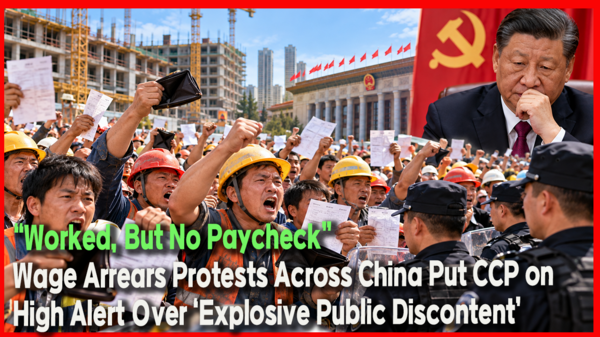
[“Give Us Back Our Blood and Sweat Money”… Workers Take to the Streets]
China’s economic crisis is moving beyond statistical indicators like real estate prices, consumption, and investment, penetrating directly into workers’ paychecks. Ahead of the Mid-Autumn Festival and National Day holidays, collective protests by workers demanding unpaid wages erupted in succession in places like Chengdu (Sichuan Province), Zhengzhou (Henan Province), and Yulin (Guangxi Zhuang Autonomous Region). Construction sites tied even to subsidiaries of central state-owned enterprises (SOEs) have been swept into wage arrears controversies.
Even more noteworthy is the response from the Chinese Communist Party (CCP). The Central Party School—the party's top-tier training institution for high-ranking cadres and its premier official think tank—issued a stern warning regarding these wage arrears protests by the Chinese public through its official organ, the Study Times.

On September 18, the Central Party School’s official publication, Study Times, defined negative public opinion spreading across various social strata as "an explosive point for social contradictions and a high-risk zone for social security," urging governments at all levels to "strengthen their public opinion response capabilities." The article further noted that "if livelihood-driven anger over working without pay combines with other social grievances, there is a risk that the economic crisis could shift from statistics to the streets, and ultimately into a social stability issue." This highlights that the CCP leadership itself is closely watching and remaining vigilant against the various protests taking place across China.
Taiwan’s Newtalk newspaper reported that one of the most recently disclosed protest cases inside China occurred in Chengdu, Sichuan Province. According to videos on local social media, construction workers who participated in the 'Longfor 3000 Sets (龍湖·三千集)' commercial complex project in Chenghua District, Chengdu, staged a collective protest demanding unpaid wages. Allegations surfaced that the developer and contractor, Qingruijiang Decoration, failed to pay the wages of around 80 workers, prompting the workers to gather at the company premises and sit near the entrance demanding a solution.
Newtalk further reported that on the same day, protests by workers demanding back pay were also reported in Longtan Industrial Park, Bobai County, Yulin City, Guangxi Zhuang Autonomous Region. Published videos showed workers holding banners that read, "Give Us Back Our Blood and Sweat Money (還我血汗錢)." Newtalk noted that seven workers completed rust removal, painting, and fireproof coating work but were left unpaid for over 500,000 yuan, with the arrears spanning nearly five years.
According to Newtalk, an even more eye-opening incident occurred two days earlier, in Zhengzhou, Henan Province. Video footage was released showing workers visiting China Railway Seventh Group Zhengzhou Engineering Co., Ltd., demanding the payout of delinquent wages. China Railway Seventh Group is a subsidiary of China Railway Group Limited (CREC), a prominent central state-owned enterprise. While wage claims at individual sites do not necessarily mean liquidity issues for CREC as a whole, it is noteworthy that wage arrear controversies have extended beyond small private firms into construction sites operated by central SOE subsidiaries.
[A Few Coincidental Cases?… The Numbers Have Already Changed]
The problem is that these scenes can hardly be viewed as isolated, accidental occurrences confined to a few regions. According to Freedom House's 'China Dissent Monitor (CDM)', a total of 5,343 protest incidents were documented in China, marking a 44% increase from 3,704 incidents. Notably, workers led 54% of all protest events. Guangdong recorded the highest number of protests, followed by Henan, Hunan, Shaanxi, and Zhejiang.
Wage arrears stand as a primary driver of labor disputes. The China Dissent Monitor analyzed that labor protests related to unpaid wages surged by 60% compared to the same period the previous year during the four months leading up to Lunar New Year. While collective actions demanding back pay ahead of major holidays are not a new phenomenon in China, the scale of publicly observable incidents has increased substantially.
Livelihood-driven protests involving labor, real estate, and land have continued. The China Dissent Monitor noted that it recorded 846 protest incidents, with homeowners and homebuyers accounting for 36%, workers for 24%, and rural residents for 18%. However, CDM explained that due to the Chinese authorities' tightened online censorship, the number of publicly captured incidents itself may have decreased. Therefore, it is accurate to view these figures not as an exhaustive census of all protests occurring in China, but as an indicator showing trends among publicly verified incidents.
[Why Are Paychecks Delayed?… ‘Circulatory Blockage’ in the Chinese Economy]
Why are wage issues resurfacing so prominently right now? Recent Chinese economic indicators provide insight into the structural background. According to China's National Bureau of Statistics, industrial production increased by 5.2% year-on-year. However, retail sales growth dropped to just 0.4%, down from 0.6%, falling short of market expectations of 0.8%. While factories continue to produce, Chinese consumers' wallets remain firmly shut.
Wage arrears in the construction sector are particularly vulnerable to the real estate slump and the cash flow constraints of project owners and main contractors. When payments from developers or project owners are delayed, workers at the absolute bottom of the funding chain—stretching from general contractors to subcontractors, work crews, and migrant workers—bear the brunt of the impact.
[And on September 18, the Central Party School Issued an Unusual Warning]
Against this backdrop, a striking article appeared on the front page of the Central Party School's official organ, Study Times. The article was titled "Improving the Capacity for Public Opinion Guidance and Public Opinion Crisis Handling (提高輿論引導和輿情處置能力)," authored by Qin Lu (秦露), Deputy Director of the Department of Literature and History at the Central Party School / National Academy of Governance.
Study Times diagnosed that China's public opinion landscape is undergoing "profound changes," noting that "public opinion has become an explosive point for social contradictions and a high-risk zone for social security." It asserted that "responding to public opinion is no longer merely a task for propaganda departments or the media, but a crucial test of governance capacity for governments at all levels."
There were even more telling passages. Quoting Xi Jinping, the article emphasized that "if we cannot pass the hurdle of the internet, we cannot pass the hurdle of long-term governance." It further diagnosed that "large AI language models are reshaping values, image models are reshaping aesthetics, and video models are reshaping narrative structures," explaining that "new technologies and platforms are becoming critical variables in national governance and ideological security."
Study Times also pointed out that "when public incidents occur, public opinion should not simply be treated as 'a fire to extinguish' or 'a nuisance to dispose of'." It argued that "real livelihood issues must be addressed while simultaneously integrating public opinion guidance and management capabilities into the national governance framework." Therefore, rather than dismissing this article as a simple 'censorship enforcement guide,' it is more accurate to read it as a document illustrating how seriously the CCP leadership views the convergence of livelihood grievances and online public sentiment as a governance risk.
[What the CCP Fears Is Not Just ‘A Single Protest’]
An even more critical aspect is online dissemination. Freedom House tracked 2,970 protest-related posts published on Douyin (the Chinese version of TikTok), finding that roughly two-thirds were subsequently deleted. This indicates that due to information controls by authorities and platforms, it remains difficult for outside observers to precisely gauge the actual scale and spread of protests.
This is precisely where the political and social sensitivity of the wage arrears issue amplifies. If a worker in Chengdu watches a protest over unpaid wages in Zhengzhou, or a worker in Zhengzhou views a video of workers in Guangxi shouting "Give us back our blood and sweat money," localized economic disputes risk being perceived as part of a shared, systemic issue. The fact that Study Times highlighted platform algorithms, AI, and new information distribution channels while framing public opinion management as a matter of governance capacity can be directly linked to these shifts in the information environment.
[Why Times Insight]
The most critical takeaway from this situation is not the handful of wage arrears incidents themselves. It is that China's economic challenges are cascading down from macroeconomic domains—such as real estate prices, local government debt, and sluggish consumption and investment—directly into workers' most fundamental lifeline: their paychecks. With retail sales growth falling to 0.4%, fixed-asset investment contracting by 7.2%, and youth unemployment climbing to 18.9%, the simultaneous emergence of economic pressure and wage protests demands close attention.
A decline in real estate prices affects assets, and local government debt may feel distant to ordinary workers. However, working for a month or two without receiving pay directly threatens immediate survival—food, rent, and children's education. The fact that labor protests related to unpaid wages observed by the China Dissent Monitor jumped 60% year-on-year in the four months leading up to Lunar New Year demonstrates how these livelihood-driven conflicts can rapidly translate into collective action.
From the CCP's perspective, a far more sensitive issue than the sheer number of individual protests is the potential linking of anger across different regions. This does not mean that a nationwide unified movement has formed, but rather that digital platforms enable geographically separated, similar grievances to be shared rapidly. It is within this context that Study Times heavily focused on the internet, AI, and algorithms as governance challenges, describing public opinion as an "explosive point for social contradictions."
To be sure, the wage arrears protests documented so far remain localized, fragmented incidents. There is currently no solid basis to directly connect them to nationwide unrest or a regime crisis for the CCP. Furthermore, internal protest metrics in China suffer from inherent limitations due to censorship and restricted access to data, making exhaustive data collection impossible. What can be confirmed is that livelihood-driven protests persist on a substantial scale, and Chinese authorities clearly recognize the convergence of online sentiment and social conflict as a major threat to social stability.
Going forward, judging the Chinese economy solely through GDP growth rates, exports, or retail sales will be insufficient. How many more workers take to the streets demanding unpaid wages? And will scattered, livelihood-driven anger connect across regions via online channels? These will serve as key indicators determining whether China's economic hardships escalate into broader social instability.
- TAG