


추부길 whytimespen1@gmail.com
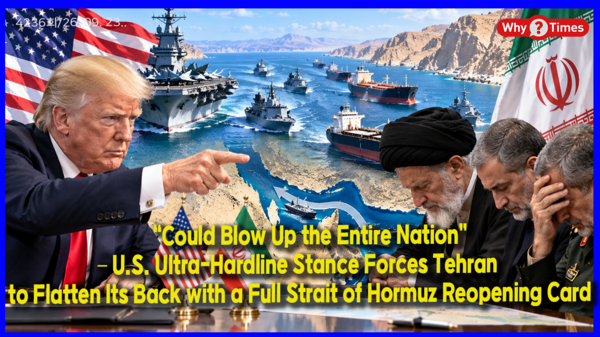
[The Strait of Hormuz Finally Placed on the Negotiating Table]
The geopolitical situation surrounding Iran is unfolding rapidly. Tehran, which had been loudly proclaiming a "decisive war," first transmitted its conditions for ending the war to the United States. Now, it has even brought its ultimate leverage card—the complete reopening of the Strait of Hormuz, which it had held onto until the very last moment—to the negotiating table.
Particularly striking is the fact that Iran proposed a concrete timetable, stating that it could reopen the Strait of Hormuz within just seven days if the U.S. eases its military pressure. Amid President Donald Trump's persistent and extreme warnings, this fuels observations that even Iranian hardliners—while outwardly calling for a fight to the death—have begun seeking an exit strategy to wrap up the conflict.
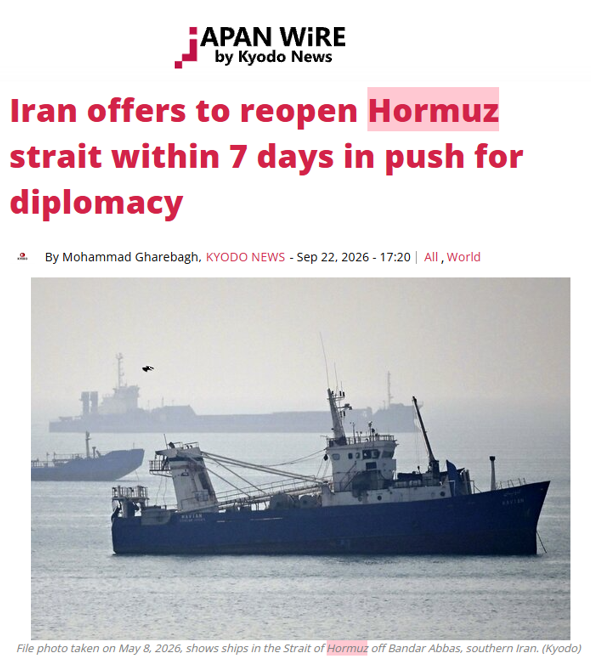
Japan’s Kyodo News reported on September 22 that "in a bid to revive the stalled end-of-war negotiations with the United States, Iran has proposed reopening the Strait of Hormuz within seven days on the condition that the U.S. eases its military pressure." It added that "a senior Iranian government official disclosed to Kyodo News that if the U.S. takes initial steps to reduce military pressure, Iran would reopen the Strait of Hormuz within a week."
Kyodo News further noted: "What is even more noteworthy is the claim that this proposal is not merely a public relations message." The news agency explained that "the official stated that the offer to reopen Hormuz had already been delivered to Washington via intermediaries, with the goal of restarting negotiations to permanently end hostilites between the U.S. and Iran. However, the speaker remained anonymous, and Anadolu Agency noted that it could not independently verify the statement."
[Why ‘Hormuz’ Is Far More Impactful Than the ‘7-Day’ Timeline]
The true weight of this proposal lies not in the "seven-day" timeframe, but in the card itself: reopening the Strait of Hormuz. Iran has long used Hormuz as a core lever to exert pressure on the United States and Gulf nations. Therefore, if the offer to reopen the strait—in exchange for mere initial steps by the U.S. to reduce military pressure—accurately reflects the true intentions of Tehran's leadership, it can be viewed as a significant shift in its posture toward negotiations.
What makes this even more remarkable is that just two days prior, public messages from Iran's leadership were vastly more aggressive. Mohammad Bagher Ghalibaf, Speaker of the Iranian Parliament, stated on September 20 that "Iran will not reopen Hormuz until its conditions are met and the U.S. fulfills its promises." He simultaneously emphasized that "Iran must negotiate while fighting."
Yet, a mere two days later, a concrete timetable of "reopening within seven days" emerged. Consequently, it is insufficient to view this move as a simple conciliatory gesture. If keeping Hormuz closed served as Iran's primary instrument of leverage, putting the timing of its reopening up for trade with the U.S. marks a fundamental shift.
[Rezaei Had Already Sent ‘End-of-War Conditions’ First]
In reality, signs of Tehran's shift began appearing several days ago. Mohsen Rezaei, Secretary of the Supreme National Security Council and a key figure in Iran's security policy, revealed in an Al Jazeera interview on September 19 that he had transmitted conditions for resuming talks and ending the war to the United States via Qatar, and was awaiting President Trump's response.
Rezaei's core conditions included an end to war across all fronts, the unfreezing of Iranian assets, and the termination of the maritime blockade. However, he simultaneously warned that "Trump's threats will yield no results" and that "Iran is also prepared for a 'decisive war'." In short, Tehran held a negotiation proposal in one hand while proclaiming a fight to the death with the other.
This is the key to interpreting Iran's current moves. While vocalizing a final battle, it is privately transmitting end-of-war conditions to Washington. And now, going one step further, it has begun offering Hormuz as a concrete bargaining chip.
[Is Ghalibaf’s Hardline Rhetoric Really a Contradictory Signal?]
Therefore, Ghalibaf’s remarks do not necessarily need to be interpreted as a message in direct conflict with the proposal to reopen Hormuz. Ghalibaf did not state that Iran would "never open Hormuz," but rather that it would not open it until Iran's conditions were met and the U.S. kept its promises. Furthermore, he explicitly maintained the stance of utilizing military force while negotiating.
Thus, simply concluding that 'negotiators and hardline fighters are clashing' within Tehran risks missing the bigger picture. One must consider the possibility of a two-track strategy: hardliners issue tough public messages to maintain regime dignity and bargaining power externally, while simultaneously seeking conditions to end the war through practical actions behind the scenes.
[Trump’s Ultra-Hardline Pressure Forced Even Hardliners to Bow Their Heads]
Why, then, has Iran begun to move on Hormuz at this specific juncture? The first factor to consider is President Trump’s recent rhetoric. In a phone interview with Fox News reporter Trey Yingst on September 20, Trump implied that he had entered "deciding mode on the Iran issue" and hinted that "a very big thing could happen soon."
The options outlined by Trump included military elimination, economic strangulation, and a deal. In particular, he issued a fierce warning aimed at Iran, stating: "The question is when to blow up the whole country. They better behave." For Iran, the risk that the U.S. is genuinely contemplating an expansion of military strikes is impossible to ignore. Trump's extreme pressure appears to have silenced even the hardline factions within Iran.
At the same time, Trump did not close the door on diplomacy entirely. He expressed openness to the possibility of meeting President Pezeshkian during the UN General Assembly. While no official meeting schedule has been announced, this represents a classic pressure tactic: maximizing military tension while leaving open the possibility of a deal.
[At That Very Moment, Pezeshkian Heads for New York]
Coincidentally, at this precise moment, President Pezeshkian departed for New York to attend the UN General Assembly. Prior to his departure, he stated his intention to strongly assert Iran's position on the international stage. The Wall Street Journal (WSJ) noted that "the Iranian president's visit to New York amidst an ongoing war presents a rare opportunity to directly explain his country's position to the international community."
According to Reuters, Trump’s public schedule in New York currently does not include a formal meeting with Pezeshkian. Thus, it is premature to conclude that a U.S.-Iran summit will take place. However, the fact that the Iranian president is in New York at the exact moment Tehran put forward the critical card of reopening Hormuz draws intense global focus toward potential indirect negotiations and follow-up proposals through mediator nations.
[Why Times Insight]
The most critical mistake in evaluating this situation would be to take the statements of Iranian hardliners at face value. Connecting the actions verified thus far shows that Tehran is sending two simultaneous signals: 'proclaiming a fight to the death in rhetoric, while seeking an exit strategy in action.' Rezaei spoke of a decisive war while transmitting end-of-war conditions to the U.S. Ghalibaf warned that Hormuz would not open while simultaneously stating that Iran must 'negotiate while fighting.' And now, a senior Iranian official has revealed that a concrete proposal—offering to reopen Hormuz within seven days if the U.S. reduces military pressure—has been delivered to Washington.
Therefore, rather than reading the aggressive rhetoric of hardliners as a outright rejection of negotiations, it should be examined as a tactical maneuver designed to avoid looking like a domestic surrender while extracting maximum concessions from the United States. In particular, placing a major leverage point like Hormuz on the table alongside a specific deadline is a signal of a fundamentally different order.
In short, the sequential rollout of bargaining chips from within Iranian hardline circles—and specifically abandoning the Hormuz card, which they regarded as their ultimate weapon—is virtually equivalent to a declaration that they will comply with U.S. conditions. This development sets the stage for significant potential progress.
The most crucial question now is what Iran will put on the table in New York following Hormuz. The key point to watch is whether the nuclear issue, the naval blockade, frozen assets, and regional pro-Iranian proxies can be wrapped into one massive comprehensive deal. Trump, too, maintains three simultaneous options on the table: military strikes, economic pressure, and negotiations.
Ultimately, the most important shift occurring in Iran today is not the rhetoric of "fighting to the death." It is the shift in action: transmitting end-of-war conditions to the U.S., awaiting Trump's response, and beginning to lay down the Hormuz card—the very last leverage piece it held—onto the negotiating table.
At that exact moment, Pezeshkian headed for New York. Whether he holds a bargaining card even larger than Hormuz, and whether Trump will accept it to open the door for a decisive deal or ramp up pressure another notch, renders this New York diplomatic showdown a major new turning point in the Iranian war.
- TAG