


추부길 whytimespen1@gmail.com

[Moscow Pierced on the Day of Putin’s ‘Victory Election’]
On the very day President Vladimir Putin sought to showcase public backing for his war through the State Duma elections, Moscow endured its largest Ukrainian air attack since the invasion began. Over 1,000 drones crossed into Russian airspace, igniting a major fire at a critical Moscow oil refinery. Crucially, Ukraine deployed a significant array of domestically designed drones and missiles, signalling a reduced reliance on Western-supplied arms. Having re-anchored his domestic political standing through a stage-managed election, Putin’s next moves against Ukraine and NATO present a pivotal wildcard.
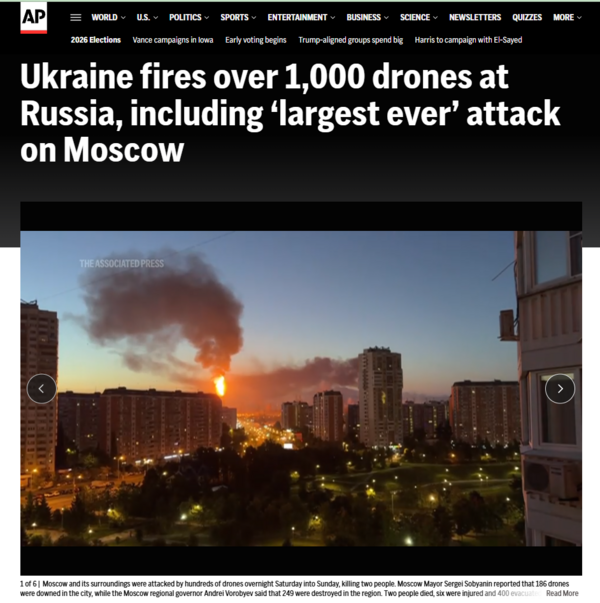
AP reported that the timing of Ukraine’s large-scale offensive carried deep symbolism. In the early hours of September 20, the final day of Russia's first parliamentary election since launching its full-scale invasion in 2022, waves of Ukrainian drones targeted Moscow and various other regions. This constituted the largest Ukrainian drone strike aimed at the capital since the war’s onset.
The Russian Defense Ministry claimed to have intercepted 1,110 drones across Russia and occupied territories. Moscow Mayor Sergei Sobyanin stated that air defense systems intercepted more than 1,600 drones overnight, with 450 approaching Moscow. Even accounting for official Russian reporting, the scale of the strike is unprecedented.
Reuters noted that several drones breached defenses to strike targets, causing a massive blaze at Gazprom Neft’s Kapotnya refinery in southeastern Moscow. Processing roughly 11.6 million tons of crude in 2024, this facility is vital to Russia’s refined fuel supply, demonstrating Kyiv’s intent to strike at Russia’s warfighting sustainability, fuel logistics, and fiscal baseline simultaneously.
[The Most Alarming Shift: ‘Ukrainian-Made Weapons’]
Beyond the sheer volume, the origins of the weaponry mark a critical tactical evolution. Early in the conflict, Ukraine depended almost entirely on long-range systems provided by the US and Europe to hit deep targets within Russian territory. President Volodymyr Zelensky, however, confirmed that indigenous weapon systems, including the FP-1 and Flamingo, were deployed in this strike. AP corroborated that domestically produced drones and missiles were utilized in the operation.
Prominent among these systems are Fire Point’s FP-5 'Flamingo' cruise missile and FP-7. A clear distinction must be drawn between the two. Official specifications indicate the FP-7 is a ground-launched ballistic missile carrying up to a 150 kg warhead over a range of up to 200 km, making it unsuited for direct long-range strikes against Moscow from deep within Ukrainian territory.
Conversely, the FP-5 'Flamingo' is a heavy cruise missile featuring a range of up to 3,000 km and a warhead payload of up to 1,150 kg. The New York Post reported a combined force structure incorporating Flamingo cruise missiles alongside shorter-range Pelican ballistic missiles and strike drones. The fundamental takeaway is not a single weapon platform, but Ukraine’s maturing capability to orchestrate multi-domain, composite strikes combining massed drones and varied missile vectors.
This capability shifts the operational dynamic. By saturating Russian air defenses with drone swarms, Ukraine can launch indigenous weapons with distinct speed and flight profiles simultaneously. The strategic question has evolved from "What weapons will the West supply?" to "How far into Russia can Ukraine strike using its own production lines?"
[Why Target Oil Refineries?]
Kyiv's strategic priority is degrading the energy and logistical infrastructure sustaining Russia's war effort. President Zelensky highlighted that the operation hit key oil and logistics infrastructure, while AP noted Kyiv's intent to exert both economic and military pressure through deep strikes.
Repeated hits on Russian refineries are causing localized fuel supply friction. Reuters reported that degraded refining capacity has triggered domestic fuel supply tightness across Russia. The Moscow refinery holds both symbolic and operational value given its direct role in supplying energy to the capital region.
According to AP, Kyiv also seeks to make the domestic Russian population feel the tangible costs of war. When refineries burn, residential areas face precautionary evacuations, and daily life in the capital is disrupted, the war ceases to be a distant conflict confined to Ukrainian soil. Imposing direct costs on the Russian public and political leadership remains a central objective of these deep-strike operations.
[Yet, on the Same Day, Putin Prepared His ‘Landslide Victory’]
Ironically, while Moscow faced aerial strikes, Putin’s domestic political grip was presented as stronger than ever. In early vote counting, the ruling United Russia party secured roughly 57.5% of the vote in the tightly controlled election process. Systemic opposition parties in parliament—such as the Communist Party, the LDPR, and New People—share the Kremlin's core policies regarding the war in Ukraine. Genuine anti-war political entities were either banned, dissolved, or barred from contesting. AP observed that the election proceeded with genuine opposition severely constrained due to arrests and exile of anti-war figures. Consequently, these election results cannot be equated with genuine societal consensus.
[What Matters Most: ‘The Day After the Election’]
Attention now turns to Putin’s post-election calculus. The Kremlin can frame the election outcome as a mandate for its military posture. The key question is how this political leverage will be utilized.
Warnings from European intelligence agencies highlight escalating risks. The Guardian reported that Baltic intelligence chiefs have warned Russia may engage in bolder tests of NATO's resolve in the coming months, utilizing limited provocations, drones, or hybrid gray-zone activities.
These assessments build on prior intelligence. The Guardian noted that in June, intelligence sources along NATO's eastern flank pointed to indications that Russia was evaluating military and hybrid maneuvers targeting Poland and the Baltic states, focusing on limited actions designed to test Alliance cohesion and US commitment rather than full-scale escalation.
[The Ball Now Moves to New York]
Following the strikes in Moscow, diplomatic momentum pivots to New York. President Zelensky confirmed plans to meet President Trump on the sidelines of the UN General Assembly after a recent phone call. Against the backdrop of recent US sanctions and weapons decisions, this bilateral meeting could shape upcoming negotiation dynamics.
The central friction point links directly to the Moscow strikes. According to Axios, President Trump requested during their call that President Zelensky cease strikes on Russian oil refineries, citing concerns over rising global diesel prices. Whether Ukraine will continue leveraging its deep-strike capabilities against Russian energy assets has emerged as a central point in US-Ukraine discussions.
The key dynamic for the New York talks is clear: Will Ukraine agree to restrict its long-range strike operations against the Russian homeland, or will it leverage these capabilities to extract concessions from Putin? Following the strikes on Moscow, this question carries added weight.
[Why Times Insight]
The primary takeaway from the Moscow strikes goes beyond raw drone tallies. Early in the war, Russia conducted unilateral deep strikes across Ukraine; today, Ukraine possesses scalable, indigenous long-range capabilities targeting Russian supply lines and energy infrastructure.
Domestically, Putin retains firm legislative control through elections held in an environment devoid of anti-war opposition. This creates a dual reality: rising conflict costs on Russian soil alongside reduced internal political checks.
The crucial factor moving forward is how the Kremlin applies its reinforced political leverage following the Duma elections. With European intelligence warning of potential hybrid tests against NATO, Russia's post-election posture warrants close attention.
The upcoming meeting between Trump and Zelensky in New York comes at a delicate moment. The Moscow strikes served both as a military operation and a demonstration of Ukraine’s indigenous strike capabilities prior to diplomacy. While Kyiv seeks to maximize leverage using its new systems, Moscow faces air defense pressures. Whether the New York talks lead toward energy-related de-escalation or continued strike exchanges will define the trajectory of the conflict this autumn.

- TAG