


추부길 whytimespen1@gmail.com
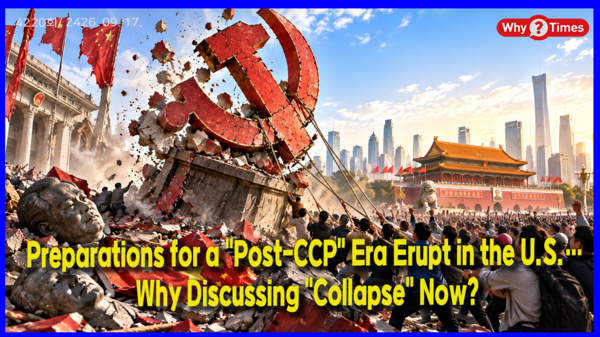
[“The Real Risk is Not CCP Success, But Sudden CCP Failure”]
Until just a few years ago, Washington worried about what to do if China surpassed the United States. Now, a strategist who directly participated in shaping U.S. China policy is publicly raising the exact opposite question: "Is the world prepared if the Chinese Communist Party suddenly collapses?"
This does not mean the fall of the Chinese Communist Party (CCP) is imminent. However, at a time when China's consumption, investment, and real estate downturns are prolonging, it is notable that Miles Yu (Yu Maochun), Director of the China Center at the Hudson Institute and former China policy advisor to the U.S. State Department, has publicly advocated for preparing for a "Post-CCP" era.
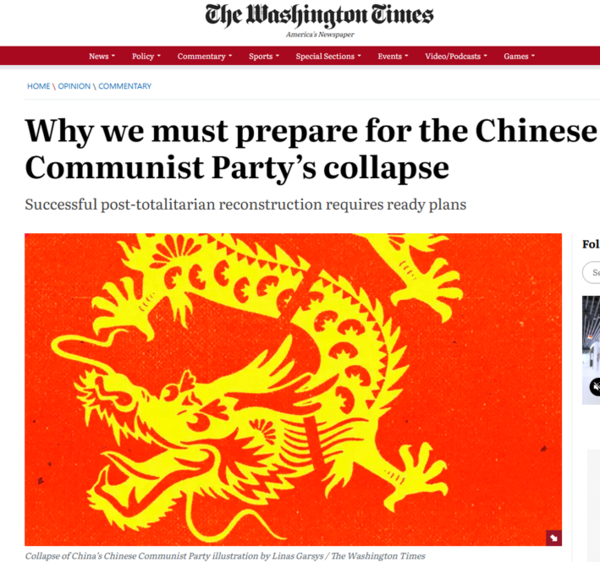
The Washington Times reported on the 14th (local time) that Miles Yu posed a highly provocative question: "Why we must prepare for the Chinese Communist Party’s collapse." For decades, Western strategy toward China has operated under the premise that the CCP would endure for a long time, focusing on deterring military expansion, countering economic coercion, protecting advanced technology, and defending Taiwan.
However, Miles Yu raised an entirely different risk. The greatest strategic challenge China poses to the world may not be when the CCP succeeds, but what happens if the Communist regime suddenly fails. He argues that the "Post-CCP" era—a scenario the West has rarely contemplated—must now be elevated into the realm of strategic contingency planning.
[Could It Collapse Overnight Like 1989?]
What Miles Yu highlights is the speed of history. In 1989, six Communist regimes in Eastern Europe collapsed within months, and the Berlin Wall fell. Approximately two years later, the Soviet Union—one of the world's two superpowers—was dissolved. Authoritarian regimes that appear solid and permanent on the surface can crumble far faster than expected once internal tipping points are crossed.
Yet, Miles Yu is not predicting an imminent collapse of the CCP. He leaves open both possibilities: that the CCP could persist for decades to come, or that it could lose central control faster than anticipated. The core point is: "Do not try to guess when it will collapse; prepare for what to do if it happens."
[Why Discuss a 'Post-CCP' Era Right Now?]
It is essential to view this in the context of China's current situation. In economic indicators for August released by China's National Bureau of Statistics on the 15th, industrial production rose 5.2% year-on-year, performing better than expected. Interpreting this as the entire Chinese economy collapsing all at once does not match the facts.
When turning to domestic demand, however, the picture is quite different. Retail sales growth in August stood at just 0.4%, while fixed-asset investment from January to August fell 7.2% year-on-year. While production holds up around advanced manufacturing, imbalances are growing clearer as Chinese consumer spending alongside corporate and local government investment weaken simultaneously.
[Real Estate Remains the Deepest Wound in China's Economy]
Even more serious is the real estate sector. From January to August this year, China's real estate investment fell 19.9% year-on-year. New home prices in August also dropped 0.1% month-on-month and 3.0% year-on-year. Although signs of improvement have appeared in parts of major cities, ongoing slumps in tier-2 and tier-3 cities prevent a broad recovery.
The real estate downturn is not merely about housing prices. Declining home sales depress land sale revenues, straining local government finances. Falling home prices erode household wealth effects and consumer sentiment. That the Chinese government recently embarked on its most extensive housing market institutional reform in decades reflects a recognition that short-term stimulus alone cannot resolve these structural issues.
[PBOC Governor: "Slow Credit Growth is the New Normal"]
An even more telling statement emerged from within China on the 16th. Pan Gongsheng, Governor of the People's Bank of China (PBOC), stated that "slower growth in bank lending may become the 'new normal' going forward." This is because "financing demand from the real estate and local government sectors is declining, while financing demand from new industries is not fully filling the gap."
In August, new yuan loans extended by Chinese banks reached just 60 billion yuan, far below market expectations of 400 billion yuan. New loans from January to August also totaled 10.44 trillion yuan, down from 13.46 trillion yuan in the same period last year, with household loans declining for six consecutive months. Describing China's current state as an "economy on the verge of collapse" is inaccurate; it is closer to an economy where traditional growth engines like real estate and local governments have weakened, but new growth engines have yet to fully fill the void.
[The Real Fear: Nuclear Weapons and the PLA]
What worries Miles Yu is a scenario where these economic and social problems lead at some point to a political crisis and a breakdown in central control. China after Communism: Preparing for a Post-CCP China, published by the Hudson Institute in 2025 under his editorship, focused squarely on this scenario. The report systematically examined potential post-CCP issues across domains including military, intelligence, economy, human rights, transitional justice, and constitutional governance.
The greatest dangers lie in nuclear weapons and the military chain of command. China possesses not only nuclear warheads and intercontinental ballistic missiles, but also the massive People's Liberation Army (PLA), armed police, intelligence and security agencies, and advanced biological research facilities. Should a sudden vacuum in central authority occur, who controls the nuclear weapons and whose orders the PLA obeys would instantly transform from an internal Chinese issue into an immediate international security crisis.
[Who Owns the Wealth… The 'Russian Nightmare']
The second issue is capital. China houses vast state-owned enterprises, financial institutions, state-owned assets, and supply chains linked to the global economy. If central power suddenly ceases to function, the question of who manages and controls these assets and institutions arises immediately.
Here, Miles Yu warns of the post-Soviet Russian experience. When regime transition occurred without democratic institutions, civil society, a legitimate system for handling state assets, and constitutional consensus, immense wealth concentrated in the hands of a few, giving rise to oligarchs. By contrast, he points to several Central and Eastern European nations where alternative political forces and institutional blueprints had accumulated prior to the collapse of Communist rule.
Ultimately, the fall of a dictatorship does not automatically produce democracy and a market economy the next day. Unprepared collapse can lead to new forms of authoritarianism or power struggles—the central warning delivered by Miles Yu.
[“Not Regime Change”… China’s Future Must Be Decided by the Chinese People]
For this reason, Miles Yu distinguishes his argument from a U.S.-led "regime change strategy." The logic is not for the United States or external powers to design China's future government, but to prepare in advance so that chaos surrounding nuclear weapons, the military, finance, and state assets during a sudden crisis does not escalate into a global catastrophe.
Above all, he emphasizes the principle that the final political system and future of China must be determined by the Chinese people themselves. He frames post-CCP preparation not as a policy of regime change, but as "strategic insurance" purchased in advance against the most significant political contingency of the 21st century.
[Why Times Insight — What Matters is Not 'Collapse' Itself, But That We Have Started Discussing 'After the Collapse']
A clear line must be drawn. Based on currently available data, there is no foundation to conclude that "the Chinese Communist Party is on the verge of collapse." China maintains a powerful central control system, and as seen in August's 5.2% industrial production growth, considerable resilience remains in advanced manufacturing and production. Linking current economic difficulties directly to regime collapse is an overinterpretation.
Nevertheless, this discussion is significant because the underlying question is shifting. Alongside Washington's strategic discourse on whether China could surpass the U.S. and how to respond to Chinese expansion, an individual who directly participated in U.S. China policy is now publicly posing the inverse question: "What if the Chinese Communist Party suddenly fails?"
Moreover, this is not an isolated thought appearing in a single column. The Hudson Institute had already examined post-CCP scenarios covering military, intelligence, economic, human rights, and constitutional issues in its 2025 publication China after Communism. While it cannot be said that the U.S. government has officially activated a "CCP collapse plan," it is clear that for certain strategists in Washington, a post-CCP era has emerged as a contingency scenario worth analyzing.
The most critical point in this discussion is not predicting the exact timing of a CCP collapse. The weakening or disappearance of an authoritarian regime does not bring freedom and democracy automatically. In a nation possessing nuclear weapons, a massive military, global supply chains, and vast financial assets like China, an unprepared regime transition poses immense risks.
Therefore, the ultimate direction of post-CCP discussions must not be about external actors determining China's future, but about preserving conditions that minimize chaos and violence during a massive transition, enabling the Chinese people to decide their political future for themselves.
The question posed by Miles Yu ultimately arrives at this point:
Not "When will the Chinese Communist Party collapse?" but "If that day comes, are China and the world prepared?"

- TAG