


추부길 whytimespen1@gmail.com
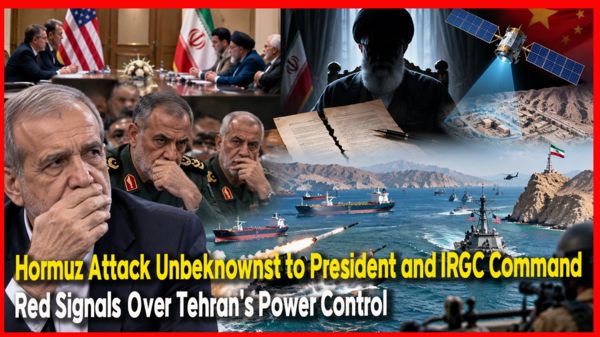
[Even the President Didn’t Know… Hormuz Attack Shatters Peace Accord]
Who is truly directing military strategy in Iran? Just as Washington and Tehran were establishing a delicate framework for peace, an unexpected assault on commercial vessels in the Strait of Hormuz effectively demolished ongoing diplomatic efforts. Shockingly, neither Iranian President Masoud Pezeshkian nor the top leadership of the Islamic Revolutionary Guard Corps (IRGC) had prior knowledge of or approved the operation.
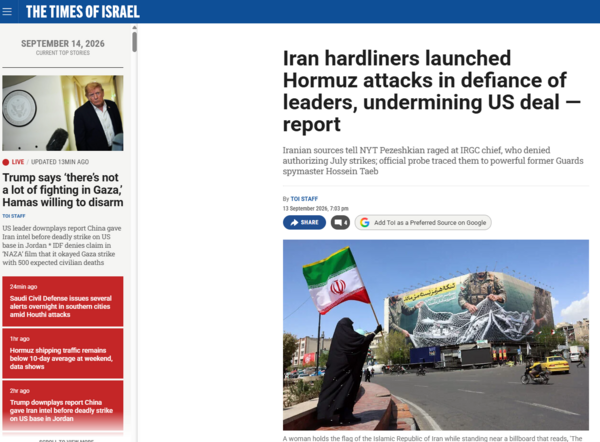
The Times of Israel reported on September 13 that the most startling detail of the incident was not merely the maritime strike itself, but that President Pezeshkian, IRGC Commander-in-Chief Ahmad Vahidi, and the Supreme National Security Council (SNSC) were all left completely in the dark. While a fragile ceasefire established under a June understanding had temporarily halted major escalation, field units deployed along the strait executed strikes on three commercial vessels. Subsequent U.S. retaliatory measures promptly dismantled the peace track.
The Jerusalem Post noted that President Pezeshkian was furious upon hearing the news, while IRGC leadership similarly insisted they had not authorized the attack. Field units reportedly justified their actions using standing orders authorizing local commanders to interdict any vessel violating Iranian maritime control without central clearance. If true, this signals that Iran faces more than ideological friction between hardliners and reformists—it raises fundamental questions about whether the official political leadership maintains actual operational control over its military forces.
[“Attempting to Kill Negotiations”… Hardliner Hossein Taeb Identified as Mastermind]
Evidence suggests the attack was not merely an operational miscalculation by local field commanders. Iranian officials pointed to Hossein Taeb, a notorious hardline figure and former head of the IRGC Intelligence Organization, as the key force orchestrating the sabotage. Taeb has maintained steadfast opposition to any diplomatic compromise with Washington from the onset.
According to internal Iranian sources cited by the Times of Israel, the motive was clear: deliberate disruption of the U.S.-Iran understanding to make a permanent end to hostilities impossible. Taeb recently reaffirmed his stance, declaring that Iran must never accept diplomatic agreements that compromise its national rights.
This highlights a profound internal rift. For President Pezeshkian and moderate negotiators, ending conflict is necessary to lift U.S. economic sanctions and relieve domestic economic strain. For the IRGC and hardline factions, persistent confrontation with Washington provides the core rationale for their political dominance and military influence. The fear of losing domestic authority post-conflict serves as a powerful incentive for hardliners to sabotage peace initiatives.
[Absence of the Supreme Leader]
In Iran’s teocratic system, internal disputes of this scale are meant to be decisively resolved by the Supreme Leader. However, serious doubts surround the actual extent of executive control currently exerted at the top.
The New York Times reported that Supreme Leader Mojtaba Khamenei has been absent from public view for an extended period, triggering internal debate regarding how decisions are currently being formulated and communicated. While statements continue to be issued under his name, questions grow over who is making final executive choices.
This leadership vacuum represents the most dangerous dimension of the crisis. If unauthorized military actions by rogue factions can unilaterally alter national war and peace policy, standard diplomatic channels become largely ineffective.
[The U.S. Dilemma: “Who Is the Real Counterpart?”]
This breakdown presents a major tactical challenge for Washington. Reaching formal agreements with Iran's official government offers little utility if autonomous military elements refuse to abide by terms negotiated by civilian officials.
Tensions have escalated further as Iranian forces targeted U.S. naval assets with ballistic missiles, prompting U.S. strikes against Iranian maritime targets. Meanwhile, the Wall Street Journal reported that U.S. officials are assessing whether external intelligence support from Russia or China has contributed to the increased precision of recent strikes.
[Enter China: High-Resolution Satellite Data and U.S. Target Alignment]
Adding another layer of complexity, the Wall Street Journal cited U.S. officials stating that Iranian forces acquired high-resolution satellite imagery from entities within China prior to an attack on the Muwaffaq Salti Air Base in Jordan, which left three U.S. service members dead and four wounded. U.S. intelligence is currently investigating the direct link between this data and the strike.
No public evidence indicates the Chinese government directly authorized the strike or supplied the satellite data. The Wall Street Journal refrained from naming specific Chinese entities, and Beijing has denied official involvement.
President Donald Trump maintained a cautious stance when asked about Chinese satellite intelligence while aboard Air Force One on September 13, framing surveillance as a reciprocal global reality rather than escalating the issue. Trump also declined to state directly whether he would raise the matter during his projected September 24 summit with Xi Jinping, a meeting Beijing has yet to officially confirm.
Trump’s reaction reflects a strategy of risk containment ahead of top-level bilateral talks. Nevertheless, Washington cannot indefinitely ignore a scenario where Chinese commercial or intelligence entities provide targeting capabilities that result in American casualties. Should the summit proceed, restricting Chinese dual-use military support to Iran will likely feature prominently on the security agenda.
[Why Times Insight — Does Iran Have Two Command Centers?]
The primary issue extends beyond the Strait of Hormuz or satellite imagery: Who actually holds the authority to decide war and peace in Tehran? If moderate political factions conclude agreements only for hardline elements to invalidate them through unilateral military actions—and the Supreme Leader fails to exercise corrective oversight—the fundamental hurdle to peace is structural rather than diplomatic.
The divergence in institutional incentives is clear: sustained hostilities reinforce the political mandate of security and intelligence apparatuses, whereas diplomatic normalization shifts state priorities toward economic management, diminishing military leverage.
Regarding Beijing, official denials of direct involvement are secondary to the operational reality. If high-resolution commercial or private satellite intelligence from China consistently enhances Iran's targeting capabilities against U.S. forces, verbal assurances will prove insufficient. Washington will likely rely on direct secondary sanctions and technology export controls targeting specific entities rather than relying solely on diplomatic commitments.
Ultimately, Washington must answer two core questions:
To Tehran: Who is the authoritative negotiating partner capable of enforcing compliance?
To Beijing: What is the extent of your oversight regarding dual-use intelligence entities?
Without definitive answers to both, any prospective peace accord remains vulnerable to disruption by a single unauthorized missile strike in the Strait of Hormuz.
- TAG