


추부길 whytimespen1@gmail.com
[80% of Dealers Reject 5-Year-Old EVs as Used Values Collapse]
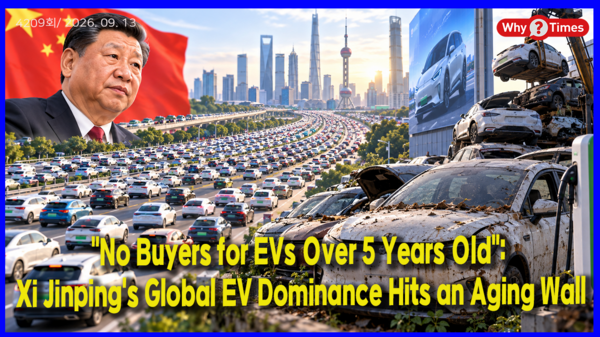
China, which has shaken the global electric vehicle (EV) market, has met an unexpected obstacle. As the number of EVs running on Chinese roads reaches 44 million, early-generation models are entering the used car market in large volumes. However, approximately 80% of Chinese used car dealers are refusing to accept battery electric vehicles (BEVs) older than five years.
Even more daunting is the fact that nearly 44 million EVs are already driving on Chinese roads. China became the world's first EV powerhouse, but as a price for that success, it is also the first to face an "EV aging" crisis on a scale of tens of millions of vehicles that no other country has experienced.
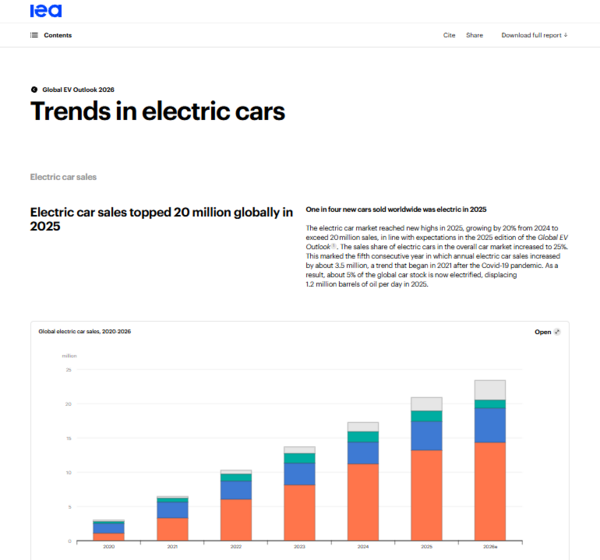
The Global EV Outlook 2026, recently released by the International Energy Agency (IEA), presents significant numbers revealing the future of China's EV market. Analyzing the Chinese used car market, the IEA stated, "It is estimated that about 80% of used car dealers in China do not purchase pure electric vehicles (BEVs) older than five years."
The reason is clear. Rapid advancements in battery technology continuously improve the performance of new EV models, causing existing vehicles to quickly become obsolete. Compounded by concerns over battery health and potential large-scale repair costs, demand for purchasing older EVs has dropped. Chinese electric vehicles are encountering the "5-year wall" for the first time.
[Car Values Plummet Before Batteries Even Fail]
Actual used car prices directly reflect these anxieties. According to the IEA, the residual value of a 3-year-old EV in China was about 46% in 2024. However, by the end of 2025, the average residual value for BEVs and PHEVs dropped to around 42%. Compared to China's overall used car market residual value, which sits slightly above 50%, the gap is clear.
However, there is an important fact here. This number should not be interpreted as "batteries degrading by half in 3 to 5 years." The 42% figure refers to the used vehicle's residual value, not battery capacity. In reality, a significant portion of EV batteries maintain sufficient performance even after five years. The issue lies in the difficulty for second-hand buyers and dealers to assess the precise state of battery health and future repair costs. Ultimately, the more alarming phenomenon appearing in Chinese EVs is that the vehicle's economic value can plummet drastically before the battery's physical lifespan ends.
[44 Million Vehicles Aging Simultaneously]
This problem is particularly dangerous in China due to its sheer scale. China deployed electric vehicles faster than any other nation in the world. In 2025, EV sales in China surpassed 13 million units, accounting for 6 out of every 10 EVs sold worldwide. Electric vehicles made up about 55% of all new car sales in China. As a result, by the end of 2025, the number of EVs on Chinese roads reached approximately 44 million, representing about 13% of all passenger cars.
Used EVs have also begun pouring out rapidly. Last year, second-hand EV transactions in China exceeded 1.5 million units, taking up about 8% of total used car trades. Until now, China was the world's largest "new EV market." Now, it is also transforming into the world's largest "aging EV market."
[Domestic Slump Drives a 154% Export Surge]
In September, an even more noteworthy shift emerged. According to a Reuters report citing data from the China Passenger Car Association (CPCA), domestic passenger car sales in China fell by 23.7% year-over-year in August, marking 11 consecutive months of decline. Sales of electric vehicles and plug-in hybrids also dropped by 10.1%.
In contrast, vehicle exports moved in the opposite direction. In August, passenger car exports from China increased by 77.5% year-over-year to 894,000 units, while the export growth rate for electric vehicles and plug-in hybrids soared by a staggering 154.7%. This indicates that the center of gravity for China's EV industry is shifting rapidly from domestic demand to overseas markets.
[Offloading Surplus Capacity to Global Markets]
This is no coincidence. According to the IEA, China was responsible for nearly 75% of global EV production in 2025. China's EV exports exceeded 2.5 million units, doubling in just one year.
What is even more significant is the gap between production capacity and domestic demand. As China's EV manufacturing capacity outpaces domestic demand, fierce price competition has broken out, prompting Chinese firms to move toward overseas markets in pursuit of higher profit margins. In Q1 2026, Chinese EV exports doubled again compared to the same period in the previous year. Excluding Europe and North America, imported vehicles from China already account for 55% of sales in the global EV market. This implies that the "5-year problem" originating in China may soon become more than just China's issue.
[Emerging Markets Face the 5-Year Threshold]
The electric vehicles that Chinese companies are currently selling in large quantities to Southeast Asia, the Middle East, Latin America, and Europe will also become used cars one day. If the phenomenon currently taking place in China repeats itself overseas, the problem will escalate.
An EV business does not end simply by exporting new cars. Manufacturers must diagnose battery conditions, maintain warranty and repair networks, supply replacement parts, and defend used car prices. In other words, the metric of competition is shifting from "how cheaply a car can be built and sold" to "who will buy that car in 5 years, and for how much." This presents a completely new type of battle for Chinese automakers who previously conquered global markets using low prices and rapid new product rollouts.
[Beijing Shifts Focus to Long-Term Quality]
Beijing has begun responding to these changes. Last month, Chinese authorities launched a massive, year-long quality improvement campaign targeting the automotive industry. Automakers were instructed to conduct self-audits on product quality, reliability, and durability, and to actively issue recalls if defects are identified.
Even more notable is that China is tightening regulations to continuously track the condition and repair history of electric vehicles. This can be viewed as a signal that the competitive criteria of the Chinese EV industry are shifting from the past years' focus on "price, new tech, and release speed" toward "quality, safety, durability, and after-sales service."
[CATL Adapts to Market Saturation]
With recent stock price adjustments for CATL—the world's largest battery manufacturer and another symbol of China's EV dominance—market interest has grown even further. However, it is premature to link CATL's stock price decline to a collapse of the Chinese battery industry.
Rather, what is more important is the fact that the entire Chinese battery industry is transitioning from a battle of "how much to produce" to "how much profit to retain amid overcapacity".
The Financial Times analyzed that "Chinese battery manufacturers are moving rapidly into the Energy Storage System (ESS) market in response to slowing domestic EV demand". Global shipments of battery cells for ESS nearly doubled last year to 612 GWh, with CATL supplying 121 GWh of that total. However, CATL's revenue per unit in the ESS segment fell by about 15%. This is because the massive supply capacity of China's battery industry is pulling prices down.
[From Growth-Driven Expansion to Profitability]
CATL's core competitiveness will not collapse overnight. China accounted for over 80% of global battery cell production in 2025, and CATL remains the world's largest producer with formidable scale and cost competitiveness. Yet, precisely because of this, the market's questions are changing. During the era of explosive EV growth, expanding production capacity itself was proof of growth. Now, amid oversupply and price wars, companies must demonstrate how effectively that immense production capacity can be converted into stable profits.
Therefore, the key takeaway from CATL's recent stock price adjustment is not "CATL's downfall," but rather the question of whether the Chinese battery industry is transitioning from a high-growth sector into a mature industry that must manage overcapacity and price competition.
[Why Times Insight]
The real test for Chinese electric vehicles begins now. Over the past decade, the key metrics used by the Xi Jinping administration to prove the success of its EV industry were production output, sales volume, export numbers, and global market share. By those standards, China's success is overwhelming. China accounts for roughly three-quarters of global EV production and commands over 80% of battery cell manufacturing. Amid a collapsed real estate market and stagnant domestic consumption, EVs and batteries have grown into crucial pillars supporting Chinese manufacturing and exports.
However, the rules of the game are changing. The question is no longer "how many and how cheaply can they make them," but rather "will this car retain its value as an asset after 5 years?"
This is not merely a matter of battery lifespan. It is a comprehensive issue spanning the entire life cycle of an EV—encompassing used car values, battery diagnostics, repair costs, warranties, insurance, leasing, parts supply, and brand trust. Furthermore, with domestic auto demand weakening, China is pushing its manufactured vehicles into overseas markets even more aggressively. Recent statistics showing a 154.7% surge in exports while domestic EV and PHEV sales declined by 10.1% in August vividly demonstrate this trend.
Right here lies the next hidden risk that Xi Jinping's EV strategy will encounter. If the "5-year wall" currently emerging in China repeats itself in Southeast Asia, the Middle East, and Europe where Chinese EVs have been sold en masse, it will become difficult for Chinese firms to dominate markets through price alone.
Automobiles are not products like smartphones that are used for a few years and thrown away. China became the world's first EV superpower. Now, it is becoming the world's first country to enter an "aging EV society." Thus, whether Xi Jinping's EV ambition will ultimately translate into true global automotive supremacy is likely to be decided by a far more challenging question than sheer sales volume:
“Will consumers still want to buy a Chinese electric vehicle five years down the road?” The answer to that very question will serve as the true report card for the myth of Chinese EVs.

- TAG