


추부길 whytimespen1@gmail.com
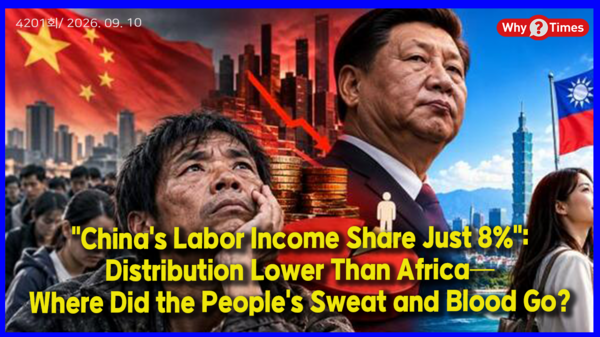
[Larry Lang Exposes: "China’s Total Wages Account for 8% of GDP—the World’s Lowest, Behind Africa"]
Taiwanese-born economist Larry Lang (Lang Xianping) sparked intense shock across the Sinosphere after stating that total wages for Chinese workers account for a mere 8% of the country's Gross Domestic Product (GDP). This figure places China at the very bottom globally—even lower than poorer African nations, where labor shares typically hover in the 20% range. The revelation implies that the wealth generated by the Chinese population's hard labor is not returning to the people, but is instead draining into the Chinese Communist Party (CCP) apparatus and other unverified channels. Should these claims be independently validated, the CCP could face significant domestic backlash.
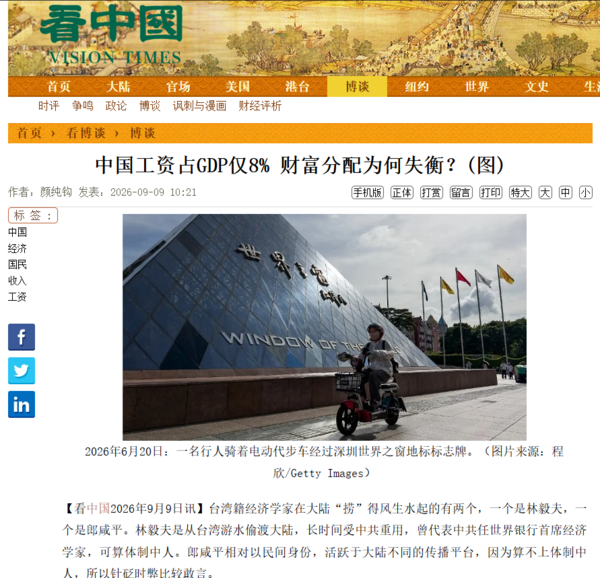
Anti-CCP outlet Vision Times (Kankan Zongguo) reported that in a recent video, Lang compared total wage shares of GDP across multiple countries. Advanced Western economies clustered in the 50–60% range: the United States at 58%, the United Kingdom at 56%, Japan and France at 53%, Canada at 51%, and Australia at 47%. Latin American nations averaged in the 30s—South Korea at 44%, Argentina at 36%, Mexico at 33%, and Venezuela at 31%—followed by Thailand and the Philippines at 28%, and Iran and Turkey at 25%.
When Lang asked his audience to estimate China's figure, over 90% guessed it would be comparable to African nations (estimated below 20%). The actual figure he disclosed—8%—shocked attendees.
Hong Kong commentator Yen Chun-kou described this as "dead last in the world." While China's absolute wage pool is large due to the total scale of its economy, the core takeaway from Lang's claim is that the proportion of economic growth returning to ordinary citizens ranks among the lowest globally.
The assertion that the world's second-largest economy distributes income to its populace at a lower rate than impoverished African nations triggered widespread discussion across Chinese-language social media. In contrast, official income-method GDP statistics published by China's National Bureau of Statistics (NBS) state that labor compensation accounts for roughly 52% of GDP—a figure comparable to or slightly higher than that of the U.S. (~51%) and Japan (~51%).
[Unreliable Chinese Statistics: Distrust Breeds Suspicion]
The core issue lies in the deep-seated international skepticism surrounding China's official statistics. The extent of this distrust was underscored by the case of Gao Shanwen, a prominent economist and former People's Bank of China (PBOC) official who served as a trusted insider analyst for three decades. Gao was investigated and disciplined after publicly claiming that China's real economic growth rate was less than half of official estimates, and he passed away. Combined with the censorship of economists' social media accounts and academic evidence of systematic GDP manipulation by local governments, the "8% controversy" has shifted from a debate over statistical accuracy to a fundamental question: which numbers in China can be trusted?
According to the South China Morning Post (SCMP), Gao held credentials that were difficult to dismiss. After earning his bachelor's and master's degrees from Peking University, he joined the PBOC in 1995, working in macroeconomic research and policy departments while completing a doctorate under former PBOC Governor Zhou Xiaochuan. He later served as Chief Economist at Essence Securities (renamed SDIC Securities in 2023) for over a decade starting in 2007. Utilizing empirical framework analysis, he researched China's potential growth rate, credit cycles, and asset revaluations, earning a reputation as one of the most reliable analysts among institutional investors.
In December 2024, during a forum at the Peterson Institute for International Economics (PIIE) in Washington, D.C., Gao remarked: "Over the past two to three years, China's real GDP growth rate is estimated to have averaged around 2%, despite official figures claiming close to 5%."
The Edge Singapore reported that following the dissemination of his comments, Chinese authorities investigated and disciplined Gao, leading to his departure from SDIC Securities in 2025. Gao passed away on July 7 at age 55. While official Chinese media cited "illness" as the cause of death, posts on social media pointed to a battle with cancer. Following his death, tributes poured across Chinese social platforms praising his willingness to speak out.
Gao was not an isolated case. According to Radio Free Asia (RFA), Hong Hao, Head of Research at BOCOM International, had his social media accounts removed without explanation in 2022. In 2024, economist Fu Peng faced WeChat account restrictions after highlighting the decline of China's middle class. Furthermore, the Unirule Institute of Economics, an independent free-market think tank, was closed down by authorities.
A study published in the academic journal World Development analyzed instances where local governments in China were caught inflating GDP figures. The researchers found that even after manipulation was officially exposed in certain regions, the practice frequently recurred. The pattern suggests that while independent experts face censorship, statistical distortion remains structurally embedded.
Larry Lang's "8%" figure resonated widely due to pervasive public skepticism regarding state-issued data. Under a single-party system where critical academic commentary is suppressed, official explanations often lack credibility among the populace. As concerns grow over bureaucratic governance and resource allocation, public frustration regarding state-led economic reporting continues to build.
[Fraudulent Official Statistics: Local Government Manipulations and Empirical Evidence]
Statistical distortions in China extend beyond central policy choices, operating systematically at the local government level. Local officials face intense pressure to meet GDP growth targets, which directly influence career advancement and political evaluations. To fulfill these quotas, officials have engaged in administrative practices such as registering revenue from non-operational entities or overstating expenditures on unfinished infrastructure projects.
In regions such as Liaoning Province, Tianjin, and Inner Mongolia, multi-billion-dollar GDP overstatements were previously acknowledged or exposed via internal whistleblowers. Unsubstantiated numbers produced for political reporting have contributed to the official narrative of China's economic scale. Independent researchers using objective physical proxies—such as satellite night-light data, electricity consumption, and freight transport volumes—frequently estimate China's actual annual economic growth to be 2 to 3 percentage points lower than officially reported figures.
These statistical practices reflect structural features of planned economic legacies and centralized governance. In market-based systems, businesses and individuals rely on verified data for investment and consumption decisions. Under centralized information controls, distorted statistics can misallocate market resources, leading to asset imbalances and financial risks whose economic burdens ultimately fall on the general public.
[The Wealth Extraction Structure Behind Distorted Figures]
The uneven distribution of economic growth in China stems from structural features of its state-directed economic model. Under the framework of state ownership and a "socialist market economy," the CCP maintains state monopolies over core industries, land, and financial assets. Capital flows generated through this system are frequently directed toward state enterprise expansion, administrative overhead, and security maintenance rather than direct wage increases or social welfare programs.
While market democracies rely on independent labor unions and legal protections to support labor income shares, China regulates labor representation through the state-sanctioned All-China Federation of Trade Unions (ACFTU). Independent labor advocacy and strikes remain restricted under social stability mandates. With administrative influence over labor pricing, institutional arrangements favor capital retention by state and connected entities, contributing to a lower labor income share relative to GDP.
This distribution structure contributes to income inequality and subdued domestic consumption. When real household income growth lags behind top-line economic expansion, consumer spending capacity remains constrained. Consequently, the Chinese economy has relied heavily on external exports, municipal infrastructure projects, and debt-financed investments. The low labor share highlighted by the "8%" figure brings these underlying structural imbalances into focus.
[Why Times Insight]
The controversy surrounding the 8% labor income share figure highlights the contrast between official claims of "socialist equality" or "common prosperity" and the reality of China's income distribution. The CCP has long relied on a tacit governance model: offering economic growth and rising living standards in exchange for public acceptance of single-party rule. However, as questions surrounding statistical transparency persist and wealth concentration remains skewed toward state-aligned elites, the foundation of this governance model faces structural strain.
Amid youth unemployment challenges and pressure on middle-class asset values, the gap between official economic reporting and lived experience creates growing public dissatisfaction. While information controls and censorship of critical intellectuals may suppress dissent in the short term, they risk deepening systemic distrust over time.
Without structural reforms toward data transparency and market-aligned distribution mechanisms, skepticism toward official statistics will likely persist. The controversy over China's labor income share serves as a notable reminder of the ongoing debate surrounding transparency and economic governance within the country.

- TAG