


추부길 whytimespen1@gmail.com
[The '19 vs. 1' Exposed at the G20: The Real Problem Starts Now]
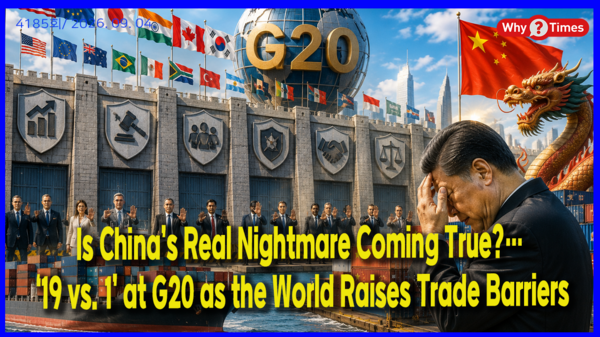
The "19 vs. 1" dynamic emerging from the G20 Finance Ministers and Central Bank Governors meeting in Asheville, North Carolina, is unlikely to remain confined to the conference hall. Every member state except China shared a growing recognition that non-market policies and an excessive reliance on exports are deepening global economic imbalances. In response, the US publicly urged other nations to re-evaluate their trade relationships with China and consider higher trade barriers if necessary. Adding to the pressure, a survey released in Germany revealed that 83% of industrial manufacturing firms face intensifying competitive pressure from Chinese rivals, with 55% of all surveyed companies supporting stronger EU countermeasures even if it entails economic costs. What Beijing truly fears is not merely losing access to the US market, but a domino effect where Europe, Asia, and Latin America—which previously absorbed Chinese goods diverted from the US—begin closing their doors one by one.
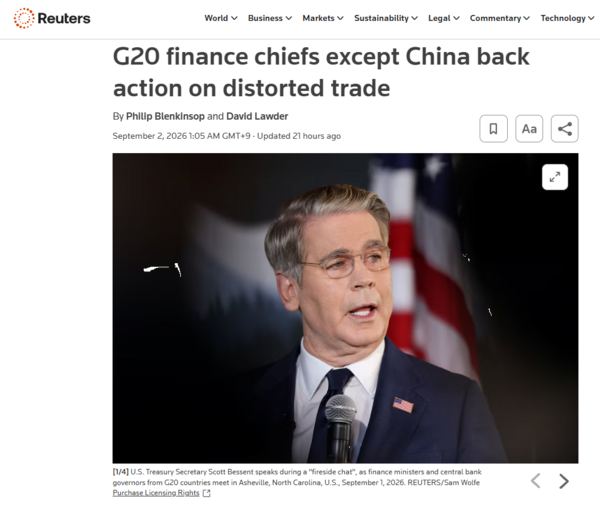
Reuters reported that US Treasury Secretary Scott Bessent directly targeted China at the conclusion of the G20 finance gathering, noting that finance chiefs from every G20 nation except China aligned on the necessity of countering non-market policies and distortions that drive export dependency and undermine growth elsewhere. Reuters further reported that Bessent criticized China’s relentless stream of low-cost exports as unsustainable, identifying Beijing as the sole dissenter, and noted that because of China's objections, the meeting concluded with a US Chair’s Statement rather than a joint official communique.
The failure to adopt a joint communique is not the primary story. Reuters pointed out that the 19 members did not explicitly agree to impose joint tariffs or sanctions against China, but rather that the true significance lies in the fact that major, diverse global economies no longer view global imbalances stemming from Chinese overcapacity and export dependency as a purely bilateral US-China issue. A critical turning point has arrived: "China's export problem" is morphing into a "global industrial problem".
[Bessent Has Already Outlined the 'Next Step After 19 vs. 1']
More noteworthy is that Bessent publicly raised the next steps even before the G20 meeting got underway. Pointing to China’s record $1.2 trillion trade surplus, Bessent criticized Beijing for relying on exports to offset weak domestic demand. He urged fellow G20 nations to re-examine their trade posture toward China and consider building higher tariff walls to curb global imbalances.
Bessent’s logic is straightforward: the US acting alone cannot solve Chinese overcapacity. According to Reuters, although the US trade deficit with China shrank significantly following tariffs and trade measures, Chinese goods simply re-routed toward Europe, Latin America, and other markets. Blocking the US market alone does not eliminate Chinese overcapacity; it merely triggers a "balloon effect," shifting export destinations. The pivotal focal point going forward is whether the US can leverage this "19 vs. 1" momentum into actual, coordinated trade policies across other major economic blocs.
[Figures Released in Germany Right After '19 vs. 1': 83% of Manufacturers Feel "Chinese Pressure"]
Signs that G20 concerns are extending beyond diplomatic rhetoric surfaced immediately in Europe. Reuters reported that a survey of 1,300 companies by the Association of German Chambers of Commerce and Industry (DIHK) showed that roughly two-thirds felt increasing competitive pressure from Chinese rivals, and within manufacturing—the core of the German economy—that figure climbed to 83%. According to Reuters, even more telling is the 55% figure: over half of all surveyed firms supported stronger EU action against Chinese market distortions, even if it meant absorbing higher prices, tariffs, or potential Chinese retaliation, compared to 37% who opposed.
The DIHK noted that Chinese companies are no longer competing strictly on cheap prices and sheer volume; they are entering global markets equipped with advanced technology and innovation capabilities, squeezing German industry. German firms are not demanding an indiscriminate trade war; rather, they are calling for a sophisticated, unified European strategy to reduce dependence while confronting unfair market practices. Coming nearly simultaneously with the G20 "19 vs. 1" alignment, these demands present a signal Beijing cannot afford to ignore.
[Blocking One Market Is Not Enough: The 'Bypassed Markets' Problem]
Here lies the strategic essence of the "19 vs. 1" stance. Historically, the US-China trade war followed a predictable pattern: when the US raised tariff barriers, China redirected surplus production elsewhere, buffering the economic shock by channeling goods into Europe, Latin America, and Southeast Asia. That dynamic changes if Europe begins viewing Chinese overcapacity as a direct threat to the survival of its own manufacturing base.
If Chinese products blocked from the US flow into Europe, and Europe responds by raising trade barriers, surplus goods will attempt to move into Asia and Latin America. If those emerging markets also take steps to protect their domestic industries, China’s trade bypass routes will narrow rapidly. Given that Bessent has openly called on G20 partners to review their trade ties with Beijing and consider higher barriers, close attention must be paid to how Washington attempts to elevate Chinese overcapacity into a joint trade agenda with key allies.
[China Knows the Risk, But Cannot Stop]
Beijing is fully aware of these risks. Yet, China maintained a divergent stance at the G20 because exports are indispensable to its broader economic framework. The Chinese economy remains bogged down by a prolonged real estate slump, sluggish domestic consumption, and deflationary pressures. Massive domestic savings remain trapped within the financial system due to property weakness and limited alternative investment outlets, with low government bond yields relative to other major economies further reflecting weak domestic demand and persistent deflationary trends.
Conversely, China’s industrial manufacturing capacity remains colossal. In strategically fostered sectors—such as electric vehicles, batteries, solar panels, and steel—vast industrial infrastructure must keep running. When domestic consumption fails to absorb this massive output, goods are inevitably pushed into overseas markets. This structural dynamic directly enabled China’s goods trade surplus to expand to a record $1.2 trillion.
[China Claims "Surplus Is Not Intentional"… No Intention to Back Down]
China forcefully rejected US allegations. The Governor of the People's Bank of China asserted at the G20 that Beijing does not deliberately pursue trade surpluses, claiming China is actively expanding domestic consumption while maintaining high-level global openness. Beijing’s counterargument contends that Washington is politicizing the price and production competitiveness of Chinese enterprises under the labels of "overcapacity" and "non-market economy". Therefore, jumping to conclusions and labeling the "19 vs. 1" vote as a formal "anti-China economic alliance" across all 19 members remains premature.
However, the deeper issue is that Beijing shows no inclination to alter its export-led manufacturing model in response to international criticism. While the world demands that China boost domestic consumption and curb its export reliance, Beijing insists its trade surplus is not the result of deliberate state distortion. With such a profound gap in perspective, escalating trade friction appears nearly inevitable.
[China’s True Fear: The Moment the World Closes Its Doors Simultaneously]
This is why the "19 vs. 1" paradigm fundamentally alters the landscape. Losing access to the US market alone is something Beijing can manage by pivoting to Europe, Southeast Asia, Latin America, and the Middle East. However, if Chinese EVs, steel, batteries, and solar products diverted from the US encounter elevated barriers in Europe, and subsequent attempts to redirect them to emerging markets trigger widespread anti-dumping duties, countervailing tariffs, and safeguards, China faces an entirely different existential crisis.
The global market capacity to absorb China’s massive production would shrink dramatically. Slashing prices further invites aggressive dumping investigations and trade defense measures abroad; raising prices undermines price competitiveness—one of China’s primary market advantages. Yet cutting production is equally unfeasible, as lower factory utilization damages corporate earnings, employment, and local economies. Ultimately, Beijing faces a severe structural dilemma: pushing exports outward invites higher global trade barriers, while curtailing domestic production deals a direct shock to its internal economy.
[The Critical Question: Will '19 vs. 1' Translate into Real Trade Barriers?]
The world has not shut its doors on China all at once. Nations compete with China while simultaneously relying on Chinese markets and supply chains. Hence, the shared concerns voiced at the G20 will not automatically translate into identical tariff policies across 19 distinct nations.
Nevertheless, the data from Germany underscores that the environment is shifting. The issue of Chinese overcapacity has spilled over from intergovernmental trade negotiations directly into industrial factory floors. As manufacturers demand stronger countermeasures from their domestic governments and the EU to combat Chinese competition, political leaders will find it increasingly difficult to ignore those calls.
The metric to watch going forward is not merely the headline figure of "19 vs. 1". The true indicators will be how actual policy tools—tariffs, anti-dumping duties, subsidy regulations, government procurement restrictions, and investment screening—evolve in practice. Should these defensive trade measures expand simultaneously across multiple major markets, China will face a level of coordinated economic pressure fundamentally different from a bilateral trade dispute with the US.
[Why Times Insight]
The G20's "19 vs. 1" outcome marks a beginning rather than a conclusion. What Beijing ought to fear is not diplomatic isolation within a summit hall, but the moment those shared concerns spill out into factories, job markets, and concrete trade policies worldwide.
Early warning signs are already visible. Following the G20, the DIHK survey revealed that 83% of German industrial manufacturers feel acute competitive pressure from Chinese rivals, with 55% advocating stronger EU action against Chinese market distortions despite potential economic costs.
If only the US closes its market, China can pivot elsewhere. But if Europe follows suit and emerging markets in Asia and Latin America move to shield their own industrial sectors, China’s options will narrow sharply. Yet Beijing cannot easily abandon its export strategy, as manufacturing and exports serve as essential pillars sustaining growth and employment amid a property slump and weak consumption.
This creates a deep structural dilemma: continued export aggressive expansion shrinks global access, while curbing production threatens domestic growth and employment. Previous iterations of the US-China trade war centered on where Chinese goods would re-route when blocked by Washington.
The upcoming conflict could look entirely different. When Chinese goods blocked from the US flow into Europe, and volume turned away from Europe streams toward Asia and Latin America, where does China go if those markets build protectionist walls as well? That is the scenario Beijing fears most.
The primary question emerging from the G20 is not "Why did it end up 19 vs. 1?" It is "Will '19 vs. 1' transform into 19 individual trade barriers?" While all 19 members will not adopt uniform policies, the transition of shared concern over overcapacity into active trade defense measures across multiple nations would mark a major inflection point for global trade.
China’s primary threat is not a specific US tariff percentage. It is the moment the global community closes its doors in unison. The "19 vs. 1" stance at the G20 represents the first clear preview of that scenario.
- TAG