


추부길 whytimespen1@gmail.com
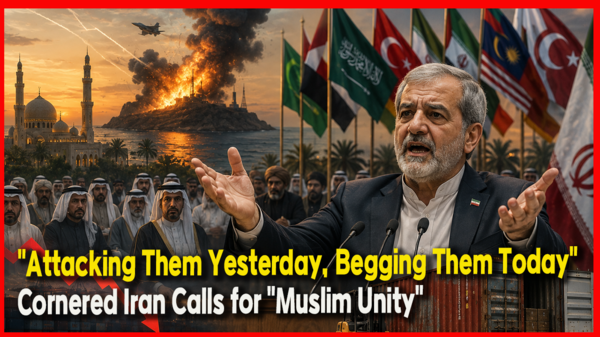
[Once Attacking Gulf States, Iran Suddenly Claims "Muslims Are One"]
Iran’s attitude has shifted abruptly. After six months of blocking the Strait of Hormuz, targeting U.S. regional allies, and clashing with neighboring Muslim nations, Tehran is now appealing for Islamic solidarity, declaring the United States and Israel as a "common enemy." Yet, on the very same day, U.S. forces carried out a surprise strike on two Islamic Revolutionary Guard Corps (IRGC) launch sites on Larak Island, where preparations were underway to deploy naval mines into the Strait. With trade falling by up to 35% and U.S. military strikes resuming, this "belated call for unity" highlights Iran’s growing desperation.
Reuters reported that Iranian Supreme Leader Mojtaba Khamenei abruptly urged unity across the entire Islamic world. In a written statement marking Islamic Unity Week, he framed the U.S. and Israel as the "real enemies" of all Muslims and urged leaders in West Asia and the Persian Gulf to recognize who their true adversary is.
Reuters further noted that Khamenei argued the U.S. and Israel target the entire Muslim community—not just Iran—and insisted Islamic nations must not remain divided. His explicit call for Gulf leaders to identify their "real enemy" was particularly striking.
However, the message creates a paradoxical scene, given that Iran was actively clashing with those exact Gulf states until just months ago. Reuters observed that during its conflict with the U.S. and Israel, Iran attacked targets in neighboring American-aligned nations and placed heavy strains on regional energy exports and maritime traffic through mines, missiles, and drone threats in the Strait of Hormuz. AP similarly noted that Iranian strikes specifically targeted nearby nations aligned with Washington.
Reading Khamenei’s message against this backdrop reveals a clear irony, inviting the skeptical reaction: "You attacked us yesterday, and now that you're in trouble, you preach brotherly unity?"
[On That Very Day, the U.S. Struck Iran Again]
An even more striking event unfolded in the Strait of Hormuz on the same day. U.S. forces launched a raid destroying two IRGC launcher sites on Larak Island in southern Iran. A U.S. official confirmed the strike was executed after observing IRGC forces preparing to launch mine-laden rockets into the Strait.
The American digital news outlet Axios noted that this attack marks the first confirmed U.S. military strike on Iranian territory since President Donald Trump paused military operations in late July. Axios emphasized that Washington demonstrated it can resume direct military action at any moment, shifting back from its temporary reliance on economic sanctions and naval blockades.
Axios added that Larak Island sits right at the entrance of the Strait of Hormuz. Having recently completed mine-clearing operations along international maritime routes, the U.S. military pre-emptively eliminated the launchers as soon as Iranian movements to re-mine the area were detected. The operation delivers a firm message: "Touch international shipping lanes in Hormuz again, and you will be hit immediately."
[IRGC Vows "Retaliation"—But Can They Really Strike Back?]
The Revolutionary Guard reacted immediately. Quoting Iranian state media, Reuters reported that the IRGC claimed casualties among combatants and civilians on Larak Island and vowed to penalize the aggressors. However, exact casualty figures were withheld.
The key dilemma is whether Iran can back up its rhetoric. Direct attacks on U.S. bases or warships would grant Washington a justification to resume full-scale military operations. Conversely, taking no action after a sovereign territory strike—occurring on the exact day the Supreme Leader appealed for Islamic unity—would severely undermine the IRGC’s standing and the regime's deterrence.
Iran is caught in a trap: "Escalate and face war, or tolerate it and face humiliation." Reuters noted that while the IRGC vowed revenge in fierce language, it notably omitted specific timelines or methods, reflecting these strategic constraints.
[Even Pezeshkian Finally Admitted It... "Who Says Sanctions Don't Work?"]
Beyond military pressure, economic collapse is plaguing Iranian leadership. In a recent state TV interview, President Masoud Pezeshkian offered an assessment that directly contradicted claims that U.S. sanctions are ineffective. Acknowledging that Iran is effectively operating under war conditions, he revealed that import and export volumes dropped by 25% to 35% over recent months.
Arab News described this admission as a significant pivot from just days prior, when officials insisted new U.S. sanctions would fail. Pezeshkian even raised the need to adjust domestic gasoline prices to compensate for fiscal shortfalls caused by shrinking trade.
This economic reality provides vital context for Khamenei’s "Muslim unity" initiative. With direct military engagement against the U.S. proving risky and maritime blockades taking a heavy toll, preventing neighboring Muslim states from actively enforcing the U.S. pressure network has become a matter of survival for Tehran.
["Stand by Our Side"—Is This the True Purpose of the Unity Call?]
Khamenei’s specific appeal asking Gulf leaders to "know who your real enemy is" carries deep political weight beyond religious rhetoric.
For Iran, as Gulf nations like the UAE and Saudi Arabia cooperate with U.S. financial and maritime enforcement, avenues for circumventing sanctions shrink drastically. With Washington pressuring third-country networks and Iranian-linked financial institutions, regional cooperation directly determines Iran's economic viability.
Ultimately, framing the U.S. and Israel as a shared threat is a calculated attempt to urge Gulf states to pull back from the U.S.-led containment strategy.
[Why Times Insight]
The most telling detail in this crisis is not what Iran is saying, but when its message changed. Early in the war, Tehran believed it could leverage the Strait of Hormuz to pressure both the U.S. and neighboring Gulf states. Six months later, the strategic reality has shifted. Economic strain is evident in Pezeshkian’s admission of a 25–35% drop in trade, and the U.S. demonstrated its willingness to strike pre-emptively on Larak Island after clearing maritime mines.
Khamenei's sudden outreach to Gulf leaders under the banner of "Muslim unity" signals shrinking options rather than strength.
The critical factor now is the IRGC’s next move. Launching actual military retaliation risks provoking broader U.S. strikes, while limiting response to verbal threats exposes weakened deterrence. The Larak Island strike goes beyond tactical destruction; it forces a strategic choice on Tehran:
"Will you attempt to block Hormuz again, or step back?"
That Iran responded to this dilemma not with a military counterstrike, but with calls for "brotherly unity among Muslim nations," clearly reflects its current predicament.
- TAG