


추부길 whytimespen1@gmail.com
[Ukraine Hits Main and Reserve Command Posts Simultaneously]
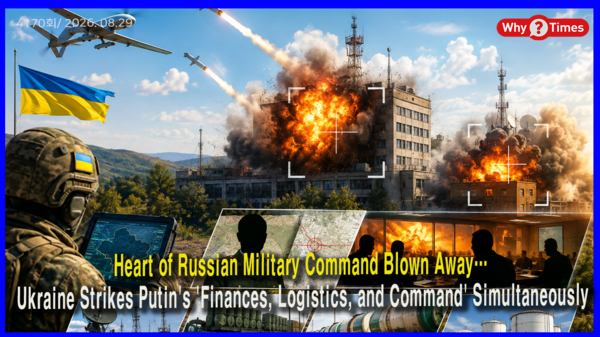
Ukraine has begun directly striking the "head" of the Russian military. Main and reserve command posts of Russian forces set up across the Donetsk region were targeted with precision strikes on the same day, and the identity of a lieutenant colonel belonging to the Operational Directorate of the 41st Guards Combined Arms Army staff has been confirmed dead. Furthermore, claims are spreading that commanders at the commander and deputy commander level of the 51st Guards Combined Arms Army—a core unit currently leading the Donetsk offensive—were killed all at once during a meeting. While the death of the 51st Army leadership remains unconfirmed, this attack demonstrates that Ukraine is moving beyond a war of attrition against individual Russian troops on the front lines, transitioning into a stage where it dismantles Russia’s "war system" itself—namely command, logistics, and energy.
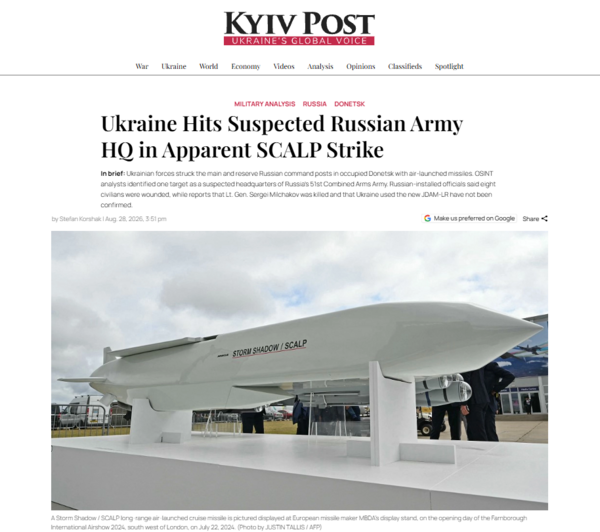
Kyiv Post reported on August 28: “The General Staff of the Armed Forces of Ukraine officially announced that between August 26 and the morning of August 27, Ukrainian forces simultaneously struck Russian main and reserve command posts in the Donetsk city area using air-launched missiles.” It quoted the General Staff as stating, “In the Donetsk region, the enemy's main and reserve command posts were hit by missile strikes,” adding that in the same operation, Russian repair and recovery units in Chonhar, Kherson Oblast, and drone control facilities in Olenivka, Crimea, were also attacked.
Kyiv Post noted: “This operation is on a completely different level from merely destroying a single command post building. Simultaneously striking the reserve command post—which is supposed to assume operational control if the primary command post is hit—can be interpreted as an intent to paralyze Russia’s backup command structure all at once.”
The outlet added: “Locally, at least six powerful explosions were heard between the evening of the 26th and the morning of the 27th. Ukrainian OSINT group CyberBoroshno analyzed that multiple missiles hit the underground parking lot of an unfinished residential complex.”
[Death of 41st Army Staff Officer Confirmed… What About the 51st Army Leadership?]
Evidence that Russian command and staff personnel suffered actual casualties from this strike has begun to be confirmed. Regarding this, Ukrainian military outlet Militarnyi reported: “Lieutenant Colonel Andrey Moiseyenko, a senior officer in the Operational Directorate of the Staff of the Russian 41st Guards Combined Arms Army, was confirmed killed in the strike on the Donetsk command post.” It added: “According to KIU, an open-source intelligence project tracking Russian officer casualties, Moiseyenko's wife confirmed her husband died in an attack by the Ukrainian Air Force on a Russian command post, where he served as a senior staff officer in the 41st Army's Operational Directorate.”
This is significant because field army-level operational staff officers are vital personnel connecting subordinate units' attack directions, force deployments, artillery/air support, and logistical planning. Consequently, a collective loss of such personnel in a command post strike creates an operational void that extends far beyond mere casualties.
The Russian 51st Guards Combined Arms Army is attracting even greater interest. Militarnyi noted: “Ukrainian OSINT channels such as Exilenova+ raised the possibility that one of the targets in this strike was the command post of the Russian 51st Guards Combined Arms Army.” It explained: “The 51st Army was reorganized in 2024 based on the former 1st Army Corps of pro-Russian Donetsk forces and is currently evaluated as a key Russian element on the Pokrovsk-Dobropillia axis.”
The most shocking claim following this strike is that Lieutenant General Sergei Milchakov, commander of the 51st Army, was killed. Kyiv Post noted: “Within Ukrainian OSINT circles, claims spread that Milchakov was holding a meeting with subordinate commanders at the time of the strike and died alongside deputy commander-level officers. However, as of August 29, the deaths of Commander Milchakov and his deputy commanders have not been officially confirmed by either the Russian or Ukrainian governments.” Nevertheless, the circumstances indicating the destruction of a Russian field command post have sent shockwaves across the region.
[The Russian Offensive Has Not Collapsed Completely]
However, this strike on command posts does not immediately mean the collapse of the entire Russian military. The General Staff of the Ukrainian Armed Forces stated: “On August 26, 229 combat engagements took place across the entire front line, with Russian forces conducting 88 air strikes and firing 294 guided bombs.” It added: “Russian offensives continued on August 27 with 206 combat engagements across the front, where Russian forces launched 36 attacks in the Pokrovsk direction alone.”
The Institute for the Study of War (ISW) in the United States assessed: “Currently, one of the primary Russian goals is to break the so-called 'Fortress Belt' connecting Sloviansk, Kramatorsk, Druzhkivka, and Kostiantynivka in northern Donetsk.” It evaluated: “While Russian forces are exerting simultaneous pressure on the northern and southern flanks of the Fortress Belt and continuously sending small infiltration groups around Kostiantynivka, the main Russian forces have not penetrated deeply enough to seize the entire city.” Thus, the most accurate characterization of the current situation is: “Russia continues to push forward on the front line, but Ukraine is striking the rear command and logistics network—the head and blood vessels—that command and sustain that offensive.”
[Ukraine's Strategy Has Shifted: Targeting the 'War System', Not Just Troops]
Notable changes become clearer when looking at recent Ukrainian attack patterns. The Ukrainian General Staff announced: “Ukrainian forces continue long-range strikes not only on Russian command posts but also on radar systems, drone operating bases, maintenance facilities, ammunition depots, and fuel facilities.” It detailed: “On August 24, Russian command posts, supply warehouses, and radar facilities were attacked, damaging military aircraft stationed at Vityazevo airfield in southern Russia. On August 26, Russian radar, maintenance facilities, and supply depots in Crimea were targeted again.”
Connecting these strikes reveals Ukraine's overarching intent. Rather than eliminating Russian soldiers one by one on the front line, Ukraine is shifting toward a strategy that simultaneously hits the indispensable networks required for Russia to conduct war: command, reconnaissance, fuel, logistics, and drone operations.
[Russia's 'Oil Heart' Begins to Waver]
An even graver issue for Russia is energy. Reuters reported on August 28: “Following a series of Ukrainian drone strikes, Russia's gasoline production dropped to roughly 80,000 tons per day by late August.” It noted: “Given Russia's domestic summer demand of around 115,000 tons per day, domestic production can only meet about 70% of demand.”
Reuters added: “The NORSI refinery in Nizhny Novgorod—Russia's fourth-largest refinery and a key gasoline production facility—halted crude processing following a Ukrainian drone attack on August 26.” It highlighted: “The paradoxical situation has emerged where Russia, a world-leading oil producer, must now worry about its domestic gasoline supply as its refineries are repeatedly targeted.”
This issue extends beyond the civilian economy. Because a modern military consumes vast amounts of fuel for tanks, armored vehicles, trucks, generators, rail, and logistical transport, prolonged damage to refineries inevitably burdens military logistics costs and operational sustainability.
[Targeting 'Head, Eyes, Vessels, and Fuel' Simultaneously]
The strategic intent behind the Donetsk command post attack becomes even clearer. While Russia pours in massive troop numbers and guided bombs to break Ukraine's Fortress Belt, Ukraine is methodically destroying the rear system that enables those attacks.
It shakes the "head" by striking command posts, neutralizes the "eyes and ears" by targeting radar and UAV control units, severs the "vessels" by hitting logistics and ammo depots, and squeezes the "fuel" that drives the war machine by attacking refineries. The recent Donetsk strike serves as a clear indication that Russian field leadership now sits directly within Ukraine's precision-strike range.
[Why Times Insight]
The true significance of this attack lies not merely in "how many Russian generals died." What matters far more is what Ukraine has started to target.
Russian forces maintain fierce offensives in areas like Pokrovsk and Kostiantynivka, engaging in hundreds of clashes daily. Their offensive capability has not disappeared. However, even with hundreds of thousands of troops, combat effectiveness degrades if the command issuing orders falters, radar and drone networks monitoring the battlefield are disabled, logistics networks transporting arms and ammo are severed, and fuel for tanks and trucks runs short.
This is precisely Ukraine’s target. Unable to crush the entire Russian military in a direct frontal force-on-force engagement, Ukraine seeks to systematically sever the vital links required for Russia to sustain the war. In this context, the attack on the Donetsk command post should not be viewed in isolation. The full picture emerges only when connected with ongoing Ukrainian strikes on Russian refineries, radar stations, UAV bases, supply depots, and logistics nodes.
Should the deaths of the 51st Army commander and deputy commanders be officially confirmed, the military shock of this strike will be far greater. Yet even if they survived, the fact that both primary and reserve command posts were hit by precision strikes on the very same night is a grave development for the Russian military.
Russia is attempting to crush Ukrainian fortresses on the front lines. Ukraine, stepping back, is directly aiming for the "head" that orders those attacks and the "vessels" of the war machine that sustain them.
The war in autumn 2026 is shifting: it is no longer just about who captures a few kilometers on the front line, but who can break the opponent's war system to an unsustainable level first.

- TAG