


추부길 whytimespen1@gmail.com
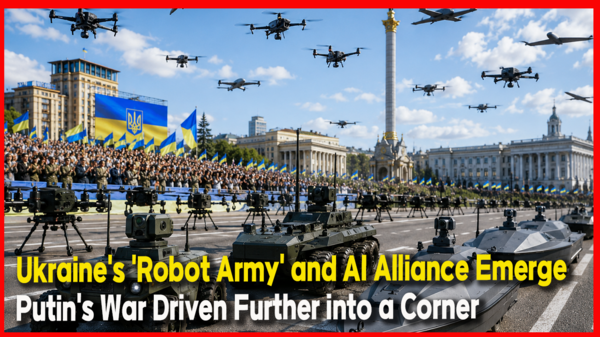
[Neither Soldiers Nor Tanks… A 'Robot Army' Marches Through Kyiv]
Ukraine is elevating its war against Russia to an entirely new dimension. While expanding long-range strikes targeting refineries, energy, and logistics infrastructure deep inside mainland Russia, Ukraine presented an unprecedented military parade on its Independence Day, putting robots and drones at the forefront instead of soldiers and tanks. Furthermore, Ukraine agreed to share its vast repository of battlefield data—accumulated over four and a half years of actual combat—with the United Kingdom to jointly develop AI weapon systems. As a war once fought through sheer numbers of troops and tanks is being reshaped around robots, AI, and data, Ukraine has begun positioning itself at the absolute forefront of this transformation.

Reuters reported that on August 24, as Ukraine marked its 35th anniversary of independence, a scene symbolizing the shifting nature of warfare unfolded in Kyiv. Instead of the massive troop formations and tanks that historically dominated military parades, Unmanned Ground Vehicles (UGVs), Unmanned Surface Vessels (USVs), and various strike, reconnaissance, and interceptor drones took center stage. Ukrainian President Volodymyr Zelensky showcased the event as a comprehensive display of Ukraine’s aerial, ground, and maritime unmanned systems. Four and a half years into the war, Ukraine demonstrated to the world that the face of its military is transitioning from "soldiers and tanks" to "robots and drones."
Crucially, these robots are not prototype display models, but systems actively deployed on the battlefield. Ukraine is deploying ground robots for reconnaissance, ammunition transport, mine clearance and laying, casualty evacuation, and direct combat. This approach reshapes combat systems to minimize human exposure to enemy firepower. In the skies, the deployment of strike drones is accelerating alongside interceptor drones specifically designed to shoot down Russia's Shahed-type attack drones. The automation of the battlefield—transferring high-risk human missions to machines—is entering a fully operational phase.
[Ukraine’s True Weapon: '5 Million Battlefield Data Images']
An even more significant evolution is occurring in artificial intelligence. The UK and Ukraine officially signed a new defense AI partnership in Kyiv. Under this agreement, the UK became the first foreign nation granted access to Ukraine’s 'Avengers AI Labs.' The British government described this initiative as an effort combining Ukraine’s peerless combat experience with the UK's AI capabilities, universities, research institutions, and technology firms.
The assets held by Avengers AI Labs are substantial. According to Reuters, the lab stores approximately 5 million annotated battlefield image datasets collected from platforms like Ukraine’s DELTA battlefield management system. Thousands of daylight cameras and infrared sensors continuously track Russian tanks, artillery, air defense systems, personnel, Shahed attack drones, and reconnaissance UAVs. Systems trained on this data analyze over 100,000 drone video feeds monthly, identifying roughly 70% of enemy targets in real time.
This indicates that Ukraine is converting four and a half years of war into a massive AI training ground. Real-world data detailing how Russian tanks maneuver, how air defense networks operate, where artillery fires from, and the flight profiles of approaching Shahed drones all serve as AI training material. Because this represents authentic combat data that cannot be replicated on training grounds, it represents an exceptionally rare asset for Western defense industries, including the UK. This explains why the British government views Avengers AI Labs as a literal "goldmine" of battlefield data.
[UK AI Meets Ukrainian Combat Data… The Birth of a 'Future Warfare Alliance']
This partnership is not a one-way transfer. The Times reported that the two nations will jointly develop new military technologies by combining Ukrainian combat data with British technological expertise. A primary example involves utilizing buried fiber-optic cables as massive AI sensors to detect intrusion and reconnaissance movements around military bases and critical infrastructure. Concurrently, both nations are pursuing the development of next-generation, low-power AI semiconductors designed for use in drones, robotics, and autonomous weapon systems.
The structural framework is clear. The Times noted that a cyclical model is taking shape: Ukraine supplies real-world combat data; British universities, corporations, and research entities use this data to develop new AI models and weapon systems; and the resulting technologies are subsequently deployed back to the Ukrainian battlefield for operational testing. In their joint declaration, the UK and Ukraine explicitly stated their intent to build a "next-generation AI-enabled military" and, where appropriate, expand this cooperation to trusted allies. The Ukrainian conflict is increasingly likely to serve as a testing ground reshaping future warfighting doctrines across the Western alliance.
[Beyond AI to Missiles… Why Russia Reacted Angrily]
British support extends beyond artificial intelligence. The Times revealed that the UK government authorized defense contractor MBDA to share classified technical information regarding British components of SCALP long-range cruise missiles with Ukraine. The objective is to assist Ukraine in establishing indigenous assembly and production lines for long-range missiles inside its own territory. Moving beyond merely supplying finished missiles to enabling Ukraine to produce long-range weapons internally represents a major strategic shift.
This shift explains the sharp reaction from Moscow. Kremlin spokesman Dmitry Peskov criticized the move, claiming that the UK is involving itself ever more deeply in the conflict on Ukraine's side, impeding peace talks, and "adding fuel to the fire." Russia went further by publicly warning that it is actively gathering intelligence to locate and target missile production facilities within Ukraine.
[Ukraine Penetrates Deep into Russian Territory… Putin Takes Emergency Measures]
Another key shift in the war is the expanding reach of Ukrainian strikes. Reuters reported that Ukrainian forces have recently intensified long-range strikes against Russian oil refineries, petroleum terminals, logistics networks, and industrial facilities. On August 20, strikes targeted the TANECO oil refinery in Tatarstan and the Tamanneftegas oil terminal in Krasnodar, causing fires. Previously, the Orsk oil refinery—located approximately 1,900 kilometers from the Ukrainian border—suspended operations following a drone attack. Ukraine’s offensive operations are increasingly shifting from the frontlines to the heart of Russia’s economy.
The impact of these strikes is reflected in Kremlin policy actions. Reuters reported that President Vladimir Putin issued a presidential decree granting the state temporary direct control over critical civilian infrastructure deemed inadequately prepared for Ukrainian drone attacks. The decree applies to vital economic and national security sectors, including fuel, energy, industrial, communications, transport, and logistics facilities. If private companies fail to properly secure facilities or delay post-attack recovery, the Russian government is empowered to assume temporary management over physical and financial assets, as well as ownership rights.
This action highlights a key reality: Ukrainian long-range strikes have escalated into a security challenge of such magnitude that the Russian government no longer trusts private sector defense capabilities, forcing direct state intervention. It reflects an implicit acknowledgment by the Kremlin that Russia’s industrial rear is no longer a safe zone.
[Russia Expands Its Own Drone Warfare… But Ukraine Pursues 'Integrated Warfare']
To be sure, Russia is not standing idle in the technological race. Reuters noted that Russia continues to employ Shahed-series attack drones and missiles in high volumes, significantly intensifying aerial bombardments against Ukraine this year. An attack in the Kharkiv region on August 18 resulted in 10 fatalities, and Russia’s summer air campaign continues to exploit Ukraine’s ongoing shortages of air defense interceptors.
However, a strategic divergence is emerging between the two sides. While Russia focuses on mass-producing drones and missiles to maximize raw firepower, Ukraine is developing a networked system connecting drones, ground robotics, unmanned vessels, sensors, battlefield management architectures, AI, and real-time operational data. According to the Ukrainian Ministry of Defense, over 70 types of weapon systems utilizing AI and computer vision to engage targets are currently operational, supported by more than 200 Ukrainian companies producing AI-enabled drones.
[From Soviet Missile Hub to 'AI Warfare Nation']
Ukraine’s technological evolution did not happen overnight. Since the Soviet era, Ukraine served as a major industrial hub for aviation, rocketry, space systems, armor, and shipbuilding. Major Soviet design and manufacturing complexes were concentrated in Dnipro, Kharkiv, and Kyiv, leaving behind a deep pool of engineering talent and manufacturing expertise following the collapse of the Soviet Union. This industrial base provided the foundation that combined with civilian IT talent, tech startups, and frontline military feedback to power today’s drone and robotics ecosystem.
Yet, describing modern Ukraine simply as an "inheritor of Soviet defense industries" misses a key distinction. The defining shift has been Ukraine’s departure from rigid, state-controlled defense production models. An agile development pipeline has emerged where frontline demands directly inform civilian engineers and tech startups, who rapidly build, field-test, refine, and redeploy systems back to the front lines. Now, this pipeline is being integrated with 5 million battlefield image datasets and AI models. Superimposing an agile ecosystem of startups, software, AI, and combat data onto an inherited engineering foundation constitutes the essence of Ukraine’s current military revolution.
[Why Times Insight]
The two events that unfolded in Kyiv on August 24 are fundamentally connected. On the streets, robots marched in place of soldiers, while in diplomatic chambers, an agreement was signed to share four and a half years of accumulated combat data with the United Kingdom. One represents a "hardware revolution" in warfare; the other represents a "cognitive revolution."
What is particularly notable is that the war launched by Vladimir Putin to pull Ukraine back into Russia’s orbit is paradoxically accelerating Ukraine’s departure from Soviet-style military paradigms. Ukraine is transitioning from a nation that merely receives Western military hardware into a strategic partner where Western forces seek to learn from real-world combat data and future warfare concepts. The UK becoming the first nation granted access to Avengers AI Labs and the joint commitment to build an "AI-era military" illustrate this transformation.
Conversely, Russia now finds itself forced to defend refineries, energy nodes, and logistics hubs deep within its own territory. This reality culminated in Putin issuing a presidential decree enabling state takeover of critical infrastructure vulnerable to drone attacks. A war intended to confine conflict to Ukrainian territory has evolved into a scenario where Moscow must worry about the security of facilities 1,900 kilometers inside its own borders.
The paradigm of warfare is undergoing a clear transformation. Thirty-five years after declaring independence from the Soviet Union, Ukraine is actively severing its reliance on Soviet-style warfighting doctrines. The sight of robots marching through central Kyiv on Independence Day provided a clear visual representation of this shift.
Paradoxically, the war initiated to force Ukraine’s capitulation is turning it into one of the world's most rapidly evolving future warfare states.

- TAG