


추부길 whytimespen1@gmail.com
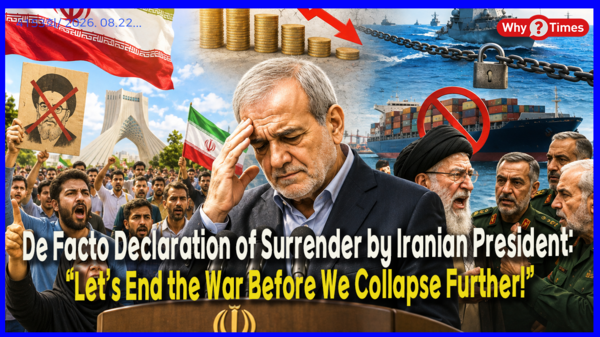
[Iranian President: “We won, so let’s end it”… A Paradoxical Declaration of Victory]
The President of Iran has sent a signal to end the war that amounts to a de facto surrender. While President Masoud Pezeshkian packaged this as a “victory” and an “honorable end to the war,” the underlying intent behind his statement—“We must end the war while maintaining our strength and dignity”—is unmistakable. It is a desperate plea to exit the conflict before the Iranian economy suffers total collapse under the U.S. naval blockade and severe sanctions.
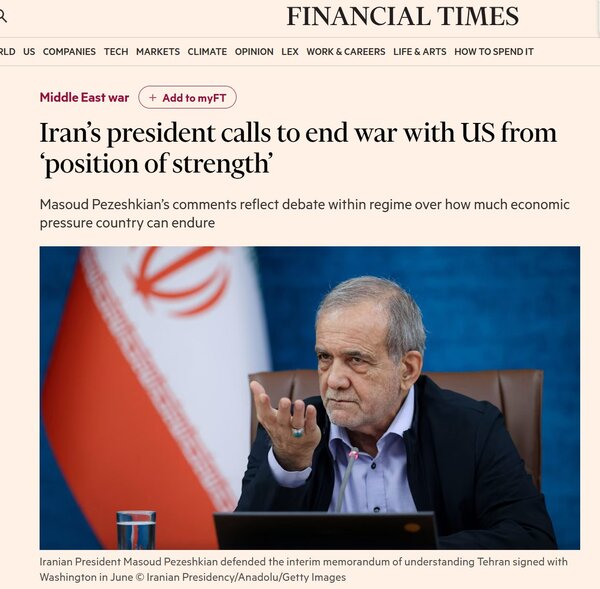
The Financial Times (FT) reported on August 22: “President Pezeshkian stated at a medical community event in Tehran the previous day, ‘It is better that we bring the war to an end now as we are in a position of power and dignity.’ He claimed that ‘the whole world acknowledges our victory’ and asserted that the U.S. has drawn international condemnation for attacking schools, hospitals, and infrastructure.” Ostensibly a declaration of triumph, the core message of his speech was an immediate push to halt the fighting rather than continue it.
In response, Reuters noted: “President Pezeshkian defended the tentative memorandum of understanding signed with the U.S. in June, describing it as an ‘honorable and valuable agreement.’ He maintained that ‘one cannot find even a single clause indicating Iran’s surrender,’ arguing instead that all obligations rest with the American side.” This serves as defensive rhetoric aimed at deflecting criticism from domestic hardliners who condemn the talks as a “humiliating concession.”
However, the FT pointed out: “The assertion that ‘we must end the war because we won’ is inherently contradictory. If continuing the war could secure a greater victory, there would be no reason to urgently plead for peace. Thus, the phrase ‘power and dignity’ is less proof of victory and more a formula for saving face while exiting before further U.S. pressure begins.” While not an official instrument of capitulation, it is widely interpreted as a plea for an exit route driven by economic reality.
[Crude Oil Exports Plunge… Iran’s Lifeline Choked Off]
Behind Pezeshkian’s plea for peace lies a rapidly deteriorating Iranian economy. Citing tracking data from Kpler, Reuters reported that Iran’s crude oil shipments in August plummeted to approximately 534,000 barrels per day (bpd)—a drop of over 60% compared to the 2025 average of 1.4 million bpd. Following the tightening of the U.S. naval blockade on July 13, Iranian crude exports through the Strait of Hormuz have effectively ground to a halt, and volumes offered to Chinese refiners for September and October delivery have dropped sharply.
Figures vary depending on tracking methodologies. Citing separate Kpler shipment data, Iran International noted that “partial tallies for this month show Iran’s oil shipments at just 287,000 bpd—a seventh of the nearly 2 million bpd exported prior to the outbreak of hostilities.” While the “one-seventh” figure reflects a specific shipment metric rather than a consensus across all agencies, every source confirms that Iran’s primary source of foreign currency has been severely damaged.
Flows of Iranian crude bound for China are also shrinking fast. Reuters reported: “China historically purchased over 80% of Iran’s seaborne crude exports. However, since the blockade, independent refiners in Shandong have begun replacing Iranian oil with Brazilian and Iraqi grades. The steep discounts that previously attracted Chinese buyers have vanished, distorting supply chains to the point where some Iranian crude is trading at a premium.”
[“If the People Starve, Military Might Is Useless”]
Voices warning of economic collapse are now emerging openly within Iran’s leadership. According to Iran International, Mohammad Bagher Ghalibaf—Speaker of the Iranian Parliament and chief negotiator with the U.S.—told business leaders in Iraq: “No matter how strong our military power is, if our people are starving, and if there is no capital circulation, economic growth, or domestic production, we cannot survive.” The fact that the word “survival” is being used by one of Iran’s top hardline politicians demonstrates that economic pressure is shaking the regime’s strategic calculations.
The hardships felt on the street are severe. AP News reported: “In Tehran, store shelves remain stocked, but many families lack the funds to buy basic food and medicine. Unemployment is rising, the national currency has lost nearly half its value compared to last year, and households are progressively giving up fruit, protein, and recreation.” Economic projections suggest inflation could hit roughly 70%, with GDP contracting by more than 5%.
Iranian officials also revealed that the U.S. is blocking access to Iran’s foreign exchange reserves abroad. The FT observed: “With crude revenue cut off and existing foreign reserves frozen, the Iranian government’s ability to secure essential imports, fuel, and defend its currency will rapidly erode. This represents the most pragmatic reason why Pezeshkian is rushing toward an end to the war even while asserting military victory.”
[Bessent’s “One-Two Punch of Blockade and Sanctions”… Details Set for August 24]
U.S. Treasury Secretary Scott Bessent stated in a CNBC interview on August 20: “We have the blockade, and we are going to have the toughest sanctions in history.” Labeling this strategy a “one-two punch,” he declared: “It is going to work in Iran, and we are going to collapse this regime.” Specific details of the measures are scheduled to be unveiled at a press conference on August 24.
Commenting on the move, Reuters stated: “The primary targets of these measures will likely extend beyond Iran to third-country entities purchasing Iranian crude or providing financial and shipping services. The ultimate success of the campaign hinges on how aggressively secondary sanctions are applied to refiners, banks, and maritime firms in China—the top buyer of Iranian oil.” Bessent pressed Beijing, arguing that because China relies heavily on the Gulf region for its energy, cooperating with U.S. measures serves China’s own interests.
China pushed back immediately. The Chinese Foreign Ministry stated that “sanctions and pressure will not resolve the issue,” calling instead for a political and diplomatic solution. However, it remains uncertain whether China will continue purchasing Iranian crude or curtail imports in consideration of U.S. financial markets and the upcoming U.S.-China summit in September. For Tehran, actual purchasing decisions by Chinese refiners matter far more than Beijing’s diplomatic rhetoric.
[President Seeks Peace, Military Command Promises “Devastating Response”]
In stark contrast to Pezeshkian’s call to end the war, Iran’s military leadership has escalated its retaliatory rhetoric. According to Reuters, Ali Abdollahi, Chief of Staff of the Iranian Armed Forces, declared that forces across the land, sea, air, air defense, and cyber domains are prepared to deliver a “devastating and punitive strike” against new U.S. threats. This highlights that the military’s hardline stance remains active, creating a clear rift with the president’s search for an exit strategy.
Tensions in the Strait of Hormuz also persist. Reuters noted: “Initial tracking data indicates that only 7 commercial vessels passed through the strait on August 20—half of the 14 recorded the previous day. Not a single VLCC (Very Large Crude Carrier) or LNG carrier was among them. A maritime artery that handled roughly 20% of global oil and LNG trade prior to the conflict remains essentially paralyzed.”
Consequently, dual messages are emanating from Iranian leadership. Conservative U.S. outlet Newsmax analyzed: “The president and negotiating team argue for an ‘honorable peace’ before deeper economic ruin sets in, while the military command threatens all-out retaliation to preserve leverage. Yet with even Speaker Ghalibaf conceding that military force is useless if the population starves, Iran’s hardline rhetoric increasingly appears less like genuine confidence and more like a defensive shield to mask the regime’s desperation.”
[Why Times Insight]
President Pezeshkian repeatedly emphasized that Iran “has not surrendered.” However, political rhetoric must be distinguished from strategic reality. Claiming “we won” while insisting “we must end the war now” reflects an exit strategy designed to withdraw under the cover of victory before total collapse, rather than the confidence of a triumphant nation. While no formal document of capitulation has been signed, economic indicators signal a de facto surrender.
Crucially, these statements came just three days before the U.S. discloses its “toughest sanctions in history.” With oil exports and foreign currency inflows already severely constrained, secondary sanctions blocking Chinese buyers would leave Iran unable to import basic food, fuel, and medicine—let alone sustain military operations. Pezeshkian’s message to domestic hardliners is ultimately a final warning: “If we do not end this now, even the opportunity to preserve our dignity will vanish.”
That said, it is premature to conclude that Iran will surrender unconditionally or that the regime will face immediate collapse. Tehran retains established sanction-evasion networks, tight internal security controls, and a military capable of threatening the Strait of Hormuz and regional U.S. bases. The key turning point will be whether the U.S. sanctions unveiled on August 24 effectively block Chinese purchases of Iranian crude. If China—Iran’s final economic lifeline—is cut off, Pezeshkian’s push for an “honorable peace” will shift from a moderate proposal into an unavoidable strategy for regime survival.
- TAG