


추부길 whytimespen1@gmail.com
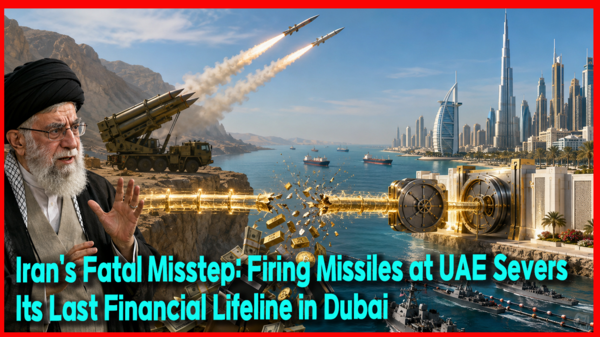
[Firing Two Missiles Costs Iran Its Final Foreign Exchange Gateway]
By launching missile threats against the United Arab Emirates (UAE), Iran has severed the last remaining financial channel that allowed its economy to survive under U.S. sanctions. With the UAE completely suspending trade, commercial exchanges, and financial transactions with Tehran, Iran’s access to informal financial networks in Dubai—including money exchangers, shell companies, and cryptocurrency exchanges—has been fundamentally undermined alongside official bilateral trade. As the U.S. enforces a naval blockade to choke off Iranian crude exports, the UAE is shutting down the flow of capital on land and within financial markets. In trying to intimidate the Gulf states through missile strikes, Iran has effectively pulled the plug on its own economic life support.
Reuters reported on August 20 that Afra Al Hameli, Strategic Communications Director at the UAE Ministry of Foreign Affairs, announced: “In light of the recent regional escalation that undermines regional and international peace and security, all trade, commercial exchanges, and financial transactions with Iran have been suspended until further notice”. While the UAE has not formally severed diplomatic relations, the move represents a near-total economic blockade. Though Al Hameli noted that Abu Dhabi remains open to dialogue and regional cooperation, the UAE provided neither a timeline nor conditions for resuming commercial ties.
Reuters noted that the catalyst for the UAE’s swift economic severance was the launch of two ballistic missiles presumed to have originated from Iran. The UAE Ministry of Defense stated that the missiles targeted maritime traffic and landed in the sea, though localized air-raid alerts were triggered across the country. Tehran dismissed the allegations as "baseless," but the UAE—whose commercial vessels have faced repeated missile and drone attacks since the war broke out in February—refused to treat the incident as accidental.
Reuters highlighted that vessels belonging to the UAE’s state oil company, ADNOC, faced repeated attacks by Iranian-linked missiles and drones while transiting the Strait of Hormuz. For Abu Dhabi, maintaining limited economic ties while its own oil tankers were being targeted became an unsustainable contradiction. Commenting on the situation, AP explained that while Iran threatened Gulf monarchies that assisting U.S. military operations would be treated as an act of war, the outcome was not Gulf submission, but rather a total financial and logistical blockade against Tehran.
[The Real Blow: Shutting Down Dubai’s Underground Financial Network, Not Just Trade]
This measure is devastating to Iran because the UAE is far more than a routine trading partner. According to the U.S. Department of the Treasury, Dubai has long served as the primary bypass for Iranian firms evading Western financial sanctions to settle import payments and recover revenues from crude oil and petrochemical sales. When formal banking channels were cut off, Iranian entities relied on Dubai-based currency exchanges, trading firms, nominee accounts, falsified invoices, and crypto platforms. Front companies registered in the UAE routinely forged documentation to make transactions appear as trade with entities in Hong Kong or Singapore, masking the source and beneficial owners of the funds.
This shadow system was exposed during the recent case involving the Dubai-based cryptocurrency exchange 'Shelbit.' Reuters reported that Shelbit acted as a key financial hub, moving at least $4 billion in sanction-evading funds for the Central Bank of Iran and organizations linked to the Islamic Revolutionary Guard Corps (IRGC). The network linked over 2,000 illegal gambling sites, crypto-mining operations, and international exchanges into a single money-laundering web, allowing sanctioned Iranian institutions access to global capital markets. The U.S. Treasury sanctioned Shelbit and its associated networks on August 7.
Consequently, the UAE’s total suspension of financial transactions goes far beyond blocking routine bank transfers. Reuters noted that if UAE authorities strictly enforce the suspension, accounts, wire transfers, currency exchanges, crypto cash-outs, and re-export transactions connected to Iranian firms will fall under intense scrutiny. Even if ghost companies in Dubai technically remain open, losing access to local financial institutions and clearing networks renders them non-functional. With the U.S. hunting down sanctions evasions and the UAE closing its doors, Iran’s shadow banking architecture faces simultaneous pressure from both sides.
Reuters clarified that there is no official confirmation that the UAE has shut down hundreds of shell companies outright. Rather, the measure effectively freezes transactions channeled through these companies, placing Dubai’s sanctions-evasion network in existential peril—serving as Abu Dhabi’s final warning to Tehran.
[Even with Oil to Sell, Foreign Currency Settlement Disappears]
The most immediate danger to Iran's economy is not crude production, but whether revenue can actually be collected. AP reported that with normal crude exports and U.S. dollar settlements crippled by naval blockades and sanctions, the closure of the UAE’s informal clearing networks leaves Iran forced to sell oil at steep discounts or rely on barter. Reduced foreign exchange inflows will severely hamper imports of food, medicine, and industrial components, accelerating the depreciation of the rial and driving up domestic inflation.
The Revolutionary Guard Corps (IRGC) faces a direct hit as well. The IRGC relies on oil and petrochemical sales, currency exchanges, front companies, and digital assets to fund foreign proxies and weapons development. With Washington tracking capital flows and Abu Dhabi sealing off financial avenues, the Iranian regime may soon be forced to choose between funding its overseas proxies or maintaining domestic stability.
[U.S. Chokes Off Iran’s Revenue While Escorting Hormuz Crude]
While isolating the Iranian economy, the U.S. is executing a dual strategy to prevent global oil markets from spiking. Axios reported that the U.S. military is escorting 15 to 20 oil tankers nightly via southern routes off the coast of Oman, enabling up to 10 million barrels of crude per day to move through the Strait. After dismantling Iran’s regional radar and maritime surveillance capabilities in earlier operations, U.S. fighters are actively protecting tankers from incoming cruise missiles and drones.
Axios noted that this operation neutralizes Tehran's strategy of shutting down the Strait of Hormuz to spike global energy prices and force the U.S. and Gulf states to the negotiating table. The current setup blocks the export and payment collection of Iranian crude while keeping oil from Gulf producers like Saudi Arabia and the UAE flowing to global markets. This operational control enabled President Trump to halt negotiations, calling talks with Iran "a waste of time."
[Why Times Insight]
Iran attempted to use missile strikes and threats to close Hormuz to force Gulf monarchies away from Washington. Instead, its missiles targeted UAE ports and shipping, triggering the severing of the very financial lifeline in Dubai that Tehran depended on most. The attempt to force submission through military threats ended up uniting U.S. naval pressure with UAE financial enforcement.
Although the UAE’s measure is framed as temporary ("until further notice"), Iranian firms and currency traders cannot operate at scale amid such complete uncertainty. Fearing U.S. secondary sanctions, global financial counterparties are likely to preemptively block Iran-related funds. Sanctions often inflict damage faster through market fear than through formal regulatory mandates.
The core issue is not simply that two missiles fell into the sea. It is that those missiles effectively demolished the financial bridge in Dubai that kept the Iranian economy afloat. With the U.S. locking down the sea lanes and the UAE closing the financial gates, Iran’s continued aggression is rapidly draining its own economic blood.
- TAG