


추부길 whytimespen1@gmail.com
[Export Routes Blocked, $80B Debt Explodes: Losses if Production Continues, Bankruptcy if it Stops]
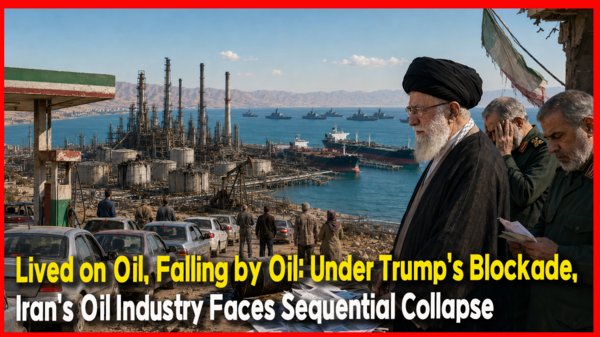
Iran, a major global oil producer, has been driven to the dire state of considering gasoline rationing due to domestic shortages. As U.S. sanctions and naval blockades choke off crude exports and foreign currency inflows, the heart of Iran’s economy—the National Iranian Oil Company (NIOC)—has had its bank accounts frozen under a crushing debt load exceeding $80 billion.
Iran is trapped in a deadly dilemma: continuing crude production leads to growing losses from a lack of buyers and storage capacity, while stopping production threatens to collapse both its oil fields and national finances. Yet, Iranian hardliners and the Islamic Revolutionary Guard Corps (IRGC) demand further sacrifices from the public, calling for "fight to the death." Who, exactly, is this fight for?
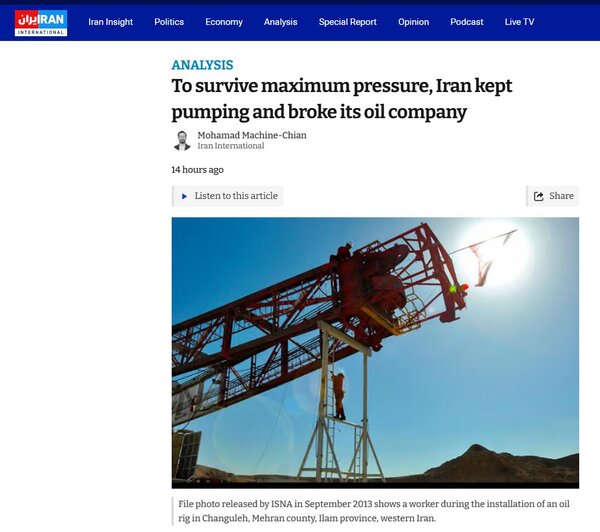
Iran International, a UK-headquartered media outlet specializing in Iranian affairs, reported that Bank of Industry and Mine, an Iranian state-owned bank, froze the accounts of NIOC over roughly $1 billion in unpaid debt owed to the National Development Fund (NDF) that was more than two years overdue. NIOC was also hit with a separate tax assessment of approximately $1.5 billion, with enforcement narrowly halted only after direct intervention by the President's office.
This is not merely a liquidity crisis for a single state-owned enterprise. Iran International noted that NIOC holds a virtual monopoly over Iranian crude production and exports, serving as the financial engine sustaining regime operations, military spending, and civil service salaries. Having its bank accounts frozen by a domestic state-owned bank signifies that U.S. economic pressure has penetrated the deepest core of Iran’s economy.
Even more alarming is that the disclosed liabilities may represent just the tip of the iceberg. According to Iran International, NIOC does not publish internationally audited financial reports, nor does Iran’s budget itemize state enterprise debts clearly. Tucked away in a single line beneath a table in this year’s budget is the deferral of $63.5 billion (€55 billion) in principal and interest owed to the Central Bank and commercial banks. Combined with $17 billion in overdue loans disclosed by the NDF, NIOC’s verifiable debt exceeds $80 billion—more than double the Iranian government’s entire annual general budget of roughly $37 billion at current open-market exchange rates.
[A ‘Grey Market’ Created to Evade Sanctions Swallows the Oil Companies]
Iran International pointed out that following the 2018 U.S. withdrawal from the JCPOA and the reimposition of sanctions, Iran chose not to abandon oil production, building a covert export network instead. By deploying IRGC-affiliated entities and domestic firms, production recovered from under 2 million barrels per day (bpd) to around 3.6 million bpd by mid-2024, creating the illusion that Iran was defying U.S. sanctions.
However, volume recovery did not equate to profitability. Iran had to sell its crude at discounts of $10 to $15 per barrel relative to Brent, relying on shadow fleets, ship-to-ship transfers, vessel identity spoofing, origin masking, and complex broker networks. While independent Chinese refineries absorbed most of this crude, steep discounts, shipping fees, intermediary commissions, and money-laundering costs drastically reduced the actual foreign currency returning to Iran.
U.S. sanctions did not function solely by blocking every drop of oil. Instead, they forced Iran to incur higher discounts and evasion expenses for every barrel sold, creating a structural sink in which continued exports progressively drained NIOC’s finances. Behind official claims of high export volumes, NIOC was quietly covering losses through bank loans and taking on new debt to service old interest.
[Losses if Production Continues, Collapse if it Stops]
With tightened U.S. naval blockades, Iran’s options have narrowed further. Reuters reported that the U.S. Navy maintains the capacity for sustained blockades via warship rotations, noting that a sharp drop in crude exports cuts off foreign exchange and forces production cuts as storage facilities fill up.
Yet oil fields cannot simply be turned on and off like a light switch. Extended shutdowns risk reservoir pressure management issues and equipment deterioration, requiring massive capital reinvestment to repair facilities. Iran is caught in a trap: continuing production accumulates unsold crude and overhead costs, while cutting output erodes its oil fields and state revenue base. The U.S. is effectively forcing Iran to consume its own oil industry without needing to strike a single field.
The New York Post reported that U.S. blockades have driven Iran’s crude exports down to rock-bottom levels, with loading activity dropping drastically at Kharg Island, Iran's primary export terminal. Former U.S. Treasury official Myad Maleki noted that with about 60% of Iranian government payrolls dependent on oil revenue, an extended blockade could threaten regime stability within months.
[National Oil Company Takes the Debt; Citizens Pay the Price]
According to Iran International's analysis, applying the published 6% interest rate to the $17 billion NIOC borrowed from the NDF yields roughly $1 billion in annual interest alone. Adding a modest 4% i[nterest rate to the $63.5 billion in bank loans generates another $2.5 billion in interest—far exceeding the $1.5 billion the Iranian government allocated for medicine imports this year.
These unpaid debts do not simply disappear. Reuters noted that commercial banks keep non-performing loans on their books as active assets and draw liquidity from the Central Bank to cover shortages. This expands the money supply, devalues the rial, and triggers soaring inflation. Ultimately, the burden of NIOC’s insolvency falls neither on the Supreme Leader nor the IRGC command, but on ordinary Iranian citizens enduring skyrocketing prices for food, shelter, and medicine.
The Iranian rial has plummeted from around 900,000 per U.S. dollar in early 2025 to nearly 2,000,000 per dollar today. While NIOC’s foreign-currency-denominated debt remains unchanged, the real value of Iran’s tax revenues and household incomes needed to service that debt has been cut in half.
[The Paradox of an Oil-Rich Nation Considering Gasoline Rationing]
In a striking paradox, one of the world's major crude producers faces domestic fuel shortages severe enough to consider rationing. Esmail Saqab-Esfahani, head of Iran’s Strategic Energy Policy Management Organization, stated that domestic gasoline production stands at roughly 121 million liters per day against consumption of about 135 million liters, leaving a daily deficit of 14 million liters.
Abundant crude does not automatically yield refined gasoline. Iran International noted that it requires refining infrastructure, investment capital, chemical additives, spare parts, and functional import channels. Years of sanctions and conflict have aged refining infrastructure and degraded output, while naval blockades impede fuel imports.
Iran spent roughly $6 billion on gasoline imports in the last fiscal year alone, but now lacks both the funds and the trade corridors to maintain those imports. Iranian officials warned that without intervention, the daily deficit could reach 70 million liters within three years, requiring an estimated $13 billion to $30 billion in new infrastructure investment to prevent.
Authorities are examining options such as daily station quotas, strict vehicle allocations with market-rate surcharges for excess use, or a baseline monthly quota of 30 liters per person. While not yet implemented nationwide, official discussions of gasoline rationing in an oil-rich nation highlight systemic energy policy failures.
Furthermore, raising retail fuel prices carries severe political risks. The sudden price hike in November 2019 triggered nationwide protests across over 100 cities that were met with violent crackdowns. The recent last-minute suspension of a pilot price-tiering program in Kerman Province illustrates the regime's fear of public backlash. Tehran faces a dangerous trap: fiscal pressures require subsidy cuts, but reducing subsidies risks sparking civil unrest that could threaten the regime.
[Trump’s 'One-Two Punch' Tightens Financial and Maritime Pressure]
U.S. Treasury Secretary Scott Bessent heralded incoming measures as "unprecedented in the history of economic isolation." He described the combination of new financial sanctions and naval blockades as a tactical "one-two punch."
The New York Post summarized this strategy: the first punch is a naval blockade blocking crude sales; the second is financial isolation ensuring that even if crude is sold covertly, proceeds cannot be repatriated. By targeting vessels, front companies, money exchangers, and digital asset wallets, the administration aims to prevent cash realization even if oil is produced. This "maximum pressure" strategy has evolved beyond traditional sanctions into an effort to halt the circulation of oil and foreign currency within the Iranian economy.
[Fight to the Death—For Whose Benefit?]
Despite these pressures, Iranian hardliners and the IRGC maintain that nuclear programs and control over the Strait of Hormuz cannot be compromised, calling for continued defiance. However, the burden of this stance is borne primarily by the general public rather than the ruling elite. NIOC’s debt feeds inflation, foreign currency shortfalls drive medicine shortages, and export blockades result in fuel rationing and job losses.
Reuters reported that with annual inflation near 66%, widespread business closures, and rising living costs, leadership fears renewed mass protests. While calling for public resilience, authorities are expanding Basij militia deployments and increasing crackdowns on journalists, students, and activists to suppress potential unrest.
[Why Times Insight]
Iran is failing not from a lack of oil, but from an overreliance on it. The U.S. maximum pressure campaign has leveraged export discounts, evasion overhead, payment blockades, foreign debt, and naval enforcement to ensure that continued oil production deepens Iranian financial losses. Consequently, NIOC—the centerpiece of Iran's economy—faces frozen accounts under an $80 billion debt load, leaving citizens in a top oil-producing nation facing fuel rationing.
While hardliners choose continued confrontation over compromise, compelling citizens to endure shortages of medicine, fuel, and basic necessities is less an act of patriotism than a political holding action to preserve regime privileges. Maximum economic pressure is exposing these internal vulnerabilities, threatening not just NIOC's balance sheet, but the economic viability of the regime itself.
- TAG