


추부길 whytimespen1@gmail.com
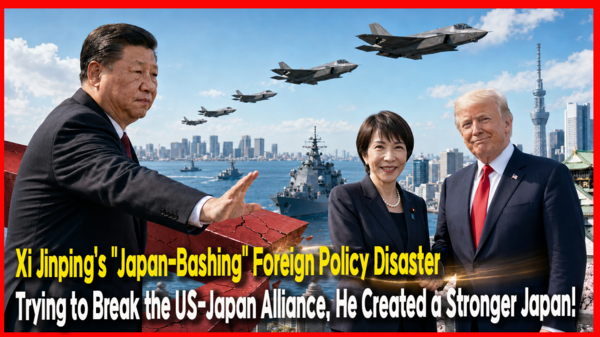
[Xi Jinping’s Sleight of Hand to Split Washington and Tokyo Backfires Completely]
Chinese President Xi Jinping sought to isolate Japan to undermine the US-led Asian alliance network, but the effort ended in a complete diplomatic blunder. Whenever Xi met with foreign leaders, he raised the issues of Japan’s "rearmament" and "neo-militarism," framing Tokyo as the root cause of regional instability. However, major nations showed little interest in China’s claims. Instead, Japan increased its defense spending and significantly strengthened security cooperation with the United States, the Philippines, and Australia. Xi’s underhanded attempt to drive a wedge into the US-Japan alliance brought about both China’s diplomatic isolation and the rise of a far stronger Japan.
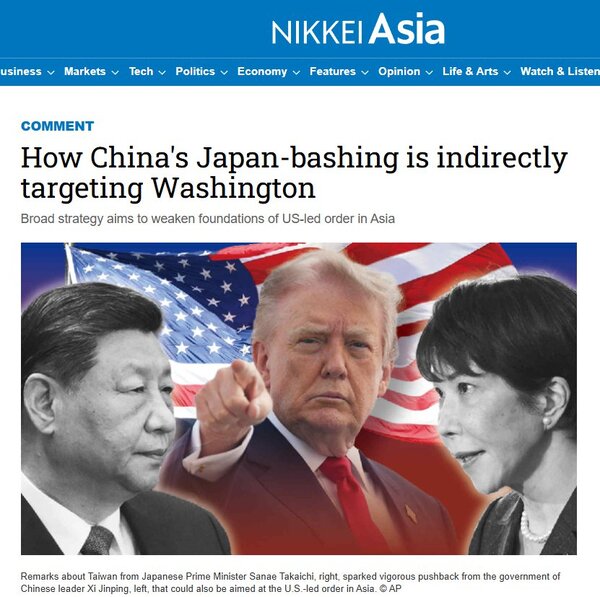
Nikkei Asia reported that China’s Japan-bashing is not aimed solely at Tokyo, but is part of a broader strategy to weaken the United States behind Japan, the US-Japan alliance, and ultimately the US-led Asian order. The true objective behind Beijing's diplomatic, security, and trade pressure on Japan is far broader than mere historical disputes or retaliation for Prime Minister Sanae Takaichi’s remarks regarding Taiwan.
[Unprovoked Criticism of Japan Erupts Even During Friendly Summit Meetings]
Particularly noteworthy is that Xi repeatedly criticized Japan even during meetings with US and European leaders. Nikkei Asia cited multiple diplomatic sources stating that since this spring, Xi would suddenly shift the topic to Japan even amidst friendly conversations, accusing Tokyo of embarking on rearmament and undermining regional peace and stability. Some leaders found Xi’s persistent raising of the Japan issue unusually peculiar.
Nikkei Asia noted that Chinese Foreign Minister Wang Yi acted no differently. During a dinner with a senior Southeast Asian leader earlier this year, Wang devoted nearly half of the conversation to Japan-related issues. Nikkei Asia added that the Chinese diplomatic apparatus framed Japan’s defense build-up as "neo-militarism," attempting to weaponize historical grievances and the Taiwan issue to spread a "Japan threat" narrative across the international community. Xi’s personal hostility toward Japan, combined with loyalty competition among bureaucrats, escalated into an all-out state-level offensive.
China’s campaign intensified after Prime Minister Takaichi stated in parliament last November that a Taiwan contingency could constitute a "survival-threatening situation" for Japan. She explained that if an armed conflict erupted in the Taiwan Strait and the US military intervened, Japan might exercise its right to collective self-defense. Although the Japanese government clarified that this did not represent a shift in its existing Taiwan policy, Beijing interpreted it as an official acknowledgment that Japan could intervene in a war over Taiwan.
Following this, China discouraged its citizens from traveling to Japan and tightened export controls on dual-use items, including rare earths, targeting Japanese companies linked to the defense industry. Furthermore, China expanded joint bomber and naval vessel patrols with Russia around Japan, applying simultaneous diplomatic, economic, and military pressure. It was an all-out coercive campaign aimed at forcing the Takaichi administration to step back on the Taiwan issue and dividing public opinion within Japan regarding its defense build-up.
[Attempting to Make an Example of Japan to Intimidate Asian Allies]
Nikkei Asia analyzed three main calculations behind China’s actions. First, as Xi assumed a hardline stance, Communist Party officials and government bureaucrats engaged in a competition of loyalty, further escalating the offensive against Japan. Second, Beijing sought to make an example of Japan to deter other nations from becoming involved in the Taiwan issue, attempting to instill fear across Asia—much like its past economic coercion against Canada and Australia—that challenging China’s core interests carries a heavy price.
The third and most crucial goal was to dismantle the US-led Indo-Pacific order. The Japanese archipelago forms the core of the First Island Chain connecting Taiwan and the Philippines, and US military bases in Japan serve as strategic strongholds deterring the Chinese navy and air force from projecting power into the Western Pacific. From Beijing’s perspective, Japan is the single most vital pillar supporting the US containment network against China. Beijing calculated that undermining Japan’s legitimacy and fostering distrust between Washington and Tokyo could fracture the entire US alliance system in Asia.
The US-based think tank Jamestown Foundation analyzed that Xi likely believed he could exploit US President Donald Trump’s preference for transactional relationships over traditional alliances. The strategy aimed to frame Japan’s defense strengthening as a "revival of militarism" and paint Prime Minister Takaichi as the source of regional instability, calculating that Washington might then distance itself from Tokyo. Ultimately, while Japan was the visible target, the real objective was the trust between Washington and Tokyo.
[Accelerating Japanese Rearmament Instead of Fracturing the Alliance]
However, Xi’s calculations produced the exact opposite result. Nikkei Asia noted that virtually no major nation across North America, Europe, or Asia publicly endorsed China’s claim that Japan is heading toward militarism again. Instead, Beijing’s economic coercion and expanded military activities around Japan reinforced the perception that China itself is the primary threat to regional stability. The diplomatic campaign aimed at isolating Japan internationally only deepened China’s own isolation.
The most painful backfire for Beijing is Japan’s defense build-up. The Japanese government announced that through its supplementary budget, it raised defense-related spending to approximately 2% of GDP, achieving the target set in its National Security Strategy earlier than originally planned. Japan continues to strengthen its defense capabilities, focusing on long-range strike capabilities, integrated air and missile defense, unmanned systems, and ammunition stockpiles. China applied pressure to prevent Japan’s rearmament, but the effort ultimately provided Japanese politicians and the public with a compelling justification to increase defense spending.
US-Japan military cooperation has also become far more concrete. At the White House summit, the United States and Japan agreed to rapidly quadruple the production of SM-3 Block IIA interceptor missiles in Japan. The two nations also decided to pursue joint production of AMRAAM air-to-air missiles, deploy advanced capabilities to Japan, and establish resilient critical mineral supply chains. China’s offensive to divide the alliance instead transformed it into an operationally focused posture integrating defense manufacturing and economic security.
[The Alliance Network Expands Around Japan]
Japan’s security cooperation is expanding beyond the United States to include the Philippines and Australia. Japan and the Philippines signed an Acquisition and Cross-Servicing Agreement (ACSA), and based on the already effective Reciprocal Access Agreement (RAA), the Japan Self-Defense Forces participated in the US-Philippines "Balikatan" joint exercises. The two nations have also initiated negotiations on a General Security of Military Information Agreement (GSOMIA). While China attempted to peel away US allies one by one, a multi-layered security network centered on Japan has become increasingly interconnected.
Furthermore, Japan, the United States, Australia, and the Philippines signed operational guidelines for a quadrilateral defense cooperation framework, institutionalizing cooperation across operations, exercises, and logistical support. This is not merely a diplomatic coalition, but a practical security network designed with joint responses during contingencies in mind. The paradox is clear: the more China pressures Japan, the closer the threat perceptions among First Island Chain nations become, leading to a more structured US-centric regional security framework.
China’s export controls on rare earths and dual-use items are also accelerating Japan’s efforts to build supply chains independent of China. The United States and Japan are expanding joint development, stockpiling of critical minerals, and crisis response mechanisms for supply chains. The economic weapon Beijing brandished to bend Japan to its will is, in the long run, reducing dependence on China and eroding Beijing's supply chain leverage.
[Why Times Insight]
This newspaper assesses this issue as a double diplomatic blunder by Xi Jinping. The first blunder was expanding historical and political hostility toward Japan into state strategy, resulting in a loss of diplomatic restraint. Bringing up criticism of Japan during friendly summits and having Foreign Minister Wang Yi spend half a conversation with a Southeast Asian leader on Japan-related matters reveals an obsession on Beijing's part rather than strategic confidence. The fact that no major nation endorsed China’s "neo-militarism" claim serves as decisive proof that Xi’s diplomatic campaign against Japan failed to gain international traction.
The second and even more fatal blunder was believing that bashing Japan would shake the US-Japan alliance. Xi sought to label Japan a "neo-militarist state" to make Washington and Asian nations wary of Tokyo. However, as the Chinese threat grew, Japan’s defense build-up gained legitimacy, and its cooperation with the United States, the Philippines, and Australia accelerated. Pressure intended to sideline Japan from discussions on Taiwan security instead expanded and institutionalized Japan’s role.
Ultimately, Xi’s "Japan-bashing" accelerated every outcome he sought to prevent. China has become more diplomatically isolated, Japan is building up its defense capabilities faster than at any point in the post-war era, and the US-Japan alliance is evolving into an operationally integrated alliance encompassing missile production and supply chains. Xi’s attempt to dismantle US alliances in Asia was exposed, and the price paid is the emergence of a stronger Japan even more tightly aligned with the United States. Xi’s hostility toward Japan did not weaken Tokyo; it served as a diplomatic self-goal that created the single most powerful outpost to counter China.

- TAG