


추부길 whytimespen1@gmail.com
[Negotiations Stalled Again After Reaching Agreement on Route Coordinates]
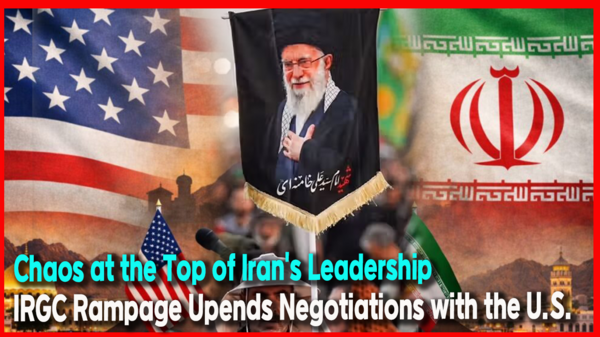
Iran reached the threshold of signing a transit agreement for the Strait of Hormuz, only to come to a grinding halt once more. While Iran and Oman reached a basic understanding regarding the route coordinates for passing vessels, arguments collided head-on over transit fees, Iran’s authority over vessel control, and the sequencing of lifting U.S. naval blockades and sanctions. The issue extends far beyond a simple dispute over terms. With Supreme Leader Mojtaba Khamenei remaining out of public view for five months, the President, the diplomatic corps, and the Islamic Revolutionary Guard Corps (IRGC) are broadcasting conflicting signals, raising a fundamental question: "Who is actually making the final decisions?"
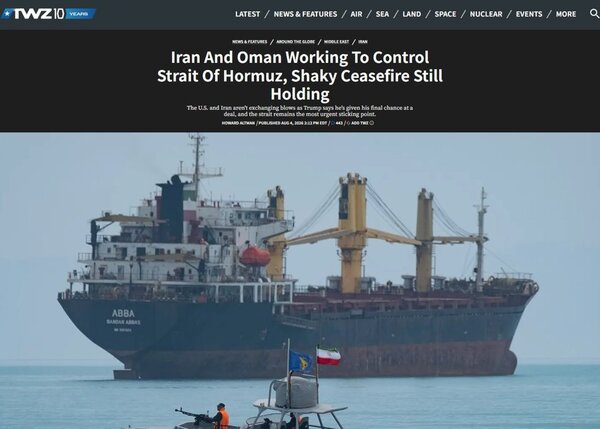
U.S. defense and security publication The War Zone reported, "On the 5th, the Iranian Foreign Ministry stated that it had reached a 'basic understanding' with Oman regarding maritime transit coordinates for the Strait of Hormuz and was preparing a joint announcement", adding that "a plan was under review where vessels entering the Persian Gulf would use Iranian lanes and outbound vessels would use Omani lanes, with Iran collecting a 5–7% fee and Oman collecting a 3% fee."
The War Zone further noted, "However, U.S. officials pushed back against such provisional navigation measures, asserting that Iranian approval was not required and drawing the line by stating that key details had yet to be agreed upon". It added, "Iran is further demanding that port blockades and sanctions relief take place first, creating a standoff over the order of implementation. In contrast, President Trump told reporters on the 3rd that 'negotiations are ongoing right now,' calling it 'the last chance for Iran to sign a good document.'" Judging by current events, a stark mismatch exists between Washington's claims and the reality unfolding around Iran. Why is this happening?
[Iran’s 'Faceless' Supreme Leader, a President Stripped of Real Power]
British broadcaster BBC observed, "The root cause behind the inability to finalize negotiations lies in the fact that Iran’s power structure is fractured beyond control." The outlet pointed out: "Final approval authority rests with Supreme Leader Mojtaba Khamenei; military and security power is held by the Islamic Revolutionary Guard Corps (IRGC) and the Supreme National Security Council; working-level negotiations are conducted by Speaker of Parliament Mohammad Bagher Ghalibaf and Foreign Minister Abbas Araghchi; while agreement execution, the economy, and public welfare fall on President Masoud Pezeshkian."
BBC continued, "The problem is that Mojtaba, who should sit at the apex of this chain, has not appeared in public even once since rising to Supreme Leader following the death of his father, Ali Khamenei, in March. For five months, he has conveyed his will solely through written messages—without a single video or audio recording. In a August 6 broadcast interview, President Pezeshkian expressed frustration, stating that communication with Mojtaba was 'extremely difficult.'"
This statement sharply contradicts his remarks in an interview just a fortnight earlier, on July 21, when he stated that "contacts with the Supreme Leader are gradually increasing." Within a framework where the Supreme Leader holds the approval stamp while the President absorbs political liability whenever deals fall through, reports emerged indicating Pezeshkian had offered to resign multiple times—though both the Presidential Office and the Supreme Leader's Office denied these claims.
Ultimately, a structure has taken hold where the Foreign Ministry cannot be certain whether the Supreme Leader will approve a negotiated draft, nor can the President guarantee that the IRGC will enforce an agreement on the ground. While the final seal rests with the Supreme Leader, the President is left holding the blame for failed talks and economic hardship, steadily narrowing Pezeshkian’s political standing.
[The IRGC Holding Guns Behind the Negotiating Table]
The force filling this power vacuum in practice is the IRGC. U.S. defense think tank Critical Threats analyzed in an August 4 report, "Iran's military apparatus is effectively driving regime decision-making, refusing substantive concessions on control of the Strait of Hormuz under the assessment that it can overwhelm the United States." The outlet diagnosed that Major General Mohsen Rezaei, military advisor to the Supreme Leader, reaffirmed on August 3 that "Iranian drone and missile attacks successfully pushed U.S. forces out of the region," reiterating the non-negotiable stance on strait control—a stance reflecting the confidence of hardliners led by Major General Ahmad Vahidi within the IRGC.
In practice, the IRGC has repeatedly used force even after the June ceasefire agreement, citing commercial ships entering "unapproved sea lanes." CNN reported on July 13 that "the IRGC struck two UAE oil tankers with missiles, claiming they turned off their tracking systems and ignored warnings while steering into 'mined channels,' resulting in the death of an Indian crew member in Omani territorial waters." CNN noted that "following this attack, the ceasefire effectively collapsed, President Trump notified Congress of resuming 'limited' military action, and U.S. Central Command reinstated naval blockades against Iranian-flagged vessels."
Critical Threats also noted that "on August 2, Iranian Army spokesman Brigadier General Mohammad Akraminia publicly stated that Iran 'fully utilized' the Memorandum of Understanding (MoU) and ceasefire period to import new equipment and repair/remanufacture damaged military systems". In contrast, moderate negotiators like Foreign Minister Araghchi, Speaker Ghalibaf, and President Pezeshkian have consistently advocated securing practical benefits through diplomacy. Pezeshkian reportedly secured approval for the initial MoU from Supreme Leader Mojtaba back in June by highlighting economic gains.
However, as pressure mounted last month around the truce, hardliners issued warnings of a "coup" against the negotiating faction, with former Foreign Minister Manouchehr Mottaki openly advocating attacks on regional U.S. bases during broadcast interviews. Against this backdrop, the IRGC broke a four-day lull on July 25 by attacking three oil tankers once again, claiming the ships "continued moving along dangerous and illegal routes despite warnings."
[Iran Rebuilt Military Capabilities Under Cover of Ceasefire]
Meanwhile, the Iranian military leadership has made no secret of treating the ceasefire period not as a window for diplomacy, but as an opportunity to rebuild military strength. The Iranian Army spokesman explicitly acknowledged that the military "fully utilized the MoU and truce phase to bring in new hardware and repair or reproduce damaged weapon systems."
Conversely, moderate figures including President Pezeshkian and Foreign Minister Araghchi maintained that diplomatic compromise was essential to secure sanctions relief and economic relief. This created an internal clash of visions: military hardliners viewing the truce as a breather for regime recovery, versus diplomatic negotiators viewing it as the last exit to prevent economic collapse.
Under such conditions, even if the Foreign Ministry completes an agreement with the United States, the moment it crosses lines unacceptable to the military, the negotiation itself risks collapse. It remains unclear whether the true boundary of concessions is set by the Foreign Ministry, the Supreme Leader, or the IRGC.
["Was That Really the Supreme Leader?"… Unconfirmed Secret Meeting Allegations]
The Supreme Leader's prolonged absence from public view has fueled various rumors inside and outside Iran. Anti-regime outlet Iran International reported exclusively on August 4 that "President Pezeshkian had a brief meeting in the back seat of a dark-tinted vehicle with a man claiming to be Mojtaba, where they could not see each other's faces, handshakes were banned, and dialogue was conducted entirely by voice." Iran International added, "Immediately after the meeting, the President asked his aides, 'Was that person I just met really the Supreme Leader?'" Such incidents highlight the unprecedented level of opacity surrounding the Supreme Leader's true status.
[Public Welfare Collapses While Leadership Disconnect Persists]
While communication breakdowns among top leadership drag on, Iran's domestic economy is collapsing at a rapid pace. The New York Post reported that "according to the Statistical Center of Iran, food and beverage prices in March rose 112.5% to 113.8% year-on-year, with bread and cereals up 140%, and milk, cheese, and eggs up 116.8%." It added that "the Iranian rial tumbled nearly 30%, falling from 1.5 million rials per U.S. dollar in January to 1.94 million rials last month."
Fox News, citing Iranian daily Jahan-e Sanat, reported that "the number of customers stealing cheese, butter, and meat—or secretly consuming them inside retail stores—has surged over the past 10 months."
Miad Maleki, a researcher at the Foundation for Defense of Democracies (FDD), noted: "While these anecdotes sound anecdotal, they match macroeconomic data precisely. Iran is already inside the 'tipping zone.'" He projected, "The real tipping point will not be a single dramatic event, but what is unfolding right now in slow motion: currency collapse, World War II-level food inflation, and basic commodity theft combining to shatter basic caloric intake across broad social classes, not just the impoverished."
Even President Pezeshkian admitted in an August 5 national address that "Iran faces difficulties and problems," while attempting to project resilience by claiming "the enemy is exerting pressure to lure citizens into protests" and asserting "Iran remains strong."
[Why Times Insight]
The essence of the current dynamic is not mere "negotiation delay." More precisely, the core problem is the absence of a single, unified governing authority capable of approving, enforcing, and accepting accountability for a negotiated deal.
Externally, Iran sits at the bargaining table as a single sovereign nation; internally, the authority to approve, negotiate, execute military action, and shoulder political responsibility is fragmented across competing factions. Even if the Foreign Ministry crafts a deal, there is no guarantee the Supreme Leader will sign it, nor can the President ensure the IRGC will observe it on the ground.
Therefore, even if a Strait of Hormuz transit accord is announced, it can hardly be interpreted as an immediate resolution to the crisis. With the Supreme Leader failing to release even a voice recording for five months, a single tactical action by the IRGC on the water could dismantle a ceasefire and reset negotiations back to square one.
Ultimately, the most dangerous revelation in Iran today is not merely the rogue momentum of the IRGC. It is that neither external observers nor insiders within Iran can clearly discern what command-and-approval structure is actually operating between diplomats, the military, the President, and the Supreme Leader. As long as this power vacuum persists, negotiations with the U.S. will drift, and the price of economic collapse and ruined livelihoods will continue to be paid by the Iranian people.
- TAG