


추부길 whytimespen1@gmail.com
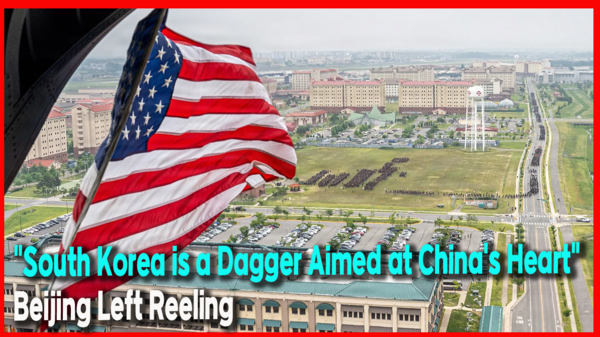
[Le Monde: "Humphreys' Transformation… From Anti-North Korea Defense Line to Strategic Outpost Against China"]
“South Korea is a dagger plunged into the heart of Asia.”
Beijing was left reeling by this single remark from General Xavier Brunson, Commander of United States Forces Korea (USFK) and the United Nations Command (UNC). China strongly protested, asserting that the United States is attempting to utilize South Korea not as a defense stronghold against North Korea, but as an advance base targeted at China. However, the essence of this controversy lies beyond the provocative phrasing of "dagger." America’s new National Defense Strategy (NDS) and the actual movement of military assets demonstrate that the role of USFK—centered around Camp Humphreys in Pyeongtaek—is expanding beyond the Korean Peninsula to the entire Indo-Pacific region.
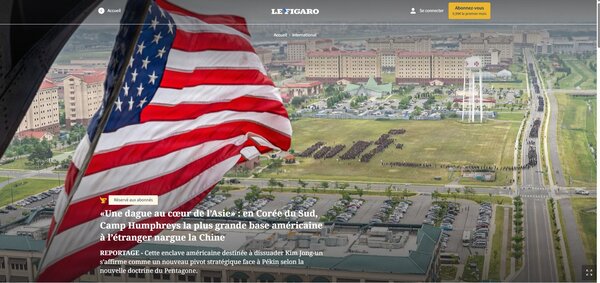
On August 1 (local time), the French daily Le Monde heavily highlighted the strategic evolution of Camp Humphreys in Pyeongtaek, the world's largest overseas US military base. Le Monde reported that "Humphreys no longer remains merely a defense stronghold against Kim Jong-un's military threats," adding that "as the US-China strategic rivalry intensifies, it is broadening its role as a regional operational hub capable of responding to contingencies across the Indo-Pacific, including China and the Taiwan Strait."
According to Le Monde, Camp Humphreys houses both the USFK Command and the UN Command. Spanning approximately 13.98 million square meters, featuring over 500 facilities and a 2,476-meter runway, it is effectively a military city. In 2004, South Korea and the United States agreed to relocate major US military facilities north of the Han River, including Yongsan, to Pyeongtaek. With the completion of the USFK Command relocation in 2018, Humphreys transformed into the largest US Army garrison in Asia.
Le Monde noted, “Initially, the primary objective of the base relocation was to move key command facilities out of the reach of North Korea's long-range artillery.” However, as Le Monde analyzed, today's Humphreys is growing in strategic value as an Indo-Pacific operational hub that handles US troop and equipment deployment, logistics and maintenance, intelligence support, and command and control. Gen. Brunson’s “dagger” comment compressed this exact transformation into a single phrase.
["South Korea is a Dagger"… Why China Reacted Bitterly]
During a podcast hosted by the US Army War College last May, Commander Brunson explained South Korea’s geopolitical position after turning the world map around to view it from China’s point of view. He stated, “When the Chinese look out, what they see is Korea, which is a dagger in the heart of Asia.” His remark viewed South Korea not simply as a defensive line blocking a North Korean invasion, but as a strategic outpost capable of applying close-range pressure on China's eastern flank.
Brunson had previously analogized South Korea as an “unsinkable aircraft carrier” capable of overcoming the geographical constraints of the Indo-Pacific. If an aircraft carrier is a sea-based platform to project power, a dagger is a tool to strike a rival's vulnerable spots from close range. This explains why China reacted with fury to both expressions.
The Chinese Embassy in South Korea launched an attack, asking, “Is calling South Korea an aircraft carrier or a dagger a display of US belligerence, or an attempt to use another country as a pawn on a chessboard?” They went further to demand whether Brunson’s statements had received approval from Washington. The fact that Chinese diplomatic authorities publicly refuted a military commander's strategic metaphor indicates that Beijing interpreted it as a grave strategic signal.
[The "Dagger" Debate Spills Over to the Shangri-La Dialogue]
The controversy migrated to the Shangri-La Dialogue in Singapore. Following a speech by the US Secretary of Defense, Professor Dong Wang of the School of International Studies at Peking University cited Brunson's "dagger" comment and publicly questioned the intent behind it. An unusual scene unfolded as Commander Brunson stepped forward to answer the question directly on the spot.
Brunson clarified that "it was meant to explain to students the need to shift perspectives and rethink where we stand," emphasizing that it was a metaphor describing geographical reality rather than a declaration to attack a specific nation.
China, however, did not take it that way. USFK strongholds, including Pyeongtaek and Osan, are close to China's eastern coastline. Combined with US air power, intelligence/surveillance/reconnaissance (ISR) assets, and missile defense systems, the Korean Peninsula can serve as a strategic foothold bridging the West Sea (Yellow Sea), the East China Sea, and the Taiwan Strait. What Beijing feared was not the word "dagger," but America's new Korean Peninsula blueprint embedded within it.
[US National Defense Strategy Signals Shift in USFK Role]
The US 2026 National Defense Strategy (NDS) reinforces the shift highlighted by Le Monde. While establishing that “deterring China is the top priority in the Indo-Pacific,” the strategy simultaneously demands that “allies assume greater responsibility for their own defense.”
Specifically, while assessing that "South Korea now possesses the capability to counter North Korea's conventional threats," it stated an intention to "update the US force posture on the Korean Peninsula to align with US strategic interests." This reveals a direction where "the ROK military assumes primary responsibility for defense against North Korea, while USFK supports Korean Peninsula defense while operating with greater flexibility."
The NDS does not explicitly state the deployment of USFK to the Taiwan Strait. However, with China deterrence elevated to the top priority, the likelihood that the operational scope of US bases in South Korea will expand beyond the Korean Peninsula has grown significantly. Even if South Korea does not engage directly in combat, it could provide logistical support, intelligence and surveillance, non-combatant evacuation operations (NEO), and support for the deployment and maintenance of US forces.
[The Iran War Makes "Strategic Flexibility" a Reality]
This shift has already materialized in actual asset movements. As the US-Iran war intensified, the United States redeployed air defense assets from the Indo-Pacific region to protect US military bases and allies in the Middle East.
During this process, a portion of the THAAD interceptor missiles stockpiled in South Korea, along with Patriot systems and personnel, were relocated to the Middle East. Although the THAAD battery and AN/TPY-2 radar themselves remained in Seongju, North Gyeongsang Province, it proved that US military assets stationed in South Korea can be moved to other theaters in accordance with global US strategy. The abstract concept of "strategic flexibility" became a reality due to the war in Iran.
This does not mean USFK's anti-North Korea mission is disappearing. The essence of the current shift is not the abandonment of the anti-North Korea mission, but rather the layering of new duties—such as containing China and responding to regional contingencies—on top of existing missions like deterring North Korea and managing the Armistice Agreement.
[Why Times Insight]
Le Monde paid close attention to the evolution of Humphreys, and China bristled at Brunson's words for the exact same reason: the world's largest overseas US military base located in South Korea is no longer acting merely as a defense base against North Korea, but is shifting into an operational hub capable of pressuring China’s eastern flank and supporting forces across the entire Indo-Pacific.
Brunson’s "dagger" remark is not an official text announcing a US policy shift. However, when viewed alongside the 2026 US National Defense Strategy and the military asset movements confirmed during the Iran war, the expansion of USFK's role has clearly already begun.
This elevates South Korea’s strategic value, but it also increases its risk profile. Should a conflict break out in the Taiwan Strait or the Middle East, US military bases and assets in South Korea could potentially be utilized in ways that do not fully align with the South Korean government's intentions.
What China truly feared was not Brunson’s harsh rhetoric. What rattled Beijing was the strategic reality pointed to by that rhetoric—the fact that Humphreys, situated right at China's doorstep, has begun executing a dual role as both a defense line against North Korea and a containment outpost against China.
Le Monde's decision to re-examine this issue as August began appears to serve as a stern warning toward China, which is deeply involved in the Middle East war behind the scenes, as well as a severe warning against its recent active pressure on Taiwan.
- TAG