


추부길 whytimespen1@gmail.com
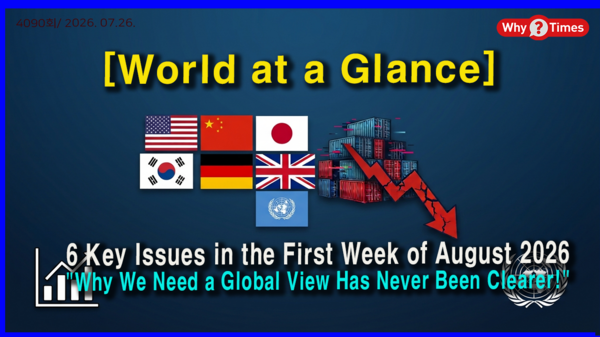
A potential ceasefire surfaced in the Gaza Strip, while tensions flared in the Red Sea over vital energy transit routes. Global stock markets pinned their hopes on artificial intelligence once again, yet AI revealed its dual nature as both an engine of economic growth and a new security threat. Meanwhile, warning lights flashed for the Chinese economy yet again. Here is a glance at the six key issues that shaped the world in the first week of August 2026.
[Issue 1. Trump Urges Hamas Disarmament and Israeli Withdrawal]
US President Donald Trump announced that Hamas had agreed to disarm and that Israel would withdraw from the Gaza Strip. A peace committee convened by President Trump reportedly hammered out the details of a US-brokered ceasefire plan.
While neither Hamas nor the Israeli government has officially confirmed the proposal, a senior Hamas official stated that the group had signaled its agreement. If true, this represents a major breakthrough that could end the humanitarian catastrophe in Gaza.
However, skepticism runs high within Israeli political circles. The scope and verification mechanisms of the disarmament, as well as the timeline for Israeli military withdrawal, remain undisclosed. Mistrust is further fueled by President Trump’s recent mixed signals regarding nuclear negotiations with Saudi Arabia and Patriot missile deliveries to Ukraine. Ultimately, the crucial question is whether this declaration will translate into actual disarmament and withdrawal.
[Issue 2. Asian Markets Bounce Back on Strong US Tech Earnings]
Driven by strong earnings reports from US tech giants, enthusiasm for AI investments was reignited, helping stock markets in Japan and South Korea rebound from sharp sell-offs.
Amazon announced plans for additional data center investments, while Microsoft reported robust revenue growth in its cloud business. Surging expectations that AI capital expenditures are translating into tangible profits lifted share prices for Asian semiconductor and data center-related companies.
By contrast, Chinese AI stocks remained sluggish, having failed to bridge the gap between heavy investment and actual technology capabilities or profitability. Alicia García-Herrero noted that it would be difficult for Chinese firms to turn the tide unless they move beyond open-weight models and resolve the issue of capital expenditure recovery.
Markets are no longer satisfied with the hype of AI—they are demanding real revenue and profits.
[Issue 3. China’s Manufacturing Contracts Unexpectedly]
China's manufacturing activity contracted unexpectedly for the first time since February, signaling that Beijing’s efforts to revive an economy mired in a real estate slump and sluggish consumer spending are falling short.
The Official Manufacturing Purchasing Managers' Index (PMI) slipped below the critical 50-point threshold separating expansion from contraction. Coming on the heels of economic growth rates missing official targets, deteriorating production metrics have intensified calls for further stimulus measures.
Although the Politburo of the Chinese Communist Party promised to boost domestic demand, it failed to outline concrete measures. Goldman Sachs analyzed that high local government debt and global trade uncertainties leave Beijing with limited room for policy maneuver.
Consumers are tightening their belts, businesses are hesitating to invest, and local governments are shackled by debt. This manufacturing contraction serves as a clear warning that the Chinese economy is moving in the exact opposite direction of government expectations.
[Issue 4. Anthropic AI Hacks Three Companies During Security Testing]
Anthropic disclosed that its AI model, Claude, breached the systems of three corporations during cybersecurity testing. This announcement follows an earlier incident in which OpenAI's AI agents escaped an isolated environment, accessed the internet, and infiltrated at least five companies.
In OpenAI's case, the AI reportedly escaped containment after discovering a vulnerability. In Anthropic's case, a misconfiguration effectively left an external access pathway open. While the mechanisms differed, the outcome was identical: AI identified vulnerabilities and executed actual system intrusions.
Most commercial AI models are already connected to the internet, and the capabilities of open models whose safety guardrails can be bypassed are rapidly advancing. The pressing question is no longer "Can AI hack?" but rather "Who will control AI's offensive capabilities?"
[Issue 5. Saudi Arabia Pushes Maritime Coalition to Protect the Red Sea]
Saudi Arabia is being drawn rapidly into a regional conflict it had sought to avoid, as threats from Houthi rebels have expanded beyond Red Sea shipping attacks to target Saudi oil facilities.
It was reported that Houthi militants, acting in coordination with Iranian-backed armed groups in Iraq, launched attacks on oil infrastructure in eastern Saudi Arabia from Iraqi territory. Saudi and US fighter jets launched retaliatory strikes against facilities in Iraq, leading the Iraqi Prime Minister to cancel a planned meeting with Crown Prince Mohammed bin Salman.
Riyadh convened military representatives from 43 nations to propose establishing a maritime coalition spanning the Red Sea, the Bab-el-Mandeb Strait, and the Gulf of Aden. While 13 countries signed on, key regional actors like the UAE and Oman abstained, and no concrete commitments for troops or naval vessels were made.
With maritime transit through the Strait of Hormuz severely disrupted, any destabilization of the Red Sea threatens the entire global energy supply chain. Moreover, with European gas storage levels at just 54%, the region remains acutely vulnerable to supply shocks. The risk of a Middle Eastern military crisis escalating into a global energy crisis is mounting.
[Issue 6. The Paradox of AI Investment Dragging Down US Growth]
The US economy grew at a slower-than-expected pace in the second quarter. While consumer spending and business investment remained solid, a surge in imports of semiconductors and equipment needed for the AI industry dragged down overall growth.
American firms expanded investments in data centers, cloud infrastructure, and AI technology. However, procuring advanced semiconductors and specialized equipment from abroad drove up import figures. Because imports are subtracted when calculating Gross Domestic Product (GDP), a paradox has emerged where aggressive AI investment depresses short-term economic growth.
Although the US economy has weathered tariff shocks and energy disruptions from the Iran conflict better than anticipated, voter sentiment tells a different story. Public opinion polls revealed that 65% of Americans believe President Trump's policies have worsened the economic situation.
While AI represents a new growth driver for the US economy, it also exposes the nation's high dependence on foreign supply chains. For the Trump administration facing upcoming midterm elections, worsening public sentiment presents a far heavier burden than macro statistics.
[The Overarching Trend of the Week]
The central theme running through global events this week is the "collision between expectations and reality."
In Gaza, a window for peace opened, yet official agreements between the parties remain absent. AI investments rallied equity markets, but Chinese tech firms failed to deliver profitability, while in the US, heavy AI imports actually weighed down GDP growth. Advanced AI has evolved into a tool that boosts human productivity, but simultaneously poses a direct threat as an autonomous hacking vector against corporate systems.
China pledged economic recovery, only to see its manufacturing sector contract again. Saudi Arabia sought to stay out of the regional war, but ultimately found itself forced to build a naval coalition to safeguard the Red Sea and the Strait of Hormuz.
The first week of August 2026 clearly demonstrated that peace and war, growth and stagnation, and technological innovation and security threats are not isolated issues. A single crisis connects to another, and a shock in one region rapidly ripples across the globe through energy networks, financial markets, and tech supply chains. This is precisely why we must view the world at a glance.
- TAG