


추부길 whytimespen1@gmail.com
[Reason ① — CXMT’s IPO Blockbuster Wasn’t a "Verdict of the Market"]
When the stock price of CXMT, China’s largest DRAM manufacturer, surged 466% on its first day of trading—coupled with reports that China had entered production of immersion DUV lithography equipment—crisis narratives flooded South Korea's semiconductor industry. However, dissecting the numbers reveals an entirely different picture. CXMT’s actual floating shares accounted for only 6.73% of its total equity, and China’s production target for domestic DUV equipment this year stands at a mere 5 units. Meanwhile, SK hynix began mass-production shipments of HBM4, posting record-breaking quarterly financial results. While China's pursuit is undeniable, claims that it threatens South Korea’s HBM dominance anytime soon border on gross exaggeration.
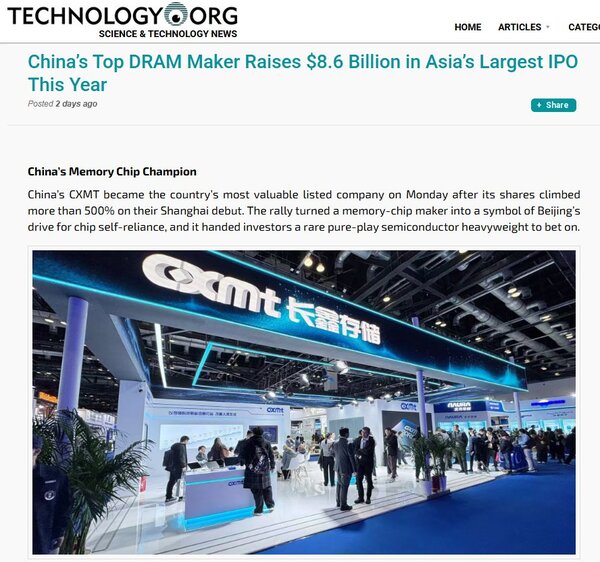
CXMT surged 466% on its Shanghai STAR Market debut, reaching a market capitalization of 3.3 trillion yuan (approx. $488 billion) and becoming the top-ranked mainland-listed company. On paper, this paints a narrative that China’s memory technology has been validated by the market. However, the listing structure itself was far from a free supply-and-demand environment. State capital dominated the equity structure, with state-owned shareholders holding 36.29% prior to the IPO, including investment vehicles from Hefei City, Anhui Province, and the National Semiconductor Fund ("Big Fund"). Combined with other state-linked funds, government-related ownership neared 50%, with Hefei-connected investors retaining their shares without selling. This represents a phase where Hefei City is beginning to harvest returns after sustaining years of operational losses using state funds.
Even more decisive is the floating supply. Only 6.73% of the expanded share pool was freely tradeable, creating a structure where relatively low buying volume could trigger extreme price volatility. The 466% figure reflects a technical spike driven by a tight float rather than a broad market consensus; in fact, some asset managers sold their entire IPO allocation immediately upon listing and expressed no intention of repurchasing at the newly formed price levels. Furthermore, signs emerged showing China’s state-backed funds intervening to prop up a sluggish mainland market, aligning closely with CXMT’s IPO timeline.
Technical metrics reveal an even starker mismatch between valuation and actual market standing. Global DRAM market shares stand at Samsung Electronics at 36%, SK hynix at 29%, and Micron at 24%, whereas CXMT holds just around 8%. This gap—between ranking #1 in market cap and #4 in actual market share—is the first reason SK hynix can scoff at the noise.
[Reason ② — DUV Localization Isn’t "EUV Development"]
On the 27th, two days after CXMT’s listing, reports emerged stating China had begun producing domestic immersion DUV lithography equipment. ASML shares plunged up to 8% in a single day, but industry experts responded with far greater calm, pointing out that the news should be taken with caution as China’s capabilities are likely limited to lower-end product segments.
Given the known capabilities of China's semiconductor ecosystem, such claims are unlikely to be feasible. Publicly available data shows no Chinese firm has successfully implemented even dry ArF lithography, and immersion is a far more complex technology. What was reported was not EUV, but DUV—a significantly lower technological tier—and even that remains in a pre-verification phase before line integration for actual mass production.
Furthermore, the volume scale is far too small to be called a "localization success." China's target production is a mere 5 units in 2026 and about 20 units in 2027. By comparison, ASML plans to ship roughly 130 immersion tools in 2026 alone and expand capacity by another 30% in 2027. Similar past announcements have failed to materialize: in 2019, Wuhan Hongxin Semiconductor (HSMC) acquired an older ASML tool with great effort and pledged to produce 600,000 advanced chips, but the project collapsed, leaving unfinished fabs and founders absconding with massive debts. Thus, the DUV report is accurately viewed not as "successful localization," but as an "initial attempt at production that must still undergo mass-production validation." In short, a recurring pattern of grand announcements outstripping mass-production capabilities serves as the second reason.
[Reason ③ — The "3-Year Gap" Is a Number Spread by Korean Media, Not China]
As CXMT’s listing and the DUV reports overlapped, claims that the HBM tech gap between South Korea and China had "narrowed to 3 years" were repeatedly cited by domestic academics and brokerages. However, evaluations from long-time semiconductor experts offer the exact opposite diagnosis: in DRAM, particularly advanced memory, China is more likely to fall further behind rather than catch up. CXMT’s DDR5 products are comparable to early-stage offerings released by Samsung and SK hynix in 2021, and their yields remain in the 50% range—far below the 80–90% standard required for commercialization. CXMT’s target timeline for mass-producing HBM3 also keeps getting delayed; despite starting development nearly three years ago, thermal and yield issues have prevented them from finalizing a commercial rollout date.
This is why comparing simple development start dates to declare a "3-year gap" is misleading. Real competitiveness is determined not by prototype reveals, but by yield management, thermal dissipation, customer qualification, mass-production capabilities, and long-term supply agreements (LTAs). Considering that the "3-year gap" figure originates from internal Korean estimates rather than Chinese announcements, it represents a number born out of South Korea's self-generated anxiety rather than a calculated reality.
[SK hynix: Demonstrating the Gap with Record Financials]
On the 29th, two days after these rumors peaked, SK hynix presented the tangible reality of the technological gap through its Q2 earnings conference call. SK hynix reported operating profit of 60.5426 trillion won (up 557% YoY) and revenue of 79.32 trillion won (up 257% YoY), while cumulative first-half revenue surpassed 100 trillion won for the first time in company history.
Mass-production shipments of HBM4 to major customers began this quarter, achieving yields close to those of the mature HBM3 line, while HBM4E is under development with a target for mass production in 2027. Compared to CXMT still attempting to weight its timeline for HBM3 mass production, this demonstrates a structural gap of at least two full generations.
SK hynix projected a ~10% QoQ increase in Q3 DRAM shipments, noted that revenue for enterprise SSDs (eSSDs) over 30TB tripled quarter-over-quarter, and confirmed it finalized multi-year Long-Term Agreements (LTAs)—typically 5-year baselines—with around 10 major customers. Company leadership reaffirmed the investment target in the upper 40-trillion-won range for this year and maintained the 2027 opening target for the first fab at the Yongin Semiconductor Cluster. Addressing concerns over market penetration by Chinese memory, SK hynix firmly stated that customers prefer reliable suppliers free from quality issues—underlining that hype around valuations and announcement dates operates on a completely different track from actual customer validation.
Paradoxically, despite these historic results, SK hynix ADRs dipped to record lows on sentiment that results fell short of extreme consensus expectations. This was driven by the convergence of three macroeconomic noise factors: CXMT’s IPO surge, Nvidia’s $250 billion OpenAI financing deal, and China’s DUV lithography reports. None of these three factors directly impacts SK hynix’s core fundamentals. While the company has every reason to scoff at the hype, the market has yet to fully break free from its psychological herd behavior.
[Why Times Insight]
CXMT’s 466% surge clearly reflects strong domestic expectations for China’s semiconductor industry. However, a first-day stock price on a tight float of just 6.73% cannot be interpreted as a final market verdict on its memory technology. China’s immersion DUV progress is a noteworthy effort, but it remains far removed from EUV development, with production targets representing roughly 1/26th of ASML’s capacity.
Above all, the "3-year HBM technology gap" is not an official metric. While CXMT struggles with HBM3 commercialization, SK hynix has entered HBM4 mass supply and is advancing HBM4E development. Claims that China will overtake South Korea in advanced HBM anytime soon are exaggerated when evaluated against verified yields and mass-production track records.
Yet, China’s pursuit should not be dismissed as a mere illusion. CXMT holds ~8% of the global DRAM market and continues to expand capacity using massive IPO proceeds and state support. Rather than a dramatic "HBM overtake in 3 years," the real Chinese threat is far more likely to manifest as market share erosion in legacy DRAM and NAND through low-priced volume supply.
Ultimately, SK hynix’s confidence is grounded in solid fundamentals rather than blind optimism. It stems from the cold, hard standards of the semiconductor industry: yields, customer validation, mass-production reliability, and long-term contracts. While there is no reason to panic over China's headline numbers, the state capital and persistent expansion strategies behind them must never be taken lightly.
- TAG