


추부길 whytimespen1@gmail.com
[“Russia-Iran Munitions Transport Ship” Hit… Iran Caught in a Tight Spot]
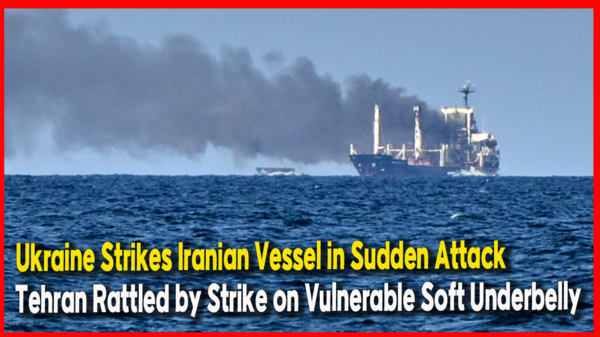
Tehran is in a state of severe disarray following Ukraine's sudden precision strike on an Iranian-linked vessel in the Caspian Sea. Kyiv claimed that the targeted ship was a sanction-evading transport vessel used to move military cargo between Russia and Iran. If this assertion holds true, the attack signifies far more than a single damaged ship—it demonstrates that the northern supply route delivering military materiel from Russia to Iran now falls within Ukraine's operational range.
The core dilemma for Iran lies in its diplomatic weakness: even if it lodges formal complaints with the European Union (EU) and the broader international community, it is unlikely to find much sympathy given its own history of indiscriminate attacks on foreign tankers and commercial vessels. In a paradoxical turn of events, Ukraine is taking a firmer stance than the aggrieved Iran.
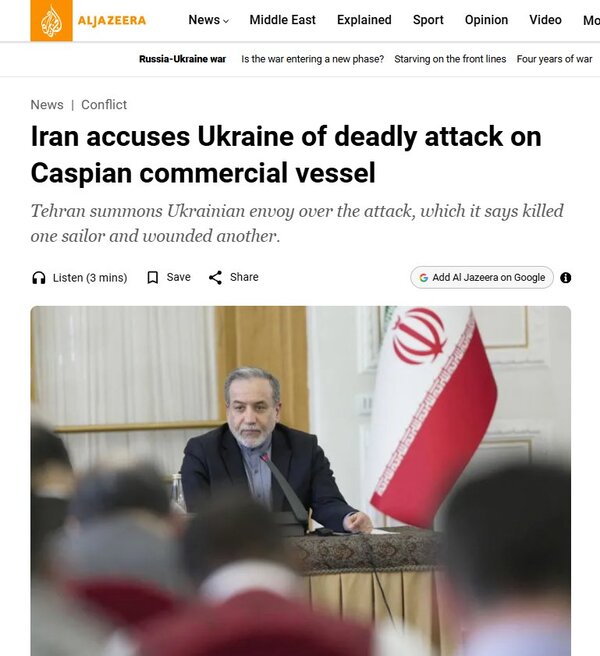
On July 26, Al Jazeera reported that "the Iranian Foreign Ministry stated on July 25 (local time) that an Iranian commercial vessel exploded in the Caspian Sea due to a Ukrainian attack, leaving one crew member dead and another injured." The ministry denounced the incident as an illegal attack violating Article 2, Paragraph 4 of the UN Charter.
Citing Iran's state news agency IRNA, Al Jazeera added that "the Iranian Foreign Ministry summoned Ukraine's deputy chief of mission in Tehran to protest the 'hostile and criminal' attack." It warned that because Ukrainian leadership effectively acknowledged the strike, the incident risks expanding the Russia-Ukraine war into the Caspian Sea and neighboring countries.
Iran’s official reaction underscores deep embarrassment. Tehran has consistently maintained that it is not directly involved in the Russia-Ukraine war and has repeatedly denied allegations that it supplies offensive weaponry to Russia. However, Ukraine’s open targeting of an Iranian-linked vessel confronts Tehran with a reality starkly at odds with its rhetoric.
Nevertheless, it has not been independently verified whether the commercial vessel reported by Iran and the transport ship identified by Ukraine as carrying military cargo are precisely the same ship, nor what cargo was onboard at the time of the attack. For now, Iran's claims of an "attack on a civilian commercial vessel" and Ukraine's assertion of a "strike on a military supply ship" stand in direct contradiction.
[Zelensky: “Hit Ship Transporting Military Cargo Between Russia and Iran”]
Regarding the incident, The Kyiv Independent reported that Ukrainian President Volodymyr Zelensky posted on X (formerly Twitter) around noon, announcing "very good results" from long-range operations in the Caspian Sea and stating that Ukrainian forces had hit Russian warships as well as "a vessel transporting military cargo in cooperation with Iran."
While President Zelensky did not disclose the precise attack location, weapon systems utilized, or the exact extent of damage and ship count, demonstrating the capability to strike deep into the Caspian Sea delivered a profound psychological shock to Tehran.
The Security Service of Ukraine (SBU) similarly asserted that the target was "a vessel evading international sanctions to transport military cargo between Russia and Iran." According to Kyiv’s explanation, the operation was not an accidental targeting of an Iranian ship, but a meticulously prepared long-range interdiction operation aimed at disrupting the military supply network connecting Russia and Iran.
Ukraine has previously pursued a strategy of striking oil refineries, airfields, ammunition depots, and defense plants deep within Russian territory to undermine the Russian military's rear support. It is now expanding its strike radius to third-country supply networks that facilitate Russia’s war effort or exchange military materiel with Moscow. This expansion represents Tehran's greatest vulnerability.
[Russian Supply Lines Now Within Ukrainian Strike Range]
The Caspian Sea is an inland sea directly connecting northern Iranian ports with southern Russia, serving as a critical segment of the International North-South Transport Corridor (INSTC). By utilizing maritime routes on the Caspian Sea alongside interconnected rail and road networks, both heavily sanctioned nations can transport goods and military equipment away from Western oversight.
For Iran, which requires a steady supply of weapons, components, and raw materials amid ongoing tensions with the United States, this northern supply route acts as a strategic lifeline. In the south, tensions around the Strait of Hormuz and the Persian Gulf persist, while western overland routes remain under intense surveillance by US and Israeli intelligence. If even the Caspian Sea—long considered a safe sanctuary—comes within range of Ukrainian long-range drone attacks, Iran’s military procurement architecture will face severe strain.
Kyiv’s objective extends beyond destroying a single Iranian vessel. It serves as a stark warning that all vessels and military logistics facilities operating between Russia and Iran are no longer safe. The implicit message is clear: as long as Iran enables Russia’s invasion of Ukraine, Kyiv will treat the military supply network connecting Russia and Iran as hostile military infrastructure.
Furthermore, President Zelensky raised allegations that Russia has been providing satellite intelligence to Iran after monitoring US military facilities in the Gulf region. If verified, this indicates that the bilateral relationship has evolved beyond simple arms sales into a functional military intelligence alliance. In this reciprocal structure, Russia leverages Iranian drones and military technology against Ukraine, while Iran utilizes Russian military supplies and satellite data to manage its Middle Eastern theater.
[Iran's Dilemma: Appealing to the EU Will Fall on Deaf Ears]
Iran is highly likely to attempt to exert pressure on Kyiv by raising this incident through EU diplomatic channels and international bodies. Indeed, Tehran is portraying itself as a victim, alleging that Ukraine's attack threatens civilian navigation and violates international law.
However, whether Iran's grievances will gain traction internationally remains dubious. Iran has a long record of seizing or attacking foreign tankers and commercial ships in the Strait of Hormuz and the Persian Gulf, and during recent escalation cycles, it faced severe criticism for threatening civilian vessels with ambiguous links to conflict parties. Similarly, the Iran-aligned Houthis have disrupted global shipping routes in the Red Sea using missiles and drones.
For Iran to now claim an attack on its own vessel violates international law is bound to be viewed by European nations as a hypocritical double standard. Appealing to civilian navigational safety and the UN Charter only after taking a hit—while previously invoking military necessity and retaliation when attacking foreign shipping—severely undermines its diplomatic standing.
Moreover, Ukraine counters that the target was not a civilian commercial vessel, but a sanction-evading ship integrated into Russia-Iran military cooperation. The more aggressively Iran presses its case through the EU, the greater the likelihood that the vessel's logs, cargo manifest, and linkages to Russian ports will face international scrutiny—potentially exposing the very reality of clandestine Russia-Iran military trade.
[Tehran's Core Dilemma Exposed in the Caspian Sea]
Tehran faces an acute lack of viable options. Retaliating directly against Ukraine would shatter its official diplomatic stance of non-involvement in the Russo-Ukrainian War. Relying on Russia to respond on its behalf is equally unviable, as Moscow's military resources are already overstretched by the prolonged war. Meanwhile, seeking international sympathy is hampered by its own history of maritime aggression.
Conversely, doing nothing presents severe risks. If Kyiv views this operation as a success, it may conduct repeated strikes against Russia-Iran transport networks across the Caspian Sea. Should the targeting scope expand to ports, storage facilities, rail transfer nodes, and additional cargo ships, the volume and velocity of military materiel flowing from Russia to Iran could be severely disrupted.
In essence, Ukraine’s strike delivered a direct hit to Iran's vulnerable soft underbelly. While Tehran sought to bolster its long-term war-fighting capacity through military cooperation with Moscow, that very partnership has exposed it to direct strikes from distant Kyiv. Instead of enhancing its security, aligning closely with Russia has forced Iran into the paradox of opening a new, unexpected front.
[Why Times Insight]
The significance of the Caspian Sea strike lies not merely in the sudden nature of the attack on an Iranian vessel, but in the reality that Ukraine now considers the entire military supply chain between Russia and Iran as a legitimate military target.
Tehran was undoubtedly caught off guard. The northern supply line in the Caspian Sea, previously assumed secure, is now exposed to Ukrainian long-range strike capabilities, threatening the flow of military supplies from Russia. Yet Iran’s past actions against international shipping render its claims of victimization largely unconvincing to the global community.
Retaliating risks dragging Iran directly into the war in Ukraine; inaction leaves its military supply lines vulnerable to continued strikes. Complaining to the EU yields little sympathy, while demanding protection from Russia offers no guarantees. With a single strategic strike, Ukraine has plunged Iran into a simultaneous military and diplomatic dilemma. This is the underlying reason for the alarm and disarray currently gripping Tehran.
- TAG