


추부길 whytimespen1@gmail.com

[EU Intelligence Agencies Officially Confirm "Russian Troops Trained at Chinese Military Bases"]
China's self-proclaimed image as a "neutral party" in the Russia-Ukraine war has suffered a devastating blow. The European Union (EU) has officially confirmed that hundreds of Russian soldiers received training at military facilities inside China, with some subsequently deployed to the active front lines in Ukraine. As the perception of China as a security threat—rather than just an economic competitor—rapidly spreads across Europe, the EU's strategy toward Beijing is entering a phase of fundamental reconsideration.
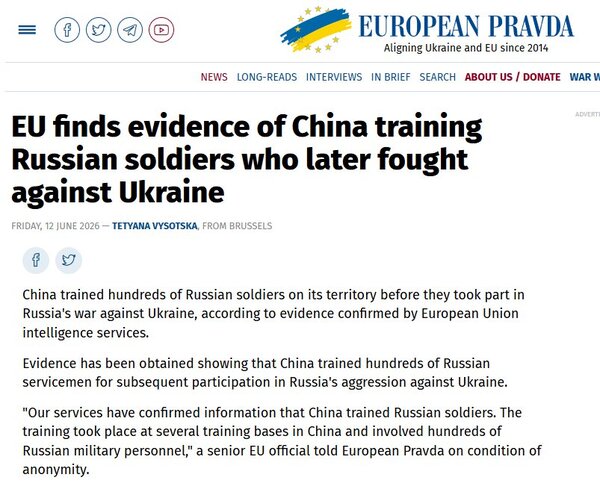
On June 13, Ukrainska Pravda, a leading European media outlet prioritizing Ukrainian and European affairs, reported that a senior EU official directly confirmed that China had trained hundreds of Russian soldiers across multiple bases within its territory. According to the report, while the official spoke on the condition of anonymity, this marks the first time the EU leadership has publicly acknowledged this fact.
Ukrainska Pravda further noted:
"The European Union has confirmed that such training is taking place across multiple locations on Chinese soil. It involves hundreds of personnel, which directly contradicts what the Chinese side has previously told the European Union. This is specific military training, and some of these personnel have subsequently appeared on the battlefield or the front lines."
The significance of this statement is clear. Since Russia's full-scale invasion of Ukraine in 2022, China has consistently maintained that it is "neutral." While it refrained from joining sanctions against Russia and maintained close economic and diplomatic ties with Moscow, Beijing has steadfastly denied providing direct military assistance. However, with the EU publicly confirming the evidence, that defense is no longer viable.
[Secret Military Cooperation Exposed by Reuters: Transfer of Drone Warfare Technology]
The EU's official confirmation is built upon an exclusive report published a month ago by Reuters. Citing officials from three European intelligence agencies and documents they reviewed, Reuters reported that in late 2025, the Chinese People's Liberation Army (PLA) secretly trained approximately 200 Russian soldiers, some of whom later returned to Ukraine to participate in combat. The core of the training focused on drone operations, which was explicitly outlined in a bilingual agreement signed by senior Russian and Chinese military officials in Beijing on July 2, 2025.
The agreement included a reciprocal clause allowing Russian soldiers to receive education at Chinese military facilities in Beijing and Nanjing, while Chinese personnel participated in training programs within Russia. However, the pact also contained strict confidentiality clauses prohibiting media coverage or disclosure to third parties. Ultimately, the attempt to keep it hidden failed.
The scope and content of the training went far beyond standard military exchanges. Russian soldiers intensively learned critical skills currently vital on the Ukrainian battlefield, including drone operations, electronic warfare, armored infantry tactics, and air support. Participants ranged in rank from non-commissioned officers to lieutenant colonels, meaning the tactical knowledge acquired in China could rapidly propagate throughout the broader Russian military upon their return.
According to Reuters, one training session held in December 2025 at the PLA Infantry Academy in Shijiazhuang involved approximately 50 Russian soldiers who practiced identifying targets via drones while firing 82mm mortars—a widely used tactic on the Ukrainian battlefield. Another course taught drone interception techniques using electronic warfare rifles and net-launching equipment. It was also confirmed that FPV drone flight simulator training took place at the PLA Aviation Training Center in Yibin.
[Trained Russian Soldiers Deployed to the Front Lines in Ukraine]
Beijing’s excuses that this was merely routine military cooperation have been dismantled. One European intelligence agency verified through identity tracking that some of the Russian soldiers trained in China subsequently engaged in actual combat using drones in the occupied Crimea and Zaporizhzhia regions. This revealed that the training was not merely theoretical, but a direct preparatory process for active deployment.
An intelligence official assessed the situation:
"The fact that China is educating Russian forces who receive operational and tactical-level training and then fight on the Ukrainian battlefield means that China is intervening in the war on the European continent far more directly than previously known."
[Chinese Components in Russian Drones Surge to 65%]
Support at the weapon-component level has also surfaced. The Kyiv Post reported:
"In May, it was confirmed that the proportion of Chinese-made parts among foreign components found in Russia's Shahed-type attack drones rose to 65%, surpassing the share of US-made components. This demonstrates that China's military support for Russia is manifesting simultaneously in two dimensions: soldier training and weapon component supply."
The Kyiv Post previously reported that in July 2025, Foreign Minister Wang Yi told his EU counterpart in a private setting that "Beijing cannot accept a Russian defeat." While posturing as a peace mediator externally, Beijing has effectively declared its alignment with Russia internally.
[June 15 EU Foreign Ministers' Meeting: A Starting Point for Redrawing China Policy]
European Pravda noted the significance of the timing of these disclosures:
"A senior EU official stated that overall EU-China relations, including this training issue, are scheduled to be discussed at the EU Foreign Ministers' meeting on June 15 in Luxembourg."
The meeting will also address Europe’s dependence on Chinese supply chains, risk factors facing the EU defense industry, and whether the EU can collectively respond in the event of a crisis in the Indo-Pacific region.
EU High Representative for Foreign Affairs and Security Policy, Kaja Kallas, recently emphasized: "China is a long-term problem using economic leverage against our markets," adding, "We must diversify our trading partners." The exposure of this military training adds a profound new dimension—a security threat—to EU-China relations, moving past mere economic friction.
[What China Stands to Lose by Distancing Europe]
Should relations with Europe deteriorate, the economic toll on China will be staggering. According to Eurostat, the EU's statistical office, the EU imported €559.4 billion worth of goods from China in 2025 while exporting €199.6 billion, resulting in a €359.8 billion trade deficit. This signifies that the EU remains one of the core markets for Chinese manufacturing. If Europe accelerates supply chain restructuring and import regulations, the Chinese manufacturing sector as a whole could face a substantial shock.
However, the more critical issue is strategic trust rather than economics. China sought to build an image as a war mediator and a responsible global power, but if the allegations of training Russian soldiers solidify as fact, that diplomatic asset will be severely damaged.
Beijing’s blueprints for participating in post-war Ukrainian reconstruction, expanding cooperation with Europe, and broadening its influence in international multilateral diplomacy are now highly likely to face severe constraints.
[The Path Chosen by China, and the Cost of Isolation]
Strategically, this situation is the consequence of a path China chose for itself. Beijing has pursued diplomacy aimed at drawing Europe in as a potential partner amid intensifying pressure from the United States. During a trilateral meeting of foreign ministers from China, Germany, and France in Munich in February 2026, Foreign Minister Wang Yi stated that "Germany and France confirmed their stance of supporting free trade and opposing decoupling." However, the exposure of this military training shakes the very foundation of that diplomacy.
The Peterson Institute for International Economics (PIIE) pointed out that "Europe does not yet possess a unified strategy on China," but predicted that "this issue will emerge as a core agenda item at the June G7 and European Council summits." Observers believe this exposure will serve as a catalyst that makes it impossible for the EU to delay the collective redesign of its China strategy any longer.
Beyond economic losses, the diplomatic and strategic blows are immense. China attempted to act as a mediator in the Russia-Ukraine war to seize leadership in reshaping the international order post-war. However, now that it has been revealed to have directly trained soldiers for one of the combatant sides, its qualifications as a mediator have vanished. China's standing for post-war reconstruction participation, cooperation with Ukraine, and multilateral diplomacy with the EU will contract simultaneously.
The path China chose was a anti-Western alliance through close alignment with Russia. However, the invoices for that choice are now arriving one by one in the form of restricted access to the European market, blockages in advanced technology cooperation, and diplomatic isolation. China's claim of 'neutrality' has effectively reached the end of its lifespan with this official confirmation by EU intelligence agencies. The weight of isolation China must bear is of its own making.
The more critical shift is that China is now highly likely to be reclassified in the eyes of Europe not merely as an economic competitor, but as a security threat. If the EU and NATO begin defining China as a substantial supporting force in Russia's war, this could escalate beyond tariffs or trade regulations into a comprehensive new pressure apparatus against China spanning technology, finance, and security domains.
The Xi Jinping leadership chose alignment with Russia amid its strategic competition with the United States. However, the outcome of that choice is returning as a geopolitical cost far greater than anticipated. This confirmation by EU intelligence agencies may well be recorded as the moment China's "neutral diplomacy" came to an end.

- TAG