


추부길 whytimespen1@gmail.com
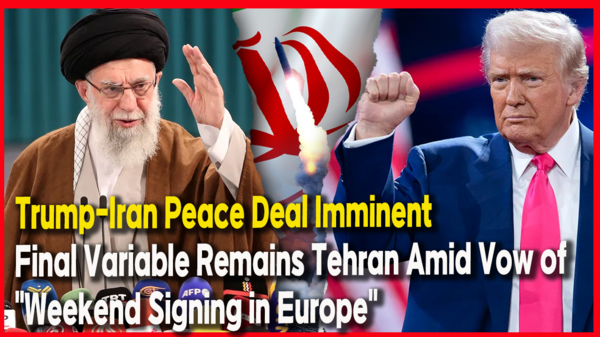
["The Papers are Final" — Announcement of Breakthrough Coincides with Canceled Air Strikes]
Following months of intense military clashes, the United States and Iran are on the verge of signing a Memorandum of Understanding (MOU) aimed at a ceasefire and nuclear negotiations. U.S. President Donald Trump abruptly canceled a scheduled follow-up airstrike, declaring that the two nations have "settled the war," and indicated that a signing ceremony could take place in Europe as early as this weekend.
However, Tehran is keeping its distance, claiming it has not approved any draft yet, leaving one final hurdle before a conclusive agreement is reached. Experts note that this MOU represents the starting point for peace talks rather than a definitive end to the conflict.
Fox News reported on June 12 that "President Donald Trump met with reporters in the Oval Office on June 11 (local time) and stated that the agreement with Iran has effectively entered its final stages." According to the report, Trump said:
"We just settled the war with Iran magnificently. The papers are in near-final form, and it’s going to happen pretty fast."
President Trump emphasized that this agreement would permanently block Iran from possessing nuclear weapons, which he noted was the core objective of the pressure campaign against Iran.
Prior to this, President Trump announced on his social media platform, Truth Social, that he was abruptly canceling the airstrikes and bombardments against Iran scheduled for that evening, based on the assessment that the negotiations had been approved at the highest levels of Iranian leadership. He claimed that the final sticking points of the agreement had received conceptual and detailed approval from all relevant parties—including the U.S., Israel, and Saudi Arabia. He listed the approving parties as the U.S., Israel, Saudi Arabia, the UAE, Qatar, Türkiye, Pakistan, Bahrain, Kuwait, Jordan, and Egypt.
The Times of Israel reported that, regarding the signing schedule, Trump explained the ceremony could take place in Europe as early as this weekend. While he will not attend personally, Vice President JD Vance, along with negotiators Steve Witkoff and Jared Kushner, will be present. However, Trump conceded that the document is not yet a formal, fully ratified treaty, characterizing it as a "somewhat conceptual, but very detailed Memorandum of Understanding." When an ABC News reporter asked what makes this time different, Trump responded to the effect that "they have been hit very hard, and they want a deal much more than I do."
[The Swap: Nuclear Renunciation for Sanctions Relief — The 60-Day Countdown is the Real Battle]
The core of the agreement disclosed by President Trump is straightforward: Iran will not develop or possess nuclear weapons, and in return, the United States will phasedly lift its economic blockade and financial sanctions.
Trump emphasized that "Iran will not have a nuclear weapon in any way, shape, or form," and stated that navigation through the Strait of Hormuz would return to normal immediately upon the signing of the agreement.
The detailed framework of the MOU, reported by CBS News citing multiple sources, is even more concrete. CBS News noted:
60-Day Negotiation Window: The signing of the MOU triggers the start of a 60-day negotiation period to hammer out the details of a permanent U.S.-Iran treaty, with an option to extend if necessary.
Freedom of Commerce: The initial step involves clearing naval mines and reopening the Strait of Hormuz to secure the freedom of trade.
Nuclear Lockout: In principle, Iran accepts a 15-to-20-year "lockout" period during which it will freeze uranium enrichment and dismantle nuclear facilities. In exchange, it will receive phased financial sanctions relief tied to its level of compliance.
IAEA Inspections & Highly Enriched Uranium: International Atomic Energy Agency (IAEA) inspectors will audit the nuclear facilities. The plan also includes treating the highly enriched uranium believed to be buried beneath the debris of the Fordow, Natanz, and Isfahan sites, which were bombed by the U.S. and Israel last June.
However, a caveat remains. The Times of Israel pointed out that while Trump has historically demanded that Iran hand over its stockpiles of highly enriched uranium, the MOU targeted for this weekend merely sets the stage for follow-up negotiations on this matter. It functions primarily to extend a fragile U.S.-Iran ceasefire while building a framework for subsequent talks. In other words, the most volatile disputes—the disposal of highly enriched uranium and the scope of sanctions relief—have been kicked down the road.
[Compensating Gulf Nations with Frozen Assets — Another Pillar of the Negotiating Table]
Money is also deeply entangled in these negotiations. Fox News reported that the U.S. Treasury Department is reviewing the utilization of frozen Iranian assets to assist Gulf allies in recovering from war damages. Treasury Secretary Scott Bessent has reportedly instructed his working groups to compile cost estimates of the damages caused by Iran. During the conflict, Iran struck infrastructure in Gulf nations, including water and power facilities in Kuwait; the current initiative aims to force Iran to pay for these damages using its own capital.
According to Fox News, billions of dollars in frozen Iranian funds are on the peace talk agenda. An Iranian official reportedly stated that releasing the $24 billion in Iranian assets frozen by the U.S. is the ultimate key to a peace agreement. Consequently, these frozen assets hold a dual nature: they are a target for "release" by Iran, and a source for "repatriation/reparations" by the United States. How the U.S. balances phased financial relief with damage compensation is expected to be the thorniest issue in the follow-up negotiations.
[Why the "Seizure of Kharg Island" Card Vanished]
Intriguingly, President Trump had put forward a diametrically opposed message just hours earlier. On the morning of June 11, he warned on Truth Social that the U.S. would "hit Iran very hard tonight," threatening that the U.S. could take over Kharg Island—the heart of Iran's oil exports—to control the oil and gas markets.
Strategic Weight of Kharg Island: Kharg Island handles approximately 90% of Iran's crude oil exports. If this bottleneck is paralyzed, the Iranian economy's literal lifeline is severed.
Yet, as negotiations rapidly progressed, Trump walked back the rhetoric, stating, "If we make a deal, we won't need to take over Kharg Island."
This shift underscores that the threat to seize Kharg Island was less an actual military operational plan and more a maximum-pressure leverage card designed for the negotiating table. By zeroing in on the Iranian regime's most vulnerable economic vulnerability, Trump successfully forced Tehran to the brink of a signature.
[On the Brink of All-Out War]
This diplomatic opening emerged from the crucible of fierce military engagement. Up until the day of the announcement, the U.S. and Iran had traded airstrikes for three consecutive days, pushing the region to the precipice of all-out war. The U.S. assaults extending into the early hours of June 11 were heavier and more expansive than the previous day.
Fox News reported that the catalyst for this latest re-escalation was the downing of a U.S. Apache helicopter near the Strait of Hormuz. President Trump blamed the Iranian regime for the incident, after which Iran reportedly launched retaliatory strikes across the region. The Indian government also announced that three Indian sailors were killed in the Strait of Hormuz during a U.S. strike targeting vessels attempting to break the blockade on Iranian ports.
Trump did not withdraw the threat of force until the final moments before the breakthrough. Earlier that day, he issued a raw warning, using visceral language, vowing to devastate Iran if its leadership refused to comply. Having already conducted two massive waves of airstrikes, this was a final ultimatum that the U.S. would launch a "third strike" if the talks collapsed. Ultimately, a single day witnessed a dizzying sequence: a threat of a "heavy strike tonight," an announced plan to seize Kharg Island, a sudden cancellation of airstrikes, and a declaration of a peace deal.
[Tehran’s Silence and Denial — "No Approved Draft Exists"]
The single largest wild card remains Tehran. While Trump stated his understanding that Mojtaba Khamenei had approved the deal, Iran’s Fars News Agency immediately pushed back, reporting that "no agreement has been finalized."
According to Israeli media outlet Ynet, sources close to the Iranian negotiating team insisted that Tehran has not yet formally approved any draft MOU.
This discrepancy points to two simultaneous possibilities:
1. Tactical Posturing: A classic piece of eleventh-hour brinkmanship designed to maximize leverage before signing.
2. Internal Friction: Real resistance from hardliners within the Iranian domestic political structure. If the latter is true, the possibility that the weekend signing ceremony in Europe could fall through entirely cannot be ruled out.
Israel is also maintaining a cautious stance. While Prime Minister Benjamin Netanyahu was reportedly not notified in advance of Trump's specific announcement, he expressed conceptual support for the move after being briefed that the final treaty would include:
The total removal of highly enriched uranium
The dismantling of enrichment facilities
Strict limitations on missile production
The termination of support for pro-Iranian proxy militias
[Analysis] The War May Pause, but the Geopolitical Tug-of-War Has Just Begun
This MOU is a textbook product of the Trumpian negotiation doctrine. He pulled Iran to the table by simultaneously presenting maximum pressure—airstrikes, blockades, and asset freezes—alongside the ultimate reward of sanctions relief.
From the Washington perspective, the objective is unambiguous. Rather than pursuing the high-risk gamble of regime change, the goal is to block nuclear weapon development, stabilize the Strait of Hormuz, and manage the Middle Eastern order. It represents an approach designed to achieve strategic goals without the liability of a massive, Iraq-style conventional military intervention.
Conversely, Iran is not entering these talks from a position of strength. With its air force, air defense networks, and oil export capabilities heavily degraded, Tehran desperately needs to buy time to ensure regime survival and economic resuscitation. Rather than a total philosophical abandonment of its nuclear ambitions, this is a pragmatic, survivalist calculation to weather an immediate existential crisis.
Israel finds itself caught between satisfaction and anxiety. While its strikes successfully degraded Iranian nuclear sites, the Iranian state apparatus remains intact. Consequently, if Iran shows any signs of clandestine enrichment during the upcoming 60-day negotiation phase, the possibility remains high that Israel will resort to unilateral military action.
Ultimately, this MOU is not a document that concludes a war; it is a document that converts a kinetic war into a diplomatic struggle. Trump used military might and economic strangulation to drag Iran to the table, but Tehran has yet to give its final seal of approval. Even if the weekend signing proceeds smoothly, the coming battle over the disposal of nuclear material, the scope of sanctions relief, and the fate of the $24 billion in frozen assets means the real confrontation is only beginning. The shooting may stop, but the strategic chess match between Washington and Tehran is merely entering an entirely new, highly volatile phase.
- TAG