


추부길 whytimespen1@gmail.com
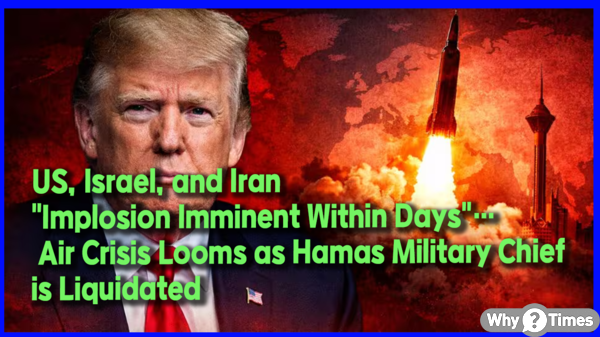
[Middle East Officials Issue Urgent Warning: "Preparations for Strike Underway"]
Israel and the United States have abruptly entered their most intensive preparations for a follow-up strike on Iran since last month’s ceasefire, ramping up military readiness to potentially launch operations within a matter of days. Amid these soaring tensions, the Israel Defense Forces (IDF) neutralized Izz ad-Din al-Haddad in an airstrike in the Gaza Strip. Al-Haddad was Hamas’s highest-ranking military commander and the last surviving mastermind of the October 7, 2023 massacre.
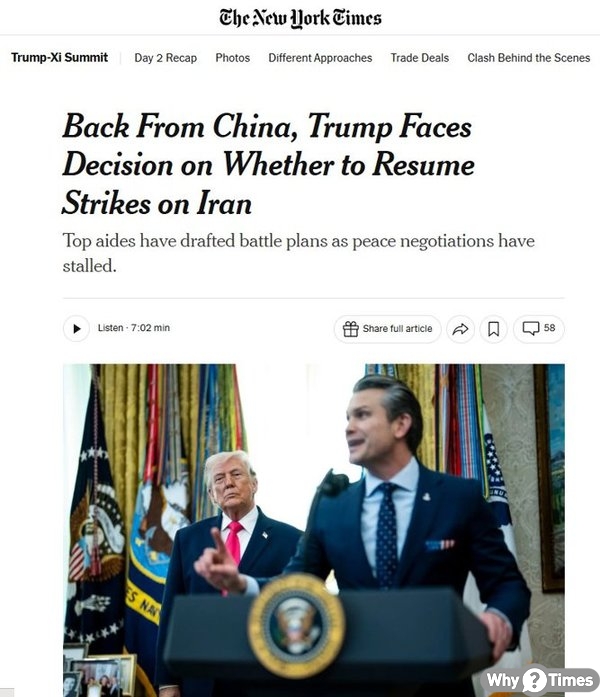
On May 16, The New York Times (NYT) cited two Middle East officials reporting that "the Pentagon is preparing for the resumption of military operations against Iran, which had been suspended under last month's ceasefire declaration." The officials added that "with a potential resumption of strikes in mind within days, the US and Israel have launched their most intensive readiness operations since the ceasefire took effect on April 7."
Iran responded immediately. Mohammad Bagher Ghalibaf, the Speaker of the Iranian Parliament, stated on the social media platform X (formerly Twitter): "Our armed forces stand ready to deliver a fitting response to any aggression." As negotiations remain effectively stalled, the Middle Eastern powder keg is once again approaching a critical breaking point.
The core of the NYT report underscores the urgency of the timeline. The phrase "within days at the earliest" implies that actionable operational schedules have been established, moving well beyond mere preliminary planning. Middle East officials assessed that "this level of readiness is more intense than at any point since the early April ceasefire." US officials noted that if military operations resume, "heavy strikes targeting major Iranian military assets and infrastructure are on the table." Furthermore, they added that "the deployment of US special operations forces on the ground to extract subsurface nuclear material is also being considered."
[Unprecedented Scenarios: Deploying Special Forces to Extract Nuclear Material]
Among the options being reviewed, the most unprecedented and high-risk strategy involves inserting special forces directly inside Iran to extract nuclear materials buried beneath the rubble of facilities destroyed by airstrikes. This goes far operations beyond conventional aerial bombardment, entailing ground combat risks and direct clashes with Iranian forces.
Citing military officials familiar with the planning, NYT warned that "executing such a complex operation would require thousands of support troops to establish a secure perimeter around the operational zone, making engagements with Iranian ground units inevitable and carrying a significant risk of casualties."
This scenario is driven by the stark assessment that Iran still possesses a massive stockpile of enriched nuclear material. Fox News, quoting the IAEA, noted that "Iran is estimated to hold approximately 440.9 kg of uranium enriched up to 60%, with over 200 kg stored in the Isfahan underground tunnel complex." The network pointed out that "unlike oil infrastructure, this nuclear material is compact, easily transportable, and hidden deep underground. Some highly fortified facilities have survived past aerial strikes, driving the perceived necessity for specialized ground operations."
[Occupying Kharg Island: A Gambit to Choke Iran's Economy]
Alongside special operations, the direct seizure of Kharg Island—Iran's largest oil export hub located in the Persian Gulf—has emerged as a highly viable option. According to officials, boots on the ground could be deployed to secure the island.
Located roughly 32 km off the Iranian mainland coast, Kharg Island is a strategic maritime chokepoint that handles up to 90% of Iran's crude oil exports. The island houses massive oil storage facilities linked via pipelines to Iran’s largest oil fields, alongside three critical energy infrastructure hubs producing 50,000 barrels of crude per day. This marks the first time the island has faced the threat of large-scale military bombardment since the Iran-Iraq War in the 1980s.
CNN reported that "some analysts within the US argue that seizing Kharg Island could completely bankrupt the Islamic Revolutionary Guard Corps (IRGC) and spark rapid political volatility inside Iran." CNN added that "US intelligence indicates Iran is taking this threat seriously, having reinforced its defenses in recent weeks by moving additional troops, air defense assets, and naval vessels to the island."
Fox News, quoting a senior US military official, stated that "there will be no [large-scale] boots on the ground on mainland Iran," but noted that "if ground forces are deployed, it would be specifically aimed at seizing islands." The official emphasized, "The US military has struck before and will strike again; the operation is not yet over."
[Additional Bombardment Options Remain on the Table]
Regarding alternative strategies, Al Jazeera reported that "more direct options include intensified bombing campaigns targeting Iran's military installations and vital infrastructure." According to the network, "US officials view this as another highly viable scenario. Earlier in this conflict, Israeli forces targeted power plants supplying the South Pars gas field—the world's largest natural gas reserve—along with Iran's largest petrochemical complex, and struck multiple airports and helicopter hangars in Tehran." Al Jazeera analyzed that "subsequent strikes would target these military and industrial infrastructures on a broader, more destructive scale."
[Unaccomplished War Goals Serve as Justification for Resumed Strikes]
The current discussions surrounding the resumption of attacks are directly tied to the genesis of the conflict. On February 28, 2026, the US and Israel launched surprise preemptive airstrikes against military and government installations across Iran during ongoing nuclear talks, eliminating several high-ranking Iranian figures, including Supreme Leader Ali Khamenei. At the time, Israeli military officials and leadership defined the goals of the offensive as degrading the regime's military capabilities, neutralizing its nuclear and ballistic missile programs, and 'creating the conditions' for the Iranian public to overthrow the regime. However, following a ceasefire signed after five weeks of intense hostilities, none of these objectives have been substantively realized.
President Trump had already declared on March 6 that only an "unconditional surrender" from Iran would be acceptable. He repeatedly set ultimatums—on March 21, March 23, and April 7—warning that he would strike Iran's energy infrastructure and bridges if an agreement was not reached. The current military movements suggest that those threats are finally transitioning into concrete actions.
Tensions across the Middle East are surging exponentially. While Iran delivered its response to the latest US peace proposal, it concurrently warned that it would not hesitate to retaliate against any fresh American aggression. With the international community watching closely, this current juncture—where the unprecedented extraction of nuclear materials, the economic strangulation via the seizure of Kharg Island, and total additional air campaigns are being simultaneously weighed—presents the most decisive turning point since the war erupted on February 28.
[IDF Eliminates Hamas Military Chief Al-Haddad]
Amid these regional developments, Israeli forces successfully eliminated Izz ad-Din al-Haddad in an airstrike. Al-Haddad was the top Hamas military commander remaining in Gaza and a primary leader behind the October 7, 2023 cross-border massacres.
Israeli Prime Minister Benjamin Netanyahu and Defense Minister Israel Katz confirmed the targeted operation in a joint statement on the evening of May 15, announcing that "a surgical airstrike carried out in the Gaza Strip successfully targeted and eliminated Hamas military leader Al-Haddad."
The operation was executed swiftly after the IDF’s Southern Command and the Military Intelligence Directorate pinpointed Al-Haddad’s exact hideout using intelligence gathered over several years. Upon receiving the actionable data from intelligence units, the Israeli Air Force immediately scrambled fighter jets to deliver the strike.
The liquidated commander was a founding member of Hamas's armed wing, active since its inception in 1987. He was the highest-ranking commander surviving in Gaza and the last remaining primary culprit of the October 7 atrocities. Al-Haddad was also the direct captor responsible for detaining and guarding former hostages Liri Albag and Emily Damari in Gaza. Upon being personally notified of the operation’s success by Defense Minister Katz, Albag posted on her social media, "Every dog gets its day," venting her enduring fury.
The Israeli government fiercely condemned Al-Haddad’s record of terrorism and atrocities. In their joint statement, Netanyahu and Katz emphasized, "Haddad was responsible for the murder, abduction, and maiming of thousands of Israeli civilians and IDF soldiers." They further noted, "He held our hostages with severe cruelty, directed ongoing terrorist acts against our forces, and flatly refused to implement the Gaza demilitarization agreement led by US President Donald Trump." The leaders assessed that "the IDF and Shin Bet are flawlessly executing the government's mandate to proactively destroy threats rather than contain them."
Israel’s leadership made it clear that a policy of powerful retaliation against terror factions will endure. The statement concluded: "We will continue to act forcefully and decisively against anyone who took part in the October 7 massacre. This is an unambiguous message to all murderers who seek our lives: sooner or later, Israel will find you and make you pay the ultimate price."
Since the outbreak of the war in Gaza, Al-Haddad had cycled through numerous safehouses to evade Israeli intelligence and airstrikes. He was deeply embedded within the hostage management network in the Strip and consistently surrounded himself with captives to use as human shields against precision strikes. Under his direct command, Hamas routinely starved and abused hostages to ensure his personal security and safeguard the survival of the terrorist organization.

- TAG